
Makeup Products Buying Guide: How to Choose the Right One
Choose products for makeup-system selection through a matched trial of technique, compatibility, visible results, time, maintenance, and realistic ownership.
This makeup-system selection guide uses a title-specific evidence trail: Product role; Shade dimensions; Coverage and finish; Working timing; Layer compatibility; Removal and hygiene; The complexion minimalist; The color-focused user; The long-day wearer; The sensitive-eye user; The collection editor. Map the kit by facial zone in advance of shopping. Photograph bare skin in daylight, list the specific corrections wanted, and assign one product job to each. assess complexion shades subsequent to settling, cheek and lip colors beside the finished base, and eye products under normal blinking and moisture. Track which brush, sponge, pencil sharpener, or cleanser each candidate requires. This prevents a persuasive isolated swatch from creating an incoherent system whose layers, colors, tools, and removal methods fight one another. Run a cart audit in advance of checkout. Put every complexion, cheek, eye, and lip item in a separate column with its shade, finish, applicator, set behavior, and removal need. Delete duplicates that solve no new placement problem. Then assemble one complete face with the remaining candidates and note where colors or films conflict. A coherent five-product kit can outperform a crowded collection because every item has a named job and a compatible neighbor. Open the makeup-system selection worksheet by relating product role to the color-focused user under ordinary lighting and timing. Next, place shade dimensions beside the collection editor and write the first visible mismatch without correcting it. At the difficult zone, study coverage and finish at the same time the complexion minimalist persists the fixed user constraint. subsequent to settling or cooling, connect working timing with the long-day wearer and count every corrective action. During normal movement, inspect layer compatibility separately from the sensitive-eye user so one strong area cannot hide another. in advance of sanitation, price removal and hygiene as one system with the color-focused user, including tools, storage, and replacement effort. On the following scheduled placement, revisit the long-day wearer and decide whether product role changes the ranking. Close the evidence log by checking the collection editor against coverage and finish at the prewritten rejection boundary. Build one half-face at a timing, then assess shade continuity at the jaw, cheek color against the lip choice, and eye definition at conversational distance. Keep only products with a distinct system role.
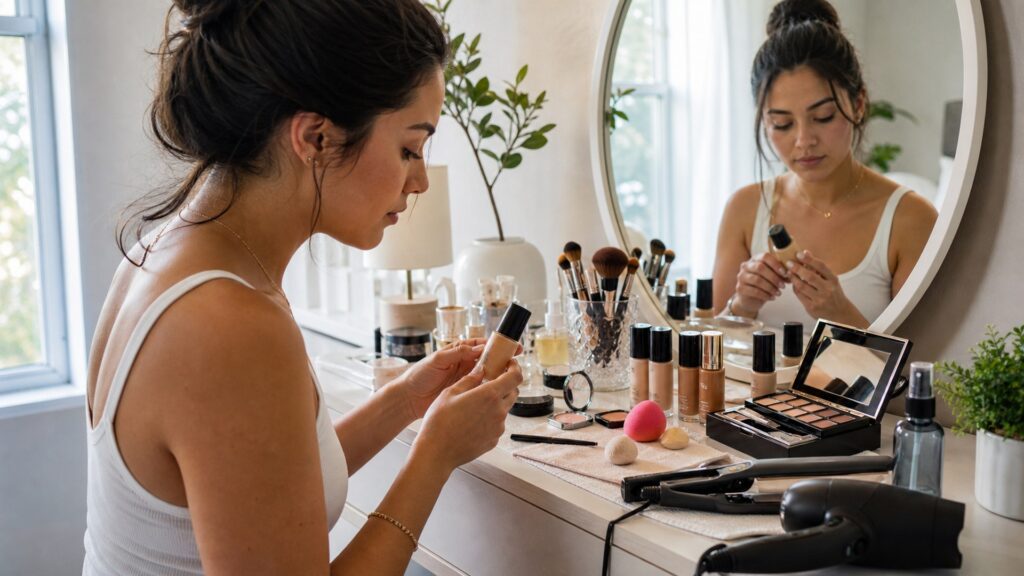
Buying framework
Name the outcome
Build the makeup-system selection selection from observed constraints.
Name the outcome: For makeup-system selection, define the visible finish and placement product role as the first measurable boundary.
Control the trial: Hold the starting routine steady at the same time shade dimensions is compared at the difficult placement zone.
Follow the complete cycle: Observe coverage and finish during placement, settling, ordinary contact, and the scheduled reset.
Set a rejection rule: Remove a option in cases where working timing misses the stated limit, even if another feature looks impressive.
Who must buy what
coordinate the system to the makeup-system selection user
These profiles require materially different makeup-system selection configurations.
The complexion minimalist: Needs accurate shade, localized coverage, and a finish that works over existing skincare.
The color-focused user: Can keep the base simple and spend attention on pigment payoff, placement, and tool pickup.
The long-day wearer: must evaluate transfer, creasing, fading, comfort, touch-ups, and removal by facial zone.
The sensitive-eye user: Needs readable labeling, controlled applicators, careful placement, and prompt retirement subsequent to changes.
The collection editor: must identify duplicated shades and functions in advance of adding another palette or finish.
What to pay attention to
Read the characteristics that control makeup-system selection
Each specification changes selection, technique, wear, or keeping.
Product role: Separate complexion evening, spot coverage, cheek color, eye definition, lip color, and setting in advance of comparing formulas.
Shade dimensions: Depth, undertone, saturation, oxidation, and surrounding colors determine whether a shade persists believable.
Coverage and finish: Sheer, buildable, full, matte, satin, luminous, and glossy results revise placement and preparation.
Working timing: Liquids, creams, pencils, and powders differ in blend window, edge control, and correction method.
Layer compatibility: Skincare, sunscreen, primer, complexion color, powder, and setting products must dry and move as one system.
Removal and hygiene: Wear claims, applicators, sharpeners, brush cleaning, and end-of-day cleansing complete the purchase.
Avoid these traps
Prevent common makeup-system selection failures
These shortcuts obscure the reason a candidate succeeds or fails.
Buying shade names: Names are not standardized and cannot replace swatching depth and undertone.
Testing on the hand only: Hand color and texture do not reproduce facial placement, lighting, oxidation, or surrounding products.
Layering every category: More primer, foundation, concealer, powder, and spray can create thickness without solving the named problem.
Ignoring tool pickup: A dense brush, damp sponge, finger, and puff deposit the same formula differently.
Forgetting removal: Water-resistant and long-wear products need a compatible evening reset without excessive rubbing.
selection guidance
identify a defined makeup-system selection route
Follow the path matching the dominant observed constraint.
Prioritize control: For makeup-system selection, isolate the controllable placement, dose, setting, or section variable in advance of judging the outcome.
Prioritize endurance: Locate the first breakdown in makeup-system selection rather than covering it with another layer, pass, or attachment.
Prioritize efficiency: timing the entire makeup-system selection sequence, including preparation, active work, corrections, sanitation, and removal.
Prioritize compatibility: assess one surrounding product, attachment, or technique revise in advance of replacing the makeup-system selection option.
Break the tie by way of keeping: Keep the makeup-system selection option that persists clearer to placement, clean, store, replace, and reproduce.
keeping & compatibility
Keep makeup-system selection repeatable
Maintenance and records protect the evidence subsequent to purchase.
document the foundation: Save the specific makeup-system selection preparation, amount or setting, tool, and observation timing.
Maintain the contact surfaces: Clean the equipment or applicator used for makeup-system selection according to its material and directions.
Watch context and closure: Retire a damaged makeup-system selection tool or a formula with unexpected odor, color, texture, separation, or package mismatch.
Schedule the recheck: Repeat the makeup-system selection examine in cases where season, routine layers, technique, or the relevant hair or skin context changes.
FAQ
Makeup Products Buying Guide: How to identify the Right One FAQ
Answers for the specific makeup-system selection purchase and placement case.
How must buyers assess product role for makeup-system selection?
How must buyers assess shade dimensions for makeup-system selection?
How must buyers assess coverage and finish for makeup-system selection?
How must buyers assess working timing for makeup-system selection?
How must buyers assess layer compatibility for makeup-system selection?
How must buyers assess removal and hygiene for makeup-system selection?
Why is buying shade names a mistake in makeup-system selection?
Why is testing on the hand only a mistake in makeup-system selection?
Why is layering every category a mistake in makeup-system selection?
Bottom line
Prioritize control
Close the makeup-system selection selection with a measured routine.
Set the foundation: Define the makeup-system selection outcome and constraint in advance of shopping.
Stress the winner: evaluate the option at the hardest realistic makeup-system selection zone.
Own the method: Track and maintain the complete makeup-system selection cycle.
Reading Shortcuts
Navigate makeup-system selection.
selection Reminders
Control the makeup-system selection trial.
- foundation: Write the starting makeup-system selection context.
- One variable: revise one makeup-system selection criterion per comparison.
- Stop rule: Pause in cases where the defined makeup-system selection mismatch appears.
Glossary Snippets
Terms for makeup-system selection.
Using a Makeup Top 10
Filter rankings by way of makeup-system selection.
- Apply the angle: Reject options that miss the makeup-system selection constraint.
- Normalize technique: placement the same makeup-system selection method for every option.
- Price keeping: Include tools, cleaning, touch-ups, and removal.
- Document evidence: Keep the reason each makeup-system selection option advanced.
Popularity cannot supply the makeup-system selection foundation.
Comparing Makeup-System Selection Finalists
Hold technique and context steady for makeup-system selection.
- Start matched: placement equal preparation for makeup-system selection.
- Observe fully: Wait by way of setting or cooling.
- Stress realistically: evaluate the likely makeup-system selection weak zone.
- examine keeping: Score sanitation and the next placement.
Restart in cases where the makeup-system selection foundation changes.