
Nail Care Products Buying Guide: How to Choose the Right One
Nail care is not one task. Shortening an edge, smoothing a snag, moving softened nonliving tissue, removing polish, and finishing a manicure call for different working surfaces and formulas. A useful purchase begins by naming that job; otherwise, a crowded kit can contain several objects that overlap while omitting the one tool that provides control.
The next check is the point of contact. Clipper-jaw alignment, file grit, pusher shape, remover system, brush loading, and bottle closure affect what happens during use and afterward. This guide separates those decisions so you can build a compact routine without treating cosmetic products as remedies for persistent nail changes.
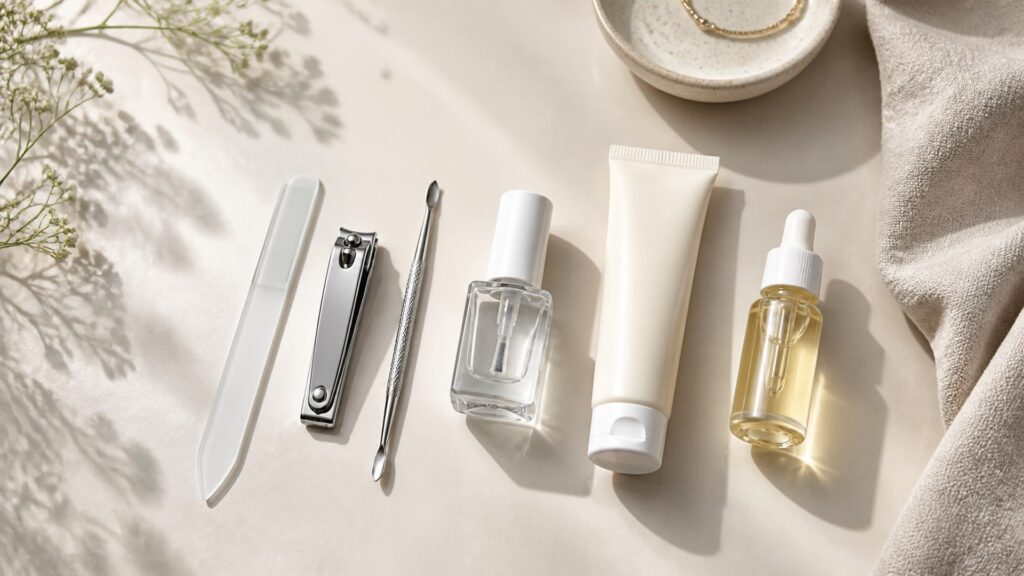
Buying framework
Give every product one clear assignment
Map the manicure from edge work to finish, and buy only for steps you perform. Products earn a place through control at the nail—not through the number of pieces in the package.
Start with the job: Separate length removal, edge smoothing, cuticle-area grooming, polish removal, surface preparation, finishing, and conditioning. Each action points to a different tool or formula.
Choose the least aggressive action: A coarse abrasive removes material quickly, while a fine surface allows smaller corrections. Select enough action for the job rather than treating speed as the main measure.
Inspect the contact point: Look closely at clipper jaws, scissor tips, file surfaces, pusher edges, and polish brushes. Alignment and shape determine whether force and product land where intended.
Read formulas by role: Remover, base coat, top coat, and oil are not substitutes for one another. Use the labeled purpose and directions to decide where each belongs in the sequence.
Budget for cleanup: Files wear, metal tools collect residue, solvents evaporate, and polish necks become sticky. A product that cannot be cleaned, closed, or replaced sensibly is a weak routine component.
Who this is for
The useful kit changes with the manicure
Think about the work you actually repeat and the materials already on your nails. These profiles need different combinations rather than different quantities of the same thing.
The bare-nail maintainer: You mainly shorten, shape, and condition natural nails. A precise clipper, a controllable file, and a neatly dispensing oil or cream cover more ground than a coating-heavy set.
The regular polish changer: Your routine adds removal, base, color, and finish. Bottle closure, brush control, drying behavior, and the remover named for the coating matter alongside basic edge tools.
The cuticle-area tidier: You focus on neat proximal and side areas without trying to cut living tissue. Favor smooth, easy-to-clean implements and formulas with directions you can follow without prolonged scraping.
The travel manicure keeper: Leaks and loose sharp tools are the main constraints. Secure caps, protective sleeves, small dispensers, and a case that separates liquids from metal pieces matter more than a salon-size assortment.
The enhanced-nail wearer: Coatings or enhancements change what may be appropriate for filing and removal. Verify that abrasives, solvents, and removal methods are intended for the material rather than borrowing a natural-nail routine automatically.
What to pay attention to
Inspect the part that touches the nail
Product names hide meaningful construction differences. Translate each detail into cutting, filing, dispensing, drying, or storage behavior.
Working surface and task control
Examine the shape, alignment, texture, and reach of the part that performs the action.
Formula role and after-use burden
Connect directions and packaging to contact time, removal, evaporation, and cleanup.
Clipper jaw meeting: Closed jaws should meet evenly without visible offset. Lever travel and jaw width affect how much force is needed and how readily the tool follows a small nail curve.
File substrate and grit: Glass, coated board, and metal surfaces wear and clean differently. Grit indicates relative coarseness; choose a surface that removes the intended amount without sacrificing edge control.
Buffer face labeling: Multi-sided blocks should identify the order and purpose of each face. If every side looks similar or the sequence is unclear, accidental overuse becomes easier.
Pusher edge profile: A rounded working edge and a handle that does not twist improve placement. Sharp corners near living skin demand more control than routine grooming should require.
Remover and dispenser: Match remover type to the coating directions, then consider delivery. A pump-top or small opening can limit spills and saturation compared with pouring from a wide neck.
Brush width and stem loading: A wider brush covers quickly but may flood narrow nail plates; a narrow brush requires more strokes. Stem wipe-off determines whether the first stroke arrives overloaded.
Cap and bottle geometry: A cap needs grip after polish accumulates around the neck, and the bottle should sit steadily. Reliable threading matters because incomplete closure speeds solvent loss and formula thickening.
Avoid these traps
Do not confuse more action with better care
Most mismatches begin with an overly broad kit or an overly strong tool. Correct the buying logic before compensating with another product.
Buying by piece count: Duplicate pushers, mystery implements, and several coarse files do not create a complete routine. List your actual steps and judge each included object by a defined purpose.
Using one abrasive everywhere: Natural nail edges, surface buffing, and enhancement shaping are not the same operation. Choose grit and substrate for the exact surface instead of treating a file as universal.
Buffing away every visible ridge: A buffer removes material; it does not diagnose why a surface changed. Keep cosmetic buffing conservative, and do not repeatedly thin the nail to chase a perfectly flat reflection.
Treating clear coats as interchangeable: Base, ridge-filling, strengthening, and top coats can have different directions and wear behavior. Buy the stated role you need rather than assuming any clear bottle can occupy any layer.
Choosing remover by speed alone: Fast removal may reduce rubbing but can also be unnecessary for an easy-to-remove coating. Match the remover to the product directions and consider dispensing, ventilation, and cleanup.
Decision guidance
Route each task to the narrowest product
Begin with what must change on the nail. Add a neighboring category only when it performs a separate step.
If nails need substantial shortening: Use a well-aligned clipper or suitable scissors for length, then a file for the final contour. Asking a fine file to remove excessive length makes shaping slow and inconsistent.
If only a rough edge catches: Choose a fine, controllable file and make small corrections at the free edge. A full clipping session or surface buffer is unnecessary for one snag.
If polish is the main routine: Build around the coating sequence: compatible remover, any genuinely needed base, color, and a finish suited to the desired wear. Edge tools remain a separate purchase decision.
If the cuticle area looks untidy: Choose a smooth pusher or another purpose-made grooming format with clear directions, plus a controllable conditioning product if desired. Avoid buying a sharp nipper as the automatic first answer.
If the kit must travel: Prefer guarded points, restrained liquid volumes, dependable caps, and a case that contains leaks. Leave bulky duplicates and poorly protected glass bottles at home.
If a change is painful or unexplained: Cosmetic tools are not the correct way to investigate pain, swelling, bleeding, or a persistent color or shape change. Pause experimentation and seek appropriately qualified advice.
Ownership & compatibility
Keep each working surface predictable
Tools and formulas age in different ways. A short inspection after use prevents a familiar object from behaving like a different product later.
Clean metal deliberately: Remove visible residue, follow the maker's cleaning guidance, and dry the hinge and working edges. Store sharp or pointed pieces with guards where available.
Retire worn abrasives: A board that sheds, clogs, bends, or develops uneven patches no longer files consistently. Do not share porous files, and replace them when the working surface stops behaving predictably.
Control solvent loss: Keep remover and coatings upright, away from heat or flame, and close caps promptly. Clean bottle threads carefully so dried product does not prevent a full seal.
Watch opened formulas: Follow label storage and period guidance. Marked thickening, separation that does not remix as directed, a changed odor, or a damaged applicator can justify disposal.
FAQ
Practical nail-care buying questions
Use these answers to settle product boundaries and routine details.
Do I need both nail clippers and a file?
What nail-file material should I choose?
Is a nail buffer the same as a file?
Should I buy acetone or non-acetone remover?
Can base coat and top coat be one product?
Are cuticle nippers necessary for home care?
How many nail-care tools should a starter kit contain?
Can household members share nail tools?
When should nail changes be assessed professionally?
Bottom line
Build the kit one job at a time
The strongest nail-care purchase solves a named task with a controllable working surface or clearly defined formula. Keep the sequence compact enough that cleaning, storage, and replacement actually happen.
Map the task: Separate shortening, smoothing, grooming, removing, coating, and conditioning before shopping.
Inspect contact: Judge jaws, grit, edges, brushes, and dispensers where they meet the nail.
Respect formula roles: Use remover and coatings according to their labeled purpose rather than appearance.
Plan the aftercare: Choose tools and bottles you can clean, close, store, and replace responsibly.
Reading Shortcuts
Navigate the article using the task map.
Decision Reminders
Keep these checks beside the shortlist.
- Job: Name the action before choosing a product.
- Contact: Inspect the surface that cuts, files, pushes, or applies.
- Formula: Keep remover, base, finish, and conditioner roles separate.
- Control: Prefer precise action over maximum aggression.
- Closure: Make sure liquids seal reliably.
- Upkeep: Plan cleaning and replacement before buying.
Glossary Snippets
Useful language for comparing nail-care products.
When to Use a Top 10 Review
Use rankings after the task map has eliminated mismatched product types.
- The task is defined: The task map names one product role.
- The format is settled: The selected format fits the task map.
- Upkeep is acceptable: Storage demands work within this task map.
- You need finalists: Product details can now refine the task map.
Already down to 2–3 options? A Comparison can expose the deciding construction or formula difference.
When to Use a Comparison
A head-to-head review can test two finalists against the task map.
- Working surfaces differ: Inspect contact design against the task map.
- Directions differ: Count the steps required by the task map.
- Packages differ: Judge dispensing within the task map.
- Routines differ: Select the repeatable task map.
Still exploring? Start with a Top 10 and return after the shortlist is genuinely comparable.