
Nail Tools Buying Guide for Daily Routines
Daily nail care is mostly inspection and small corrections, not a miniature manicure every morning. The useful tools are those that smooth a fresh snag, clean away visible debris gently, and remain easy to retrieve without inviting unnecessary cutting.
Build the routine around a fine file, a soft cleaning brush, and protected storage. Clippers belong in the kit for length changes, but repeated trimming, aggressive buffing, and routine cuticle cutting can create more damage than maintenance.
Routine framework
Separate daily checks from occasional grooming
Frequent care should prevent rough edges and contamination while leaving healthy nail structures alone.
Scan for snags: Run a fingertip lightly along each free edge after washing and drying hands. Address only catches that could split farther or snag fabric.
Keep corrections brief: Use a few controlled file strokes rather than repeatedly reshaping the whole nail. Reserve clipping for meaningful length, breakage, or a scheduled grooming session.
Set a stop point: End when the edge feels smooth. Pain, heat, thinning, redness, or bleeding means the action is no longer routine maintenance.
Daily users
Match the small kit to ordinary wear
Work, hobbies, nail thickness, and coatings change which quick-maintenance tool deserves easy access.
The frequent hand washer: Choose corrosion-resistant implements and a file that can be cleaned as directed. Dry everything before returning it to enclosed storage.
The polish wearer: Keep a gentle edge file nearby, but avoid scraping chips with metal tips. Remove coatings with products and methods intended for that formula.
The hands-on worker: A compact protected file can stop a split from traveling during the day. Gloves and sensible nail length may matter more than extra implements.
Useful details
Favor gentle surfaces and protected edges
Daily tools should offer control at low pressure and tolerate frequent handling.
What one week reveals
A week shows whether the kit prevents clothing snags without gradually shortening, thinning, or roughening nails through unnecessary repetition.
What the storage spot reveals
The chosen location exposes splash risk, accidental access by children, trapped moisture, and whether clean tools contact loose cosmetic residue.
File grit: Select a surface appropriate for natural nails and fine finishing. Coarse abrasives remove material quickly and are poorly suited to repeated touch-ups.
Brush softness: Cleaning bristles should lift loose debris without painful pressure beneath the free edge. A hard pointed implement is not a daily substitute.
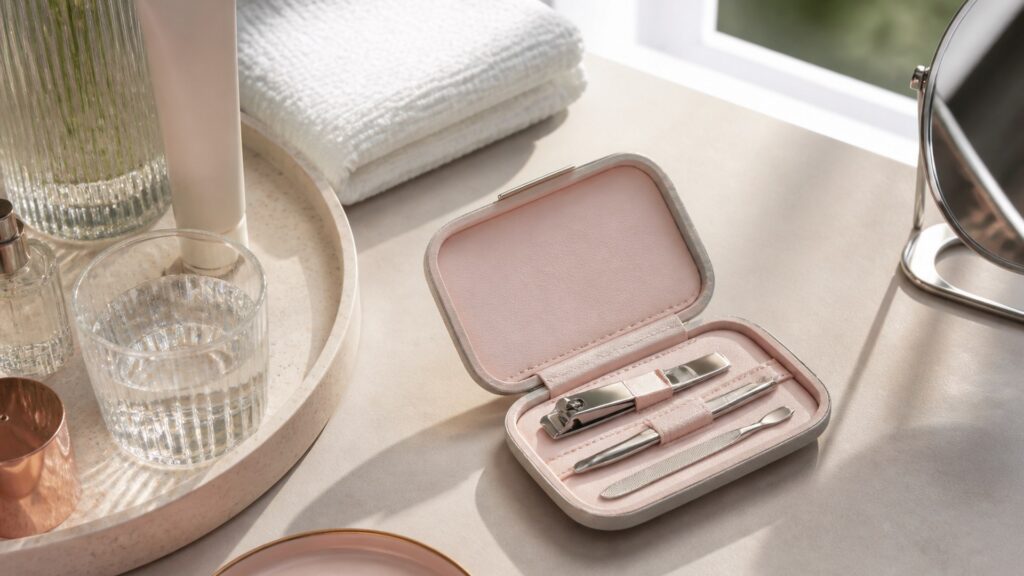
Portable protection: Cases and caps should cover abrasive faces, blades, and tips while allowing cleaned items to dry before enclosure.
Daily-care errors
Avoid turning maintenance into overwork
More frequent tool contact does not automatically produce healthier or neater nails.
Buffing every day: Repeated abrasion can thin the nail plate. Follow product directions and treat buffing as an occasional technique rather than a reflex.
Cutting attached cuticle: Living tissue protects the nail area. Do not make routine removal a daily goal, and stop immediately if an action causes pain or bleeding.
Ignoring a recurring split: A nail that repeatedly cracks in the same place may need protection, a different length, or professional assessment—not endless filing.
Kit choices
Keep the accessible set deliberately small
A few understandable tools reduce clutter and discourage unnecessary intervention.
Keep within reach: Store a suitable finishing file and soft cleaning brush where the routine happens, provided they remain dry and protected.
Store cutters separately: Clippers and sharp specialty implements can stay in a secured grooming case until a planned session requires them.
Skip daily gadgets: Powered buffers, drills, and elaborate cuticle sets add complexity and risk without solving the ordinary problem of a small rough edge.
Upkeep
Clean the tools before they disappear into a drawer
Daily availability works only when used items return clean, dry, and undamaged.
Remove residue: Brush off nail dust and clean surfaces using material-specific directions. Do not let filing debris accumulate inside cases or around hinges.
Dry fully: Water left on metal joints encourages corrosion, while a damp enclosed brush can develop odor. Allow airflow before closing protective storage.
Check condition: Replace a worn file that no longer finishes smoothly, a brush with distorted bristles, or metal pieces showing looseness, rust, or rough edges.
FAQ
Daily nail-tool questions
These answers keep frequent maintenance gentle, limited, and hygienic.
Which nail tools are useful for daily routines?
Is it safe to file natural nails every day?
How should daily nail tools be stored?
Final check
Let restraint define the daily routine
A successful everyday kit fixes minor roughness quickly and then stays out of the way.
Smooth only what catches: Correct the damaged spot without changing every nail merely because the file is already in hand.
Protect healthy tissue: Keep blades and sharp tips away from attached skin, irritated areas, and any site showing possible infection.
Reset the kit: Return clean, fully dry tools to protected places so tomorrow’s brief check begins without contamination or searching.
Reading Shortcuts
Move directly to the daily use decision stage you need.
Decision Reminders
Keep the evidence for daily use visible while comparing.
- Role: The nail tool serves the named task.
- Proof: The trial observes clean cuts, controlled filing, comfortable leverage, and intact surrounding skin.
- Care: Remove filings, disinfect compatible surfaces, and dry metal hinges before storage.
Glossary Snippets
Useful language for comparing nail tools.
When a Top 10 List Helps
Use rankings to discover credible nail tools, then screen them for daily use.
- The format is undecided: A broad list reveals plausible forms and price levels.
- A shortlist is needed: Rankings narrow discovery but do not replace fit testing.
Have finalists already? Open the comparison section.
When a Direct Comparison Helps
Compare finalists after establishing their suitability for daily use.
- Two candidates remain: Side-by-side evidence exposes meaningful tradeoffs.
- An upgrade is uncertain: Compare whether added cost corrects the original weakness.
Still exploring? Start with the Top 10 section.