
Nail Tools Buying Guide for Small Vanities
A small vanity rewards a short nail-tool list and punishes duplicate kits. Measure the drawer, counter edge, and safe hand clearance before buying; clippers and files need less space than decorative cases, powered devices, or upright cups filled with unexplained implements.
Storage must protect blades and pointed ends while allowing freshly cleaned tools to dry elsewhere first. Compare closed dimensions, slot retention, vertical options, corrosion resistance, retrieval order, and whether the setup leaves cosmetics and the sink usable.
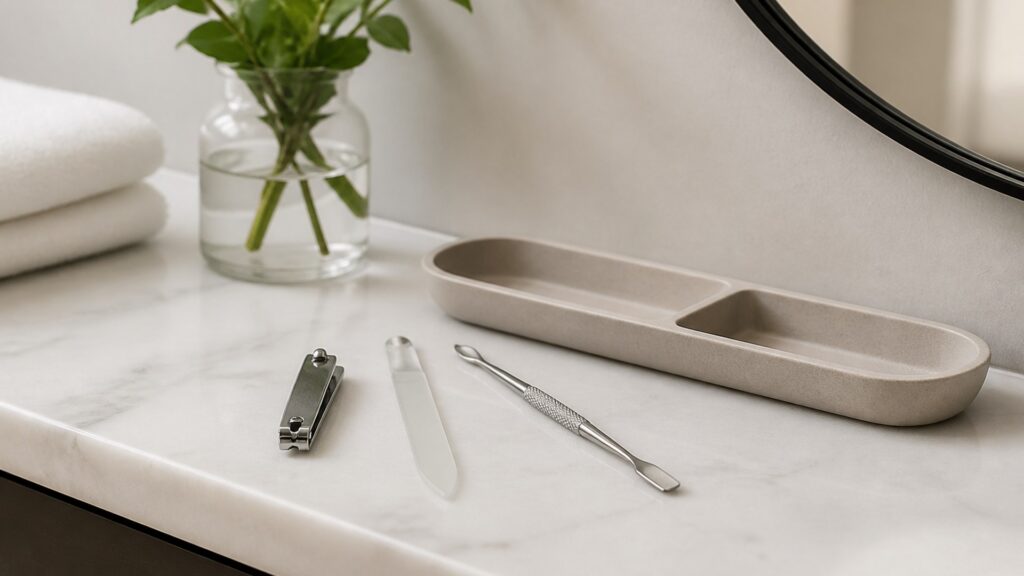
Space plan
Measure the routine, not just the drawer
The working footprint includes open cases, hands, cleanup, and a temporary drying area.
Inventory by function: Keep one dependable option for each real job. Remove duplicate clippers, worn files, and specialty pieces whose purpose the owner cannot explain.
Map active clearance: Open the drawer and case while neighboring bottles remain in place. Confirm that the tool can be lifted safely without reaching past exposed tips.
Reserve drying space: Clean metal and brushes need open airflow before enclosed storage. A washable mat can serve temporarily without becoming permanent counter clutter.
Vanity profiles
Fit storage to the available architecture
Drawer depth, cabinet height, outlets, and sink splash determine the safest layout.
The shallow-drawer owner: Use a flat fitted roll or divided tray that stops implements from sliding. Check handle thickness before assuming the drawer will close.
The drawerless counter: Favor a compact lidded box with protected internal slots, stored away from the basin edge and opened only during planned grooming.
The vertical-space user: A wall cabinet can free the counter, but sharp pieces must remain secured and reachable without dropping them onto lower products.
Storage details
Read case dimensions and retention closely
A compact exterior is useful only when the contents remain separated and easy to grasp.
What a layout test reveals
Placing every daily product nearby exposes blocked drawers, unstable stacking, and whether nail tools can be retrieved without moving breakable bottles.
What cleanup reveals
A complete wash-and-dry cycle shows whether the vanity has enough temporary airflow and whether residue returns to a supposedly clean case.
Fitted slots: Clippers, files, and pointed tools should not collide when the case moves. Elastic loops must hold firmly without covering contaminated areas that need cleaning.
Cleanable interior: Nail dust gathers in seams and corners. Prefer removable or wipeable organization over flocked surfaces that trap residue and cannot tolerate care.
Safe opening: The lid should stay open without springing shut on fingers, while hinges and latches must not require dangerous force near exposed implements.
Small-space errors
Avoid solving clutter with a larger kit
More compartments do not help when most of their contents are redundant, unsafe, or unused.
Displaying sharp tools: Open cups leave nippers and pointed implements exposed to hands, children, splashes, and falls. Use protected slots inside a closable container.
Storing tools damp: Do not close washed implements immediately to reclaim the counter. Let joints and crevices dry fully on a clean temporary surface.
Stacking over the sink: A precarious case can fall into water or damage items below. Choose a stable permanent location that does not depend on balancing.
Buying decision
Pay for compact order, not miniature clutter
Space-saving value comes from dependable multipurpose essentials and protective organization.
Choose a slim core: A quality clipper, suitable file, and cleaning brush cover many routines and fit more safely than a broad generic manicure assortment.
Add one specialist: Include another implement only when its technique is established and its protected dimensions fit the assigned location.
Decline oversized cases: A luxurious box is poor value when it blocks daily products, cannot lie flat, or dedicates space to tools that remain unused.
Vanity upkeep
Reset the small space after every session
A consistent return order keeps sharp pieces controlled and prevents nail dust from spreading into cosmetics.
Clear residue first: Clean each tool according to its material directions and wipe the temporary work surface before restoring makeup or skincare products.
Close only when dry: Move fully dried implements into assigned slots, verify protective caps, and latch the case before returning it to the drawer or cabinet.
Edit periodically: Discard damaged tools and relocate rarely used specialists. Scarce vanity space should reflect the current routine, not every kit ever purchased.
FAQ
Small-vanity nail-tool questions
These answers address footprint, sharp-item protection, and clean storage.
Which nail tools fit a very small vanity?
Can nail tools be stored upright in a cup?
How should I measure a vanity for nail-tool storage?
Final check
Make every stored tool justify its footprint
The finished vanity should remain usable while sharp equipment stays clean, dry, and controlled.
Count functions: Each retained piece performs a distinct recurring job and can be identified immediately without emptying the case.
Test retrieval: Hands can remove and replace every implement without contacting blades, knocking products over, or blocking the sink.
Test the reset: Used tools move through cleaning and complete drying, then return to protected positions without leaving permanent clutter.
Reading Shortcuts
Move directly to the limited space decision stage you need.
Decision Reminders
Keep the evidence for limited space visible while comparing.
- Role: The nail tool serves the named task.
- Proof: The trial observes clean cuts, controlled filing, comfortable leverage, and intact surrounding skin.
- Care: Remove filings, disinfect compatible surfaces, and dry metal hinges before storage.
Glossary Snippets
Useful language for comparing nail tools.
When a Top 10 List Helps
Use rankings to discover credible nail tools, then screen them for limited space.
- The format is undecided: A broad list reveals plausible forms and price levels.
- A shortlist is needed: Rankings narrow discovery but do not replace fit testing.
Have finalists already? Open the comparison section.
When a Direct Comparison Helps
Compare finalists after establishing their suitability for limited space.
- Two candidates remain: Side-by-side evidence exposes meaningful tradeoffs.
- An upgrade is uncertain: Compare whether added cost corrects the original weakness.
Still exploring? Start with the Top 10 section.