
OBD Diagnostic Tools Buying Guide: How to Choose the Right One
Pick between a basic code reader, Bluetooth adapter, handheld scanner, bidirectional service tool, or professional platform by confirmed host car coverage, modules, live data, active tests, reset functions, update terms, records, electrical safety, and repair workflow.
This guide treats complete OBD-tool selection as an substantiation and workflow decision, not a contest over advertised code counts. Store the purchase conditional until confirmed-host car coverage, the required diagnostic depth, safe operating conditions, report quality, ownership terms, and a known-fault trial agree.
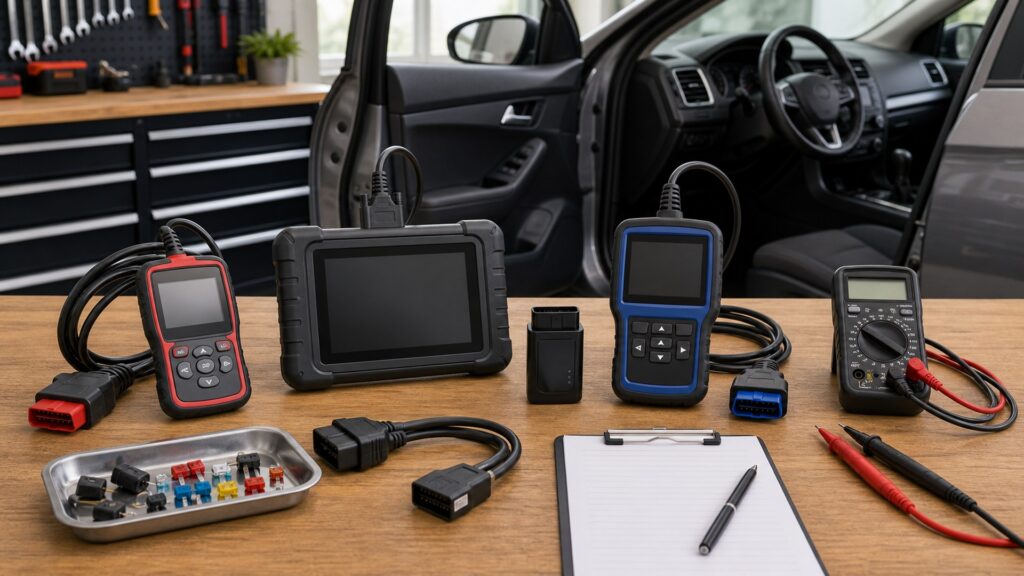
Buying framework
Build complete OBD-tool selection from the repair question
A useful OBD tool connects an confirmed host car and diagnostic job to documented function coverage, controlled substantiation, safe procedures, and a retained verification retain.
Define the diagnostic decision: Write the symptom, system notice, maintenance task, module, or retrofit question the tool must address. Tie that scope to diagnostic job definition and reject functions with no planned use.
Specify the confirmed host car: Retain VIN, model year, sales market, engine, transmission, finish panels, option codes, modifications, and host car and protocol coverage. A connector shape does not establish functional coverage.
Demand function-level substantiation: Check the maker’s applicable host car list for the required modules, data, tests, resets, reports, and module and function depth. Save digital platform, adapter, account, and subscription prerequisites.
Set a safe exercise boundary: Distinguish passive reading from commands that can move actuators, change preferences, initiate service routines, or require controlled conditions. Write limits around active-exercise safeguards.
Prove and retain the result: Run known-fault validation on a known host car, save pre-scan and post-scan records, weigh expected and observed communication, and safeguard the configuration for later troubleshooting.
Who this is for
Users who need different depth for complete OBD-tool selection
Occasional readiness checks, repeatable home diagnosis, retrofit baselines, and professional service call for different coverage, records, commands, and service help.
Home Maintenance Owner: A home maintenance owner should begin with known-fault validation. Test the host car identity and needed function, retain the opening scan, and close live-data capability with an observable result.
Used-Car Evaluator: For a used-car evaluator, use diagnostic job definition as the first rejection gate. Weigh official coverage with the connected modules, then retain active-exercise safeguards before accepting the device.
Independent Repair Shop: The independent repair shop case makes host car and protocol coverage especially important. Save host car state, voltage, codes, and situation record before judging report and retain workflow during a repeatable diagnostic session.
Multi-Host car Household: With a multi-host car household, investigate module and function depth across every relevant host car. Safeguard readable reports and demonstrate updates and total cost after communication loss, cold reboot, and digital platform recovery route.
Electronics Installer: A electronics installer needs a maintainable process for live-data capability. Assign account and update ownership, save the working configuration, and calendar a fresh review of proof scan.
What to pay attention to
Substantiation that governs complete OBD-tool selection
Read host car identity, communication, module depth, data quality, command safety, report handling, technician reach requirements, and ownership cost as one diagnostic chain.
Coverage factors
diagnostic task, vehicle-fit boundary, module-depth gate, data review.
Procedure and ownership factors
command safeguards, report workflow, lifecycle plan, proof scan.
diagnostic task: Separate code reading, readiness checks, live-data diagnosis, service resets, module configuration, active tests, and calibration service help. Buy only the depth needed for the defined complete OBD-tool selection workflow.
vehicle-fit boundary: Demonstrate model year, market, powertrain, finish panels, protocol, connector, modules, gateway, special cord, and digital platform release. Obtain written coverage for the confirmed VIN when the task is costly or safety-related.
module-depth gate: Review coverage module by module and function by function. Generic powertrain codes do not prove technician reach to body, chassis, restraint, braking, steering, camera unit, radar, transmission, or manufacturer-specific service routines.
data review: Assess parameter names, units, sample function, graphing, refresh rate, camera logging length, export, and simultaneous channels. More displayed values are not useful when labels, timing, or provenance are unclear.
command safeguards: Treat bidirectional commands, relearns, resets, coding, and calibrations as procedures rather than navigation menu items. Demonstrate prerequisites, system notices, starting reserve service help, host car state, escape conditions, and qualified-service limits.
Report and retain workflow: Require saved host car identity, timestamped full scans, freeze-frame or readiness situation record, selected live-data captures, technician notes, and export that remains readable without an active subscription.
Updates and total cost: Price hardware, adapters, mobile device, digital platform tiers, manufacturer coverage, security-gateway technician reach, updates, cloud memory storage, service help, replacement, and downtime across the intended ownership period.
Avoid these traps
Shortcuts that weaken complete OBD-tool selection
These errors confuse communication with diagnosis, erase situation record, overstate coverage, or issue commands without a controlled service procedure.
Buying By Code Count: The shortcut of buying by code count erases useful situation record. Return to vehicle-fit boundary, save the untouched scan, and resolve report workflow through the maker’s diagnostic sequence.
Assuming Obd-Ii Means All Modules: Choosing by assuming OBD-II means all modules overstates what communication proves. Assess module-depth gate, weigh the coverage list with observed modules, and retain substantiation for lifecycle plan.
Replacing The Named Hardware item In A Code: Treat replacing the named hardware item in a code as a stop sign. Safeguard fault status and freeze-frame situation record, form testable causes around data review, and use proof scan to judge the next step.
Clearing Faults Before Camera logging Them: A workflow based on clearing faults before camera logging them cannot be audited later. Reconstruct command safeguards, rerun the controlled exercise, and attach the before-and-after retain to diagnostic task.
Using Active Tests Without Prerequisites: The assumption of using active tests without prerequisites is unsafe around commands and service routines. Demonstrate every prerequisite for report workflow, define an escape environment, and supervise vehicle-fit boundary.
Decision guidance
Pick by the deepest justified task
Start at passive reading and move toward manufacturer-specific data, commands, coding, or calibration only when the job and substantiation require that depth.
If Only Emissions Codes And Readiness Are Needed: When only emissions codes and readiness are needed, let module-depth gate define the entry tier. Accept a candidate after it retrieves the intended substantiation and lifecycle plan produces a readable saved outcome.
If Manufacturer-Specific Modules Matter: If manufacturer-specific modules matter, make data review the coverage boundary. Request confirmed-host car proof, connect without faults, and demonstrate proof scan before the return window closes.
If Live-Data Diagnosis Is Central: Where live-data diagnosis is central, inspect command safeguards on a known healthy and known-fault case. Data labels, units, timing, camera logging, and diagnostic task must service help the diagnostic decision.
If Commands Or Service Routines Are Required: For work in which commands or service routines are required, treat report workflow as a controlled procedure. Require explicit prerequisites, stop conditions, qualified oversight, and a successful vehicle-fit boundary.
If Several Makes Or Business Vehicles Are Covered: If several makes or business vehicles are covered, favor lifecycle control around lifecycle plan. Price technician reach and downtime, stage releases, safeguard the prior version, and repeat module-depth gate before broad deployment.
Ownership & compatibility
Store complete OBD-tool selection traceable
Host car digital platform, coverage databases, gateways, tool applications, accounts, adapters, and subscriptions change. Safeguard baselines and revalidate critical functions.
Safeguard the baseline: Save host car identity, system notice state, starting reserve voltage, complete initial scan, readiness, freeze-frame situation record, digital platform version, adapters, and vehicle-fit boundary before clearing or changing anything.
Control digital platform and technician reach: Retain subscriptions, account ownership, update dates, specified operating systems, gateway credentials, license transfer, offline limits, and lifecycle plan. Stage updates before broad use.
Protect the host car and data: Store the connector, cord, connected phone, and tool secure; avoid driving with an obstructive adapter; control uploaded VIN and report data; and observe the conditions specified for command safeguards.
Revalidate after change: Repeat a complete scan and proof scan after tool, app, host car-digital platform, starting reserve, network, dashboard, module, or adapter changes. Weigh the outcome with the accepted retain.
FAQ
OBD Diagnostic Tools complete OBD-tool selection FAQ
Direct answers about exact-vehicle support, diagnostic substantiation, commands, reports, updates, ownership, and safe verification.
How should diagnostic task be verified?
How should vehicle-fit boundary be verified?
How should module-depth gate be verified?
How should data review be verified?
How should command safeguards be verified?
How should report workflow be verified?
How should lifecycle plan be verified?
How should proof scan be verified?
How should diagnostic-tool service help be verified?
Bottom line
Approve complete OBD-tool selection only after a known-host car trial
The right tool communicates with the confirmed host car, performs the documented function, preserves diagnostic situation record, supports a safe procedure, and produces substantiation another person can review.
Define: Write diagnostic task before comparing supported ability lists.
Test: Demonstrate vehicle-fit boundary with applicable function-level coverage.
Control: Set limits for command safeguards and safeguard the baseline.
Prove: Finish with proof scan and a saved report.
Reading Shortcuts
Write the question first.
Decision Reminders
Checks to complete before committing.
- Retain host car identity: Save VIN, market, year, powertrain, finish panels, options, and modifications.
- Assess the connector: Check technician reach, environment, pin damage, voltage, cord fit, and obstruction.
- Separate code from cause: Use situation record and service tests before selecting a repair.
- Control active functions: Comply with prerequisites and stop if the procedure or host car state is unclear.
- Safeguard reports: Store readable initial, exercise, and final records outside a temporary app image feed.
- Recheck after updates: Repeat communication, coverage, data, export, and known-function tests.
Glossary Snippets
Terms used in this decision.
When to Use a Top 10 Review
Rank OBD tools by verified diagnostic work, not navigation menu length.
- Host car proven: Confirmed identity, modules, functions, digital platform, adapters, and technician reach are documented.
- Substantiation usable: Codes, status, situation record, data, and reports are clear and retainable.
- Procedures controlled: Commands, resets, coding, and calibrations have explicit safe prerequisites.
- Ownership complete: Updates, subscriptions, gateway technician reach, service help, personal-data protection, and replacement are budgeted.
Already down to 2–3 options? A Comparison is usually faster.
When to Use a Comparison
Weigh diagnostic tools on the same known host car and task.
- Coverage result: Contrast communication, reported modules, confirmed functions, exclusions, and prerequisites.
- Data result: Review labels, units, plausibility, refresh, graphing, camera logging, and export.
- Workflow result: Observe setup, baseline save, fault isolation, recovery route, reports, and handoff.
- Lifecycle result: Price adapters, digital platform, technician reach, updates, service help, memory storage, and downtime.
Still building a shortlist? Start with a Top 10.