
Off-Road & Overlanding Buying Guide for Durability and Payload Needs
Durability is not the same as weight. A thick bracket can survive impact yet crack its mounting panel through leverage. A heavy bumper can resist trail contact while consuming rear-axle reserve and increasing vibration elsewhere. The complete load path decides what lasts.
Set a payload budget before comparing materials. Count every bracket, fastener, carrier, battery, fluid, and spare, then place that mass by axle. Ask which loads are static, dynamic, impact, wind, recovery, or fatigue cycles. Examine joints, drainage, coatings, weld access, and replaceable wear parts. The strongest purchase is the lightest system that reliably handles the defined duty and remains inspectable and repairable after real travel.
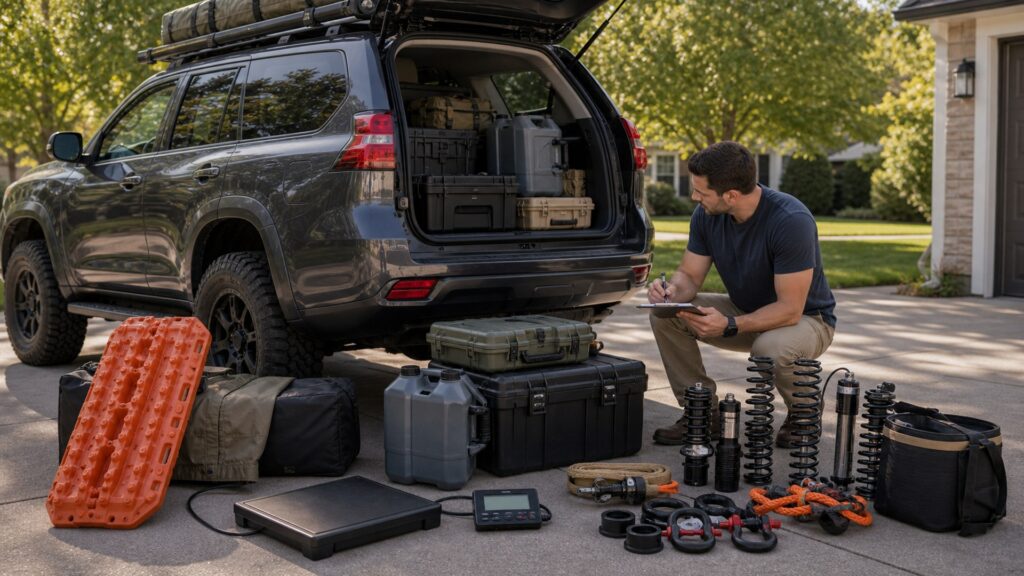
Buying framework
Define durability as surviving a known duty cycle
Choose equipment from load cases, cycles, environment, vehicle attachment, and payload—not a vague heavy-duty label.
Write the load cases: Include cargo mass, braking, washboard vibration, wind, branch contact, impact, recovery forces, repeated opening, temperature, and corrosion.
Trace force into the vehicle: Follow load through accessory, joint, bracket, backing, body or frame, including leverage and side loading.
Budget installed mass by axle: Add every supporting part and consumable, then protect total, axle, tire, roof, bed, and hitch reserves.
Plan inspection and repair: Make cracks, loose joints, coating damage, drains, wear pads, and replaceable modules visible and serviceable.
Who this is for
Match construction to exposure and repair reality
Desert washboard, salted winter roads, rock contact, humid storage, and long cantilevers punish different details.
High-cycle travelers: Prioritize short load paths, joint retention, fatigue evidence, vibration isolation where engineered, and regular crack inspection.
Impact-prone trail users: Use localized protection, replaceable wear plates, smooth snag-resistant shapes, and mounts that protect critical vehicle structure.
Wet and salty climates: Favor drainage, sealed cavities, compatible metals, renewable coatings, accessible washout, and connectors isolated from collected spray.
Payload-limited vehicles: Choose formed shapes, modular coverage, shared structures, and removable camp systems instead of stacking thick overlapping accessories.
What to pay attention to
Durability evidence beyond material thickness
Material grade, shape, joint, test direction, attachment, and environment determine whether a weight penalty buys real life.
Structural Life
Load direction, section shape, joints, fatigue, impact, leverage, proof tests, and vehicle attachment.
Lifecycle Cost
Installed mass, corrosion, inspection, replaceable wear parts, repair tools, warranty, and removal access.
Complete weight and center: Request installed system mass and locate it relative to axles, roof, hitch, or cantilever—not shipping weight alone.
Material and section: Grade, temper, thickness, bends, ribs, closed sections, weld process, and heat-affected zones matter together.
Fastener and clamp system: Check grade, engagement, backing area, locking method, torque instructions, slotted adjustment, edge distance, and retorque policy.
Test relevance: A centered static proof load may not represent off-axis impact, repeated vibration, wind uplift, recovery angle, or fatigue at vehicle mounts.
Corrosion and repair design: Look for drainage, isolation, sealed or vented cavities, coating preparation, chip repair instructions, and replacement hardware.
Avoid these traps
Durability purchases that spend payload without reducing failure
Mass becomes a liability when it protects the accessory by transferring load into the vehicle or duplicating structure.
Assuming steel is always stronger: Alloy, temper, section geometry, welds, joints, load direction, and corrosion matter; aluminum can be efficient while poorly designed steel can fatigue.
Comparing bare component weights: Mounts, adapters, carriers, spare, fluids, wiring, and required reinforcement can reverse the apparent payload advantage.
Ignoring stress at the vehicle: A rigid accessory may remain intact while thin body, roof, bed rail, frame hole, or weld zone cracks around its mount.
Coating over trapped water: A durable finish cannot compensate for unsealed overlaps, clogged drains, mixed-metal contact, internal rust, or inaccessible chips.
Decision guidance
Buy only the durability the route can use
Choose the minimum coverage and structure that controls the defined failure without exhausting the vehicle's capacity.
If vibration is the threat: Shorten spans, reduce tip mass, improve joint support, and choose fatigue-tested architecture rather than simply thicker plate.
If impact is localized: Protect the contact zone with replaceable or modular structure instead of armoring unrelated surfaces.
If corrosion drives replacement: Prioritize drainage, compatible materials, coating repair, sealed joints, wash access, and renewable hardware before cosmetic finish.
If payload is tight: Remove redundant racks and boxes, choose shared mounting systems, keep water and batteries low, and compare lighter trip routines.
Ownership & compatibility
Durability depends on finding damage early
Loose joints and coating chips amplify loads and corrosion long before a visible break strands the vehicle.
Establish inspection landmarks: Mark fasteners, photograph welds and seams, record torque procedures, and note clearances so movement becomes visible.
Clean before judging: Remove mud and salt from drains, overlaps, mounts, recovery points, wiring, and coating damage; trapped contamination hides cracks.
Retire or repair by evidence: Follow maker criteria for bends, cracks, elongated holes, damaged threads, corrosion loss, UV exposure, and overloaded recovery or tie-down equipment.
FAQ
Durability and payload questions
These answers cover materials, fatigue, testing, corrosion, mounts, and weight budgets.
Is heavier overlanding equipment always more durable?
Is aluminum suitable for off-road armor and racks?
What does a static load rating tell me?
How should accessory weight be added to payload?
Why do mounts crack even when the accessory looks undamaged?
Do stronger springs solve a heavy overlanding build?
How can mixed-metal corrosion be reduced?
What durability features improve field repair?
When should overlanding hardware be retired?
Bottom line
Durability is useful life purchased with finite payload
Define the duty, trace the load into the vehicle, and choose inspectable construction that survives without creating a heavier failure elsewhere.
Specify the duty: Name loads, cycles, exposure, and likely contact zones.
Count the whole system: Include supports and enabled cargo, then protect every axle and vehicle limit.
Inspect the interface: Maintain joints, drainage, coatings, wear parts, and the surrounding vehicle structure.
Reading Shortcuts
Move from the operating problem to a vehicle-compatible load-path system that can be installed and verified.
Decision Reminders
Keep the complete load-path system in view while comparing parts.
- Duty: Static, dynamic, impact, wind, recovery.
- Cycles: Fatigue can govern before strength.
- Interface: Trace force into the vehicle.
- Mass: Count the full installed system.
- Corrosion: Drain, isolate, coat, and repair.
- Service: Keep joints and cracks visible.
Glossary Snippets
Terms that separate useful performance from apparent compatibility.
When to Use a Top 10 Review
Use a product roundup only after the required function and load-path system limits are known.
- Problem defined: The visibility or mobility failure is specific.
- Vehicle mapped: Interfaces and limits are documented.
- Format chosen: The correct product family is settled.
- Evidence available: Finalists can be compared on relevant tests.
Have finalists already? Open a Comparison for a closer tradeoff.
When to Use a Comparison
Compare finalists that solve the same defined load-path system problem on the same vehicle.
- Application: Both match the exact vehicle and function.
- Performance: Evidence addresses the operating problem.
- Integration: Mounting and system effects are understood.
- Ownership: Inspection and service demands are acceptable.
Need a broader field? Use a Top 10 to form a shortlist.