
Off-Road & Overlanding Buying Guide for Jeep and Truck Builds
“Jeep build” and “truck build” hide several architectures. A short-wheelbase solid-axle vehicle, a crew-cab pickup with independent front suspension, and a long body-on-frame SUV place mass, steering loads, storage, and recovery forces differently.
Begin with the exact platform and loaded mission. Measure current axle weights, wheel travel, clearances, cooling openings, sensor zones, spare location, and service points. Then sequence tires, recovery, protection, suspension, and storage so one change does not force three corrective purchases. Bed racks must accommodate bed-to-cab movement; roof loads must respect the specific roof system; wheel offset must be evaluated with steering and bearings. Build the interfaces, not the badge.
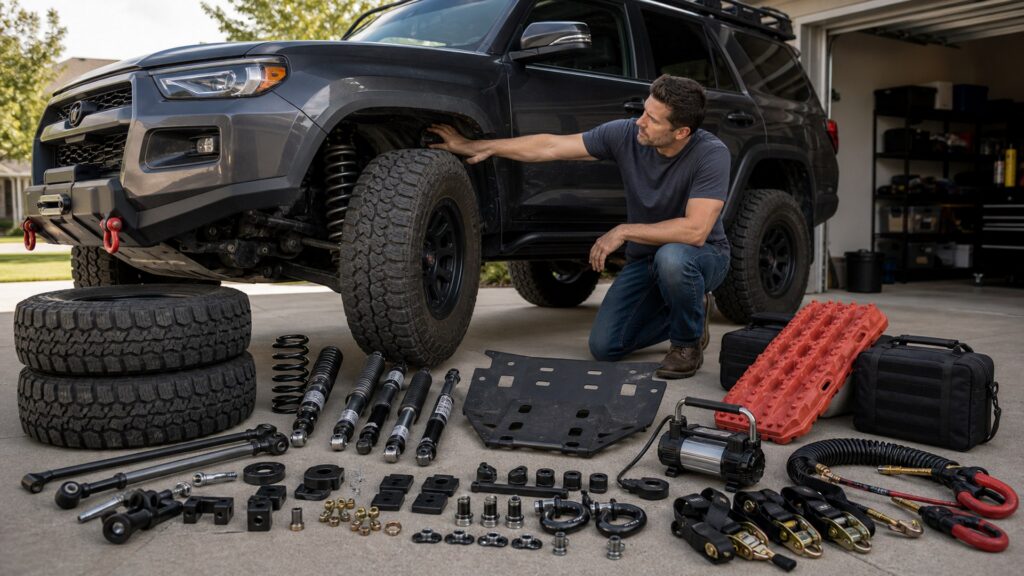
Buying framework
Build from platform interfaces, not vehicle identity
Map geometry, mass, structure, suspension, electronics, and service points before choosing the modification sequence.
Measure the stock platform: Record wheelbase, track, overhangs, clearances, wheel travel, axle loads, roof and bed limits, and approach or departure constraints.
Define structural attachment: Identify frame, body, bed, roof, subframe, and manufacturer accessory points; confirm allowed loads and directions.
Sequence coupled changes: Model how tire diameter and offset affect gearing, brakes, steering, clearance, spare storage, and calibration before suspension or fender work.
Preserve repair access: Keep recovery points, jacking, filters, drains, alignment adjusters, sensors, tow equipment, and damaged-part removal usable.
Who this is for
Match build architecture to the platform and trip
Short wheelbases, pickups, and enclosed SUVs solve cargo, sleep, terrain, and highway travel differently.
Short-wheelbase trail vehicles: Protect stability and payload while using maneuverability and breakover advantages; avoid concentrating heavy gear high or behind the rear axle.
Crew-cab pickups: Manage long wheelbase, rear overhang, bed flex, axle distribution, dust, and camper or rack loads while retaining bed utility.
Enclosed body-on-frame SUVs: Exploit weatherproof interior volume but secure every item, preserve occupant space and exits, and control rear-axle loading.
Daily-driver builds: Favor reversible, quiet, corrosion-resistant systems with acceptable braking, steering, fuel use, parking dimensions, and inspection or warranty consequences.
What to pay attention to
Build specifications that expose platform side effects
Part fitment is incomplete without loaded geometry, dynamic movement, and downstream service consequences.
Chassis Consequences
Wheel and tire mass, steering, brakes, gearing, suspension travel, cooling, alignment, and electronic controls.
Cargo Consequences
Bed or roof movement, payload, axle balance, center of gravity, securement, weather sealing, and access.
Loaded axle weights: Weigh the intended travelers, fuel, water, camper, spare, bumpers, armor, and tongue load; compare total, axle, tire, and wheel capacities.
Tire-wheel geometry: Check diameter, width, offset, backspacing, scrub radius, brake clearance, steering sweep, compression travel, chain space, and full-size spare fit.
Suspension operating range: Evaluate spring rate, damping, bump and droop travel, CV or driveshaft angles, brake lines, sensors, alignment range, and loaded ride height.
Frame-body-bed interface: Use mounts designed for relative movement and avoid rigidly bridging structures that twist independently unless the engineered system allows it.
Accessory integration: Confirm airflow, crash structure, cameras, radar, parking sensors, airbags, lighting, tow ratings, hitch access, and corrosion protection.
Avoid these traps
Platform builds that chase clearance by creating new limits
Platform modifications often trade geometry for mass, steering load, heat, or lost articulation.
Lifting before defining the obstacle: Ride height can improve some clearance while increasing driveline angles, center of gravity, alignment difficulty, and entry height without changing axle clearance.
Choosing wheels by stance: Aggressive offset can alter scrub radius, bearing load, steering effort, fender contact, debris throw, and tire coverage.
Bridging pickup bed and cab: Rigid accessories can fight the structures' relative movement, producing cracks, noise, or mount failure on uneven terrain.
Stacking rear-biased accessories: Bumper, carrier, spare, drawers, water, and tongue load can overload the rear axle long before total vehicle mass looks dramatic.
Decision guidance
Choose the next modification from the platform bottleneck
Address the route-limiting interface while preserving stock strengths and avoiding compensating modifications.
If traction is limiting: Select appropriate tires and pressure tools first, then verify full travel, steering, brakes, gearing, spare, and load ratings.
If contact is limiting: Identify the exact contact zone and choose driving line, localized protection, tire change, or modest suspension work rather than a blanket lift.
If cargo is limiting: Compare interior modules, bed storage, camper, rack, trailer, and gear reduction using axle load, weather, access, and daily use.
If recovery is limiting: Install documented frame-compatible recovery points and controls without blocking cooling, sensors, crumple behavior, towing, or service.
Ownership & compatibility
Reinspect every interface after the chassis settles
New mass and geometry reveal movement, rubbing, heat, alignment drift, and fastener problems during the first loaded trips.
Run articulation and steering checks: With qualified procedures, observe compression, droop, steering sweep, brake lines, driveshafts, CVs, tires, fenders, sway links, and sensor wiring.
Reweigh and align loaded: Check actual axle weights, tire pressures for load, ride height, alignment, headlamp aim, braking behavior, and stability-system warnings.
Inspect structural transitions: Watch rack feet, bed mounts, frame brackets, welds, coating edges, bumpers, recovery points, hinge carriers, and high-cycle fasteners for movement or corrosion.
FAQ
Platform-specific build questions
These answers cover lift, tires, payload, bed racks, suspension, and sequencing.
Should tires or suspension come first in a build?
Does a suspension lift increase ground clearance everywhere?
How do I know whether a bumper is too heavy?
Can a pickup bed rack attach to the cab too?
What wheel offset is best for off-road tires?
Do heavier springs increase payload capacity?
Should armor be installed before recovery equipment?
How can I keep a truck build useful every day?
What should a post-build shakedown include?
Bottom line
A strong platform build preserves the vehicle's useful geometry
Modify the bottleneck, understand every connected interface, and keep mass, electronics, movement, and serviceability inside the design.
Map the platform: Measure structure, suspension, geometry, loads, sensors, and service points.
Sequence dependencies: Let tires, recovery, protection, suspension, and storage inform one another before purchase.
Validate loaded: Weigh, align, articulate, scan, aim, and inspect after real heat and vibration cycles.
Reading Shortcuts
Move from the platform-build problem to a vehicle-compatible plan that can be installed and verified.
Decision Reminders
Keep the complete platform system in view while comparing parts.
- Platform: Wheelbase, track, suspension, overhang.
- Interface: Frame, body, bed, or roof.
- Mass: Check axle and tire limits.
- Geometry: Test steering and full travel.
- Electronics: Preserve sensors and stability systems.
- Service: Keep drains, jacks, and spares reachable.
Glossary Snippets
Terms that separate useful performance from apparent compatibility.
When to Use a Top 10 Review
Use a platform-build roundup only after the required function, vehicle interface, and operating limits are known.
- Problem defined: The visibility or mobility failure is specific.
- Vehicle mapped: Interfaces and limits are documented.
- Format chosen: The correct product family is settled.
- Evidence available: Finalists can be compared on relevant tests.
Have finalists already? Open a Comparison for a closer tradeoff.
When to Use a Comparison
Compare platform-build finalists that solve the same defined problem on the same vehicle configuration.
- Application: Both match the exact vehicle and function.
- Performance: Evidence addresses the operating problem.
- Integration: Mounting and system effects are understood.
- Ownership: Inspection and service demands are acceptable.
Need a broader field? Use a Top 10 to form a shortlist.