
Off-Road & Overlanding Buying Guide for Trail Recovery Planning
Vehicle recovery is a force-management problem performed around people. Mud suction, a high-centered chassis, a buried axle, an uphill pull, and a disabled vehicle can demand very different directions and loads. The equipment label is only one part of the system.
Start with the vehicle's approved recovery points and the stuck scenarios likely on the route. Match winch, rope, connectors, extensions, pulley devices, and anchors by rating, geometry, material compatibility, and manufacturer instructions. Separate static winching from kinetic recovery; they store and release energy differently. Plan one leader, clear communication, a defined exclusion zone, and stop criteria. Practice on stable ground before a real recovery adds weather, slope, fatigue, and urgency.
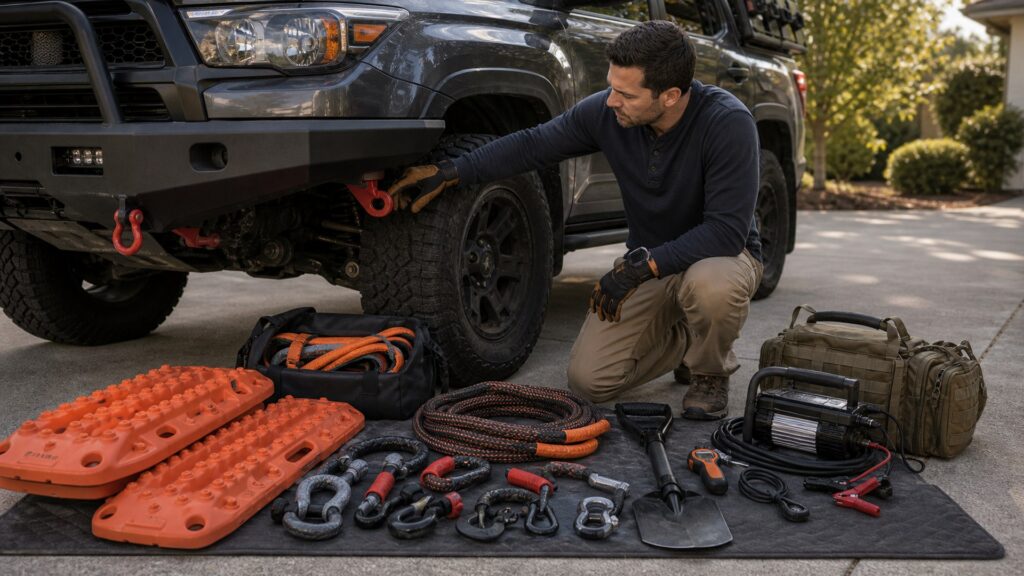
Buying framework
Plan the load path before tensioning anything
Identify what is stuck, where force should act, how it travels through every component, and where people must not stand.
Assess before rigging: Stabilize vehicles, check occupants and terrain, identify resistance, slope, rollover or slide risk, traffic, fire danger, anchors, and a low-force escape path.
Trace every loaded component: Follow force from the recovering vehicle through its point, connector, rope, redirect, anchor, and the stuck vehicle point, including side-load and bend-radius effects.
Choose the energy method: Use static winching for controlled pulls and kinetic equipment only when the vehicles, points, rope, space, and trained procedure support dynamic recovery.
Control people and communication: Appoint one leader, agree on signals and stop commands, remove spectators from the manufacturer-defined danger area, and never step over or handle a tensioned line.
Who this is for
Build the kit around likely recoveries
Solo desert travel, forest convoys, snow routes, and technical rock terrain require different anchors, reach, digging, and redundancy.
Solo remote travelers: Prioritize self-recovery points front and rear, a maintained winch, anchor options, traction and digging tools, communication, gloves, and practiced single-person procedures.
Convoy travelers: Standardize signals, inspect cross-vehicle attachment compatibility, assign recovery roles, and carry enough rated connectors and extensions to avoid improvised chains.
Sand and snow users: Early tire-pressure changes, shoveling, and traction boards can reduce resistance before higher-energy pulls; protect equipment from grit, ice, and hidden anchors.
Rock and slope users: Controlled direction, vehicle stabilization, short moves, protected winch line, strong side-load discipline, and experienced spotting outweigh rapid extraction.
What to pay attention to
Recovery specifications that must agree across the system
A high rating on one component cannot compensate for an unknown vehicle point, poor geometry, damaged rope, or unsafe technique.
Force System
Vehicle points, ratings, line layers, angles, redirects, bend radius, anchors, connectors, and stored energy.
Operating System
Battery and cables, thermal duty, controls, roles, communication, inspection, storage, and retirement criteria.
Vehicle-point documentation: Confirm point location, intended recovery direction, hardware, simultaneous-point requirements, and restrictions in the vehicle or accessory instructions.
Compatible ratings and geometry: Compare working ratings, minimum strengths, pin or rope diameters, soft-shackle bearing surfaces, pulley compatibility, side loading, and the weakest rated link.
Winch performance curve: Rated line pull is not constant across drum layers. Review current draw, line speed, duty limits, minimum rope wraps, cable size, and thermal protection.
Rope construction and condition: Material, diameter, stretch, heat sensitivity, abrasion, contamination, splices, thimbles, age, and manufacturer retirement rules determine serviceability.
Rigging and exclusion plan: The kit needs adequate reach, tree protection, redirects, line dampers where specified, remote-control discipline, gloves, communications, and a practical spectator boundary.
Avoid these traps
Recovery shortcuts that concentrate force in the wrong place
The most dangerous errors substitute appearance or vehicle weight for documented attachment, compatible ratings, and controlled technique.
Using a tow ball as a recovery point: A towing component is not automatically approved for dynamic or angled vehicle recovery; use only documented rated recovery attachments and directions.
Mixing kinetic and static components: A winch extension, tree protector, chain, or ordinary tow strap may not be designed to stretch or absorb a dynamic pull.
Standing near the loaded system: Hooks, shackles, points, ropes, anchors, and vehicle structure can fail. Follow equipment instructions and keep everyone outside the defined danger zone.
Pulling harder before reducing resistance: Digging, changing tire pressure, clearing the chassis, improving alignment, and using traction aids may lower required force more safely than a more aggressive pull.
Decision guidance
Choose the lowest-energy recovery that can work
Reduce resistance and improve direction before escalating from driving aids to static or dynamic pulling.
If tires are lightly buried: Stop wheelspin, assess underbody contact, dig ramps, adjust pressure within a safe plan, and use traction boards before loading recovery hardware.
If a controlled pull is possible: Use an appropriately rated winch system, straight alignment where practical, suitable anchor, correct line layer, and monitored electrical and thermal duty.
If direction must change: Use a compatible rated redirect device with suitable rope and anchor geometry; recalculate loaded components and keep people out of the new force paths.
If considering kinetic recovery: Proceed only with documented points, compatible kinetic equipment, adequate space and traction, trained operators, clear communication, and a method-specific exclusion zone.
Ownership & compatibility
Inspect, clean, and practice the recovery system
Damage often begins as abrasion, corrosion, heat, contamination, UV exposure, bent hardware, loose point fasteners, or poor rope spooling.
Inspect before and after every use: Check vehicle points, fasteners, mounts, rope, splices, hooks, shackles, pins, pulleys, straps, controls, cables, terminals, and anchors against manufacturer retirement criteria.
Store by material needs: Clean and dry textile gear, protect synthetic rope from abrasion and chemicals, control metal corrosion, respool correctly under specified tension, and keep labels traceable.
Practice full procedures: Rehearse rigging, signals, clutch use, remote control, controlled line loading, double-line setups, shutdown, and repacking on stable ground with qualified instruction.
FAQ
Trail recovery planning questions
These answers clarify points, ratings, winches, kinetic gear, anchors, and exclusion zones.
Is a factory tow hook always a recovery point?
How large should a recovery winch be?
Can I use a kinetic rope for winching?
Are soft shackles safer than metal shackles?
What is the weakest link in a recovery system?
Why does winch pull decrease as the drum fills?
Should I place a damper on synthetic winch rope?
When is a double-line winch pull useful?
What should happen before a difficult trail recovery?
Bottom line
Recovery readiness is a practiced force system
The safest kit is compatible from vehicle point to anchor, suited to likely stuck conditions, and operated by people who understand its energy and limits.
Assess and reduce: Stabilize the scene, dig and realign, and choose the lowest-energy effective method.
Trace the load path: Verify every point, connector, rope, redirect, anchor, angle, rating, and duty limit.
Control the operation: Use one leader, clear signals, a strict exclusion zone, stop criteria, inspection, and regular practice.
Reading Shortcuts
Move from the trail recovery problem to a vehicle-compatible plan that can be installed and verified.
Decision Reminders
Keep the complete trail recovery system in view while comparing parts.
- Scenario: Mud, sand, snow, high-center, slope.
- Point: Use only documented recovery attachments.
- Ratings: Check the complete weakest link.
- Method: Do not mix kinetic and static gear.
- People: One leader and a clear danger zone.
- Practice: Inspect, rig, operate, and repack.
Glossary Snippets
Terms that separate useful performance from apparent compatibility.
When to Use a Top 10 Review
Use a trail recovery roundup only after the required function, vehicle interface, and operating limits are known.
- Problem defined: The visibility or mobility failure is specific.
- Vehicle mapped: Interfaces and limits are documented.
- Format chosen: The correct product family is settled.
- Evidence available: Finalists can be compared on relevant tests.
Have finalists already? Open a Comparison for a closer tradeoff.
When to Use a Comparison
Compare trail recovery finalists that solve the same defined problem on the same vehicle configuration.
- Application: Both match the exact vehicle and function.
- Performance: Evidence addresses the operating problem.
- Integration: Mounting and system effects are understood.
- Ownership: Inspection and service demands are acceptable.
Need a broader field? Use a Top 10 to form a shortlist.