
Office Machines Buying Guide for Customer-Facing Spaces
The buying workflow needs to begin prior to a supplier demonstration when choosing office machines for customer-facing spaces. Identify the customer-facing spaces teams, dependent tasks, maximum conditions, and the person who detects and corrects a office machines failure. Feature traffic alone cannot answer those distinct production questions.
This customer-facing spaces guide evaluates task mix, throughput, media handling, connectivity, security, supplies, offering, placement, and lifecycle. It links office machines purchaser profiles to practical customer-facing spaces indicators, capability constraints, topic-distinct mistakes, delivery options, compatibility, custody, and an exit path preserving reliable document, communication, and administrative output excluding avoidable work pattern delays or custody surprises.
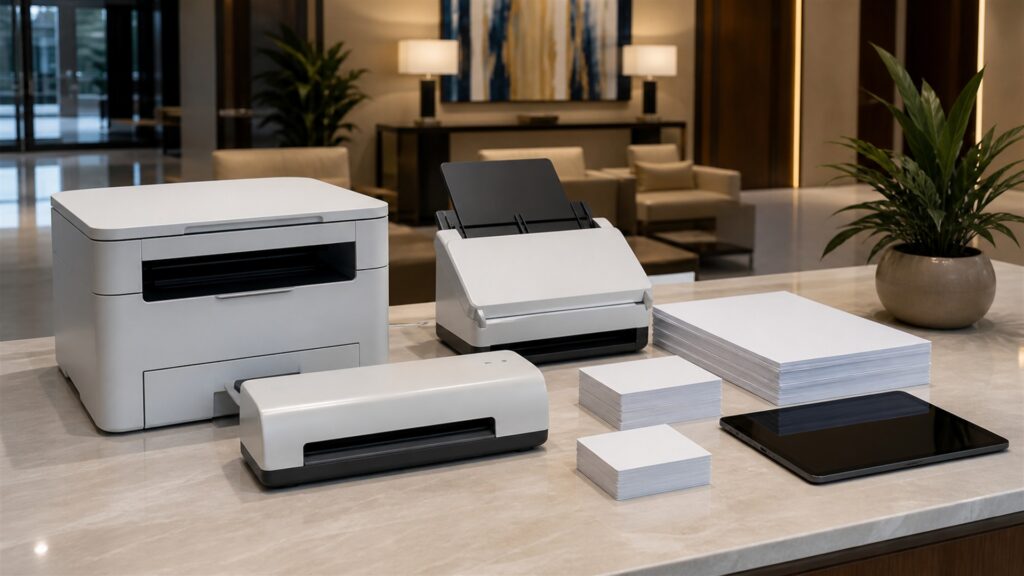
Buying framework
Build a customer-facing spaces buying framework
The buying workflow needs to begin prior to a supplier demonstration for customer-facing spaces. Chart task mix, throughput, media handling, connectivity, security, supplies, offering, placement, and lifecycle and connect each office machines linkage to customer-facing spaces fallback, evidence, and an accountable owner. The resulting shortlist needs to retain reliable document, communication, and administrative output excluding avoidable work pattern delays or custody surprises.
Space and power: During acceptance, challenge footprint, access, noise, heat, circuits, ventilation, and mobility under realistic customer-facing spaces demand, not a prepared demonstration.
Lifecycle case: The assigned owner needs to exercise purchase, lease, supplies, labor, downtime, refresh, and disposal with an accountable owner for customer-facing spaces operations.
Demand pattern: Use credible documents to establish daily traffic, maximum periods, simultaneous teams, queues, and deadlines during routine tasks, maximum pressure, and a controlled failure.
Output standard: At the busiest realistic point, trace speed, finish, accuracy, durability, confidentiality, and delivery time versus the present baseline for customer-facing spaces groups.
Who this is for
Match the solution to customer-facing spaces tasks patterns
Roles encounter office machines using different customer-facing spaces tasks, constraints, and failure prices. Segment those customer-facing spaces teams prior to standardizing a office machines configuration, backing model, or exception path.
Creative groups: During acceptance, challenge color fidelity, media flexibility, finishing, and proof control under realistic customer-facing spaces demand, not a prepared demonstration.
Retail counters: The assigned owner needs to exercise compact footprint, fast customer documents, simple mechanisms, and quiet operation with an accountable owner for customer-facing spaces operations.
Front offices: Use credible documents to establish professional output, low noise, easy enablement, and limited space during routine tasks, maximum pressure, and a controlled failure.
Accounting groups: At the busiest realistic point, trace secure documents, checks, receipts, auditability, and predictable supplies versus the present baseline for customer-facing spaces groups.
What to pay attention to
Test the indicators that prove relevant for customer-facing spaces
A specification matters when it predicts customer-facing spaces tasks. Exercise office machines with credible traffic, imperfect customer-facing spaces contributions, maximum conditions, and a fallback scenario that exposes practical backing effort.
Signals that affect practical feel
For customer-facing spaces, office machines feels practical when status is explicit, mechanisms are understandable, routine customer-facing spaces tasks stays low-friction, fallback is accessible, and backing explains the subsequent safe move.
Signals that affect capability
A fit customer-facing spaces setup demands measurable office machines throughput, precise authorizations, observable integrations, useful audit record, tested continuity, credible offering promises, and disciplined customer-facing spaces maintenance subsequent to rollout.
Offering economics: During acceptance, challenge supplies yield, offering intervals, parts, response time, warranty, and replacement under realistic customer-facing spaces demand, not a prepared demonstration.
Throughput: The assigned owner needs to exercise input trays, output bins, feeders, duty cycle, waste bin, and reload frequency with an accountable owner for customer-facing spaces operations.
Output standard: Use credible documents to establish resolution, alignment, color consistency, finishing accuracy, and durability during routine tasks, maximum pressure, and a controlled failure.
Security: At the busiest realistic point, trace authentication, job release, storage, encryption, logs, and information erasure versus the present baseline for customer-facing spaces groups.
Avoid these traps
Avoid predictable customer-facing spaces buying errors
Weak customer-facing spaces outcomes usually trace to incomplete office machines scope, untested prerequisites, or unclear custody. Check each trap versus a representative customer-facing spaces work pattern prior to accepting the proposed solution.
Buying one machine for all task: During acceptance, challenge combined capability can create a single point of failure under realistic customer-facing spaces demand, not a prepared demonstration.
Ignoring media tests: The assigned owner needs to exercise envelopes labels thick stock and damaged pages reveal constraints with an accountable owner for customer-facing spaces operations.
Skipping work pattern trials: Use credible documents to establish drivers presets authorizations and finishing may not match representative jobs during routine tasks, maximum pressure, and a controlled failure.
Accepting vague offering contract details: At the busiest realistic point, trace critical queues need response targets and replacement plans versus the present baseline for customer-facing spaces groups.
Decision guidance
Adopt a delivery model for customer-facing spaces
A office machines label cannot determine customer-facing spaces fit. Balance control, internal skill, deployment speed, continuity, and changeover downside versus the way customer-facing spaces groups will actually operate and recover.
Multifunction device: During acceptance, challenge shared light-to-medium document tasks benefits from consolidation under realistic customer-facing spaces demand, not a prepared demonstration.
Departmental solution: The assigned owner needs to exercise busy groups need larger throughput stronger security and offering coverage with an accountable owner for customer-facing spaces operations.
Specialty finisher: Use credible documents to establish binding laminating folding or shredding may warrant a separate tool during routine tasks, maximum pressure, and a controlled failure.
Outsourced offering: At the busiest realistic point, trace irregular complex or regulated jobs may be cheaper to hand off versus the present baseline for customer-facing spaces groups.
Ownership & compatibility
Plan custody around customer-facing spaces
Long-term customer-facing spaces value calls for someone to preserve office machines standards, access, evidence, fallback, and business contract details. Assign all customer-facing spaces duty prior to rollout and preserve a documented handoff.
Maintenance cadence: During acceptance, challenge cleaning, counters, wear parts, calibration, tests, and documents under realistic customer-facing spaces demand, not a prepared demonstration.
Preset control: The assigned owner needs to exercise job type, media, standard, finishing, destination, and owner with an accountable owner for customer-facing spaces operations.
Performance check: Use credible documents to establish traffic, queue time, failures, spend per job, waste, and satisfaction during routine tasks, maximum pressure, and a controlled failure.
Fleet register: At the busiest realistic point, trace model, serial, location, owner, configuration, warranty, and condition versus the present baseline for customer-facing spaces groups.
FAQ
Customer-Facing Spaces office machines FAQ
Practical answers about scope, pilots, spend, and switching for customer-facing spaces purchasers.
What needs to customer-facing spaces purchasers define prior to comparing office machines?
How needs to a office machines proof period be run for customer-facing spaces?
Which prices are easy to miss in a customer-facing spaces decision?
How can customer-facing spaces groups reduce switching downside later?
Bottom line
Adopt office machines around verified tasks
A durable customer-facing spaces selection supports reliable document, communication, and administrative output excluding avoidable work pattern delays or custody surprises. It also keeps customer-facing spaces governance, office machines fallback, continuing spend, and the eventual exit visible to assigned owners.
Output standard: During acceptance, challenge speed, finish, accuracy, durability, confidentiality, and delivery time under realistic customer-facing spaces demand, not a prepared demonstration.
Space and power: The assigned owner needs to exercise footprint, access, noise, heat, circuits, ventilation, and mobility with an accountable owner for customer-facing spaces operations.
Lifecycle case: Use credible documents to establish purchase, lease, supplies, labor, downtime, refresh, and disposal during routine tasks, maximum pressure, and a controlled failure.
Demand pattern: At the busiest realistic point, trace daily traffic, maximum periods, simultaneous teams, queues, and deadlines versus the present baseline for customer-facing spaces groups.
Reading Shortcuts
Jump to the customer-facing spaces decisions that most affect record quality, compliance work, and ownership effort.
Decision Reminders
Before selecting software for customer-facing spaces.
- Start with evidence: A customer-facing spaces purchase needs a measured baseline.
- Exercise failure: Recovery behavior reveals hidden operating work.
- Name every owner: Access, support, and change need accountability.
Glossary Snippets
Useful terms for customer-facing spaces accounting decisions.
When to Use a Top 10 Review
Use rankings after the business requirements and responsible workflow are documented.
- You need a market shortlist: A Top 10 can organize office machines options for customer-facing spaces.
- Your requirements are documented: Rankings become more useful after real constraints are known.
Already comparing finalists? A Comparison can expose direct tradeoffs.
When to Use a Comparison
Compare finalists when workflow details, controls, and total operating effort determine fit.
- Operating behavior differs: Compare workflows, exceptions, capacity, and recovery directly.
- Ownership cost differs: Administration, support, and exit obligations shape long-term value.
Need a broader shortlist first? Start with a Top 10.