
Performance & Tuning Buying Guide for Emissions and Inspection Planning
Emissions planning begins before a part is purchased, not on inspection day. A modification can preserve drivability while changing certified hardware, calibration, diagnostics, catalyst operation, evaporative integrity, or monitor completion. Federal anti-tampering obligations also exist independently of a state’s inspection schedule.
Identify the exact vehicle emissions family and every jurisdiction in which it will be registered or operated. Obtain application-specific evidence for the exact part and revision, then compare that evidence with local OBD, visual, tailpipe, smoke, and noise procedures. Record the stock configuration and baseline readiness before installation. After commissioning, verify lawful control operation and retain approvals, labels, files, receipts, and scan reports so later updates, repairs, inspections, and resale remain supportable.
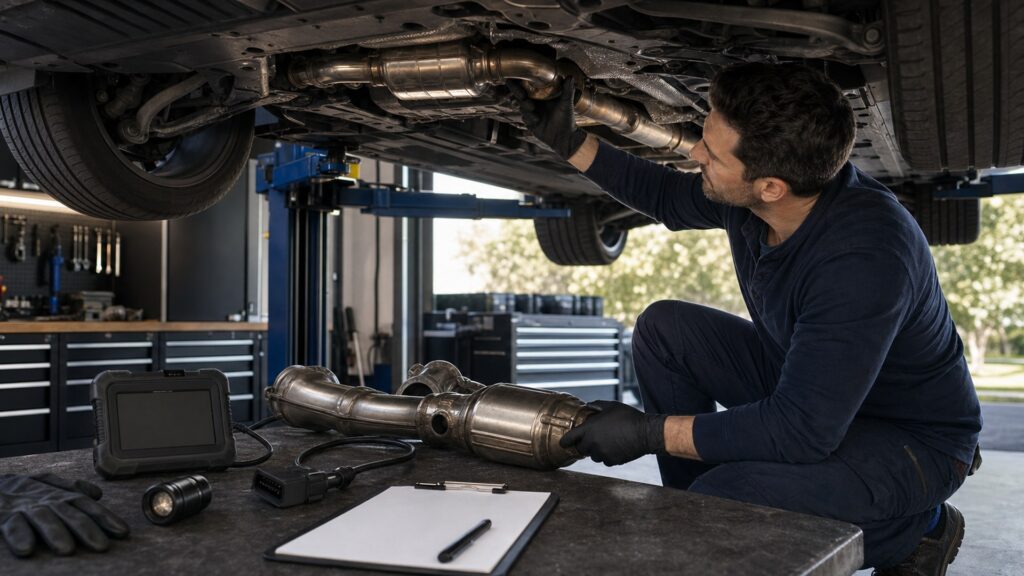
Buying framework
Plan from obligations and evidence, not inspection folklore
Federal anti-tampering rules, local inspection procedures, and product documentation answer different questions and all must be satisfied.
Identify governing use: Record road, competition, registration, travel, and transfer plans; do not assume a local inspection exemption permits emissions tampering.
Capture vehicle certification identity: Photograph the emissions label and record VIN, engine, model year, market, emissions family, software, and installed controls.
Verify the exact candidate: Match part number, revision, application list, required companion parts, legal evidence, labels, calibration, and installation conditions.
Write the inspection lifecycle: Plan baseline scan, installation records, readiness completion, visual access, noise, recurring tests, software updates, and eventual restoration or sale.
Who this is for
Inspection exposure depends on vehicle, jurisdiction, and modification
A new daily driver, older vehicle, diesel truck, and transferred vehicle may face different controls and test procedures.
Daily road vehicles: Prioritize documented compliant applications, stable diagnostics, retained monitors, reasonable noise, service access, and repeatable recurring inspection.
Multi-state owners: Check registration and operating jurisdictions directly; do not assume one approval, exemption, or seller claim travels everywhere.
Older or exempt vehicles: Confirm what exemption actually covers while preserving federally required controls and considering future sale, relocation, or rule changes.
Competition-only projects: Use a truly dedicated competition plan and current rules; a label or occasional event use does not automatically legalize road-vehicle defeat hardware.
What to pay attention to
Evidence and system behavior that determine inspection outcomes
The strongest choice connects application paperwork with functional controls, truthful diagnostics, and the actual local test.
Compliance Evidence
Exact application, test or certification basis, part markings, conditions, installation, and retained records.
Inspection Behavior
Visual presence, OBD communication, monitors, faults, tailpipe or smoke results, noise, and recurring service.
Application scope: Verify the document covers exact part and revision, vehicle years, engine, transmission where relevant, emissions family or stated application, and configuration.
Control-system integrity: Confirm catalysts, filters, EGR, oxygen and NOx sensors, evaporative controls, diagnostics, and protective strategies remain installed and functional as required.
OBD transparency: A compliant system should communicate, report genuine faults, complete applicable monitors, and avoid masking diagnostic or readiness information.
Inspection procedure match: Research current connector, monitor allowance, permanent-code treatment, visual list, tailpipe or opacity test, noise method, and paperwork requirements.
Lifecycle documentation: Keep labels, approvals, instructions, receipts, stock components, calibration IDs, before-and-after scans, repairs, and inspection results tied to the vehicle.
Avoid these traps
Inspection planning errors that surface after money is spent
Sales language, cleared codes, and a current sticker cannot substitute for exact legal and technical evidence.
Treating no check-engine light as proof: A lamp can be off while monitors are incomplete, permanent codes remain, communication is altered, or a visual requirement is unmet.
Relying on generic compliance wording: Terms such as legal, certified, or emissions-friendly are insufficient unless documentation covers the exact application and applicable conditions.
Clearing codes immediately before inspection: This can reset readiness and erase useful diagnostic evidence without repairing the underlying fault.
Ignoring future configuration changes: New software, a different pulley, injector, fuel, exhaust section, or companion part can move the vehicle outside documented coverage.
Decision guidance
Choose only modifications with a complete compliance path
The acceptable product is the one whose exact application, installation, calibration, diagnostics, and records support lawful recurring use.
If application evidence is ambiguous: Do not purchase until the manufacturer confirms exact part, vehicle, revision, configuration, jurisdictional use, and supporting documentation in writing.
If a required monitor will not complete: Diagnose operating conditions, faults, software, sensors, leaks, temperature, and service information rather than suppressing or falsely reporting it.
If visual access will be blocked: Choose a layout that preserves required component identification, routing, inspection access, and serviceability.
If relocation or resale is likely: Favor reversible, well-documented configurations with retained stock parts, transferable licenses, labels, and a known restoration procedure.
Ownership & compatibility
Maintain compliance through software, repairs, and inspections
A lawful commissioned state can change when modules update, components age, faults develop, or the configuration is revised.
Review after every change: Recheck application coverage and function after software updates, repairs, fuel-system changes, exhaust work, sensor replacement, or new performance parts.
Track readiness honestly: Use a compatible scan tool to record faults, permanent codes, monitor state, and expected drive conditions; never fabricate or hide diagnostic results.
Preserve the evidence package: Store documents and stock components with part revisions, calibration IDs, dates, installer details, scans, receipts, labels, and inspection history.
FAQ
Emissions and inspection planning questions
These answers cover anti-tampering, documentation, readiness, visual checks, updates, competition claims, and resale.
Does passing a state inspection prove a modification is federally legal?
What documents should come with an emissions-related performance part?
Can I clear codes and drive until the monitors become ready?
What is the difference between a fault code and readiness status?
Does a competition-use label make a part legal on the street?
How do software updates affect compliant calibrations?
What should I inspect before an OBD emissions test?
Can a replacement catalytic converter be chosen only by pipe size?
How should I prepare a modified vehicle for resale?
Bottom line
Make inspection success repeatable and supportable
Use exact application evidence, retain required controls and truthful diagnostics, and maintain a complete record through every configuration change.
Verify before purchase: Match the vehicle, part revision, use, jurisdiction, compliance evidence, and inspection procedure.
Commission transparently: Confirm controls, faults, readiness, visual details, noise, and test behavior without suppressing evidence.
Maintain continuity: Preserve labels, files, scans, stock parts, receipts, and coverage after every update or repair.
Reading Shortcuts
Move from the measured problem to a documented compliance plan that can be installed and verified.
Decision Reminders
Keep the complete compliance plan in view while comparing parts.
- Law: Federal and local duties differ.
- Application: Exact vehicle and part revision.
- Controls: Retain lawful emissions function.
- OBD: Faults and monitors stay truthful.
- Inspection: Know the current test method.
- Records: Support service, updates, and sale.
Glossary Snippets
Terms that separate useful performance from apparent compatibility.
When to Use a Top 10 Review
Use a product roundup only after the required function and compliance plan limits are known.
- Problem defined: The visibility or mobility failure is specific.
- Vehicle mapped: Interfaces and limits are documented.
- Format chosen: The correct product family is settled.
- Evidence available: Finalists can be compared on relevant tests.
Have finalists already? Open a Comparison for a closer tradeoff.
When to Use a Comparison
Compare finalists that solve the same defined compliance plan problem on the same vehicle.
- Application: Both match the exact vehicle and function.
- Performance: Evidence addresses the operating problem.
- Integration: Mounting and system effects are understood.
- Ownership: Inspection and service demands are acceptable.
Need a broader field? Use a Top 10 to form a shortlist.