
Performance & Tuning Buying Guide for Engine and Drivetrain Goals
Engine output reaches the road through a chain of ratios, friction surfaces, shafts, joints, gears, differential action, and tire grip. Raising torque at the crankshaft does not guarantee useful acceleration if the calibration closes the throttle, the clutch slips, the transmission overheats, or the tires cannot transmit it.
Define the speed range and duty cycle first, then capture a healthy baseline. Map fuel pressure, knock control, temperatures, shifts, gearing, traction, and component condition. Choose the smallest coherent stage that improves the measured limit while preserving emissions compliance and protective diagnostics. A complete build is not the engine plus supporting parts; it is a controlled torque path that repeats under the intended load.
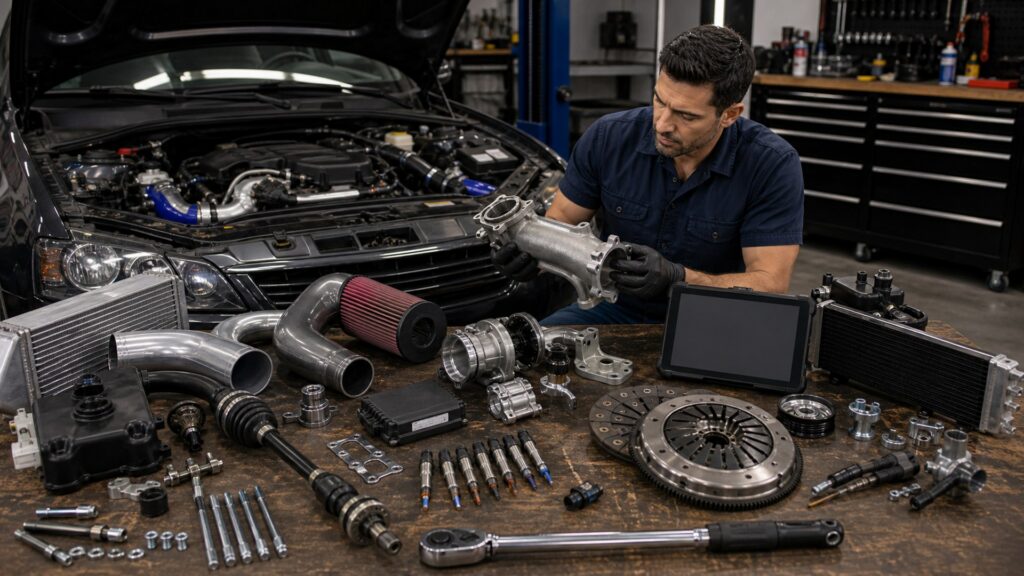
Buying framework
Follow torque from the requested outcome to the tires
Start with an acceleration event, calculate the operating range, and inspect every interface that carries or controls torque.
Define the event: State starting speed, ending speed, load, gear, surface, fuel, repetition, and acceptable response rather than a horsepower target.
Record a healthy baseline: Log faults, fuel pressure, knock, air and fluid temperatures, throttle, boost, shifts, slip, speed, and weather before modification.
Map the torque path: Document engine, clutch or converter, transmission, transfer case where fitted, shafts, differential, axles, wheel, tire, and control limits.
Stage one bottleneck: Change the limiting system with its calibration and thermal support, then repeat the baseline test before stacking another stage.
Who this is for
Match the powertrain plan to the demanded motion
Street response, straight-line launches, sustained circuits, and heavy-load use stress different parts of the torque path.
Street-response drivers: Favor broad controllable torque, available fuel, smooth shifts, traction, catalyst protection, quiet operation, and stable heat in traffic.
Launch-focused drivers: Prioritize tire preparation, axle and differential shock, clutch or converter behavior, mounts, wheel hop, and repeatable starting procedure.
Track users: Value oil control, fuel delivery, cooling recovery, progressive response, gearbox temperature, differential behavior, and session-long consistency.
Heavy-load users: Use manufacturer towing limits, sustained grade temperature, transmission strategy, braking, tire load, and conservative low-speed torque management.
What to pay attention to
Specifications that describe the whole torque path
Peak output matters only alongside operating range, ratios, pressure, temperature, control authority, and transient capacity.
Delivered Performance
Torque curve, ratios, losses, tire radius, traction, shift time, and response.
System Survival
Fuel, knock, cooling, lubrication, friction capacity, gears, shafts, joints, mounts, and diagnostics.
Torque curve and gear overlap: Compare useful torque across engine speed with ratio drops so each shift lands inside the desired response band.
Fuel and combustion margin: Verify commanded and measured fueling, pressure under load, fuel quality, knock activity, ignition, boost, and protection behavior.
Friction and hydraulic capacity: Clutches, converters, bands, packs, fluid, pumps, and pressure controls must match torque, heat, shift energy, and vehicle mass.
Gear and shaft loading: Ratios multiply torque; material, diameter, spline, joint angle, shock, tire grip, and fatigue influence real component margin.
Thermal recovery: Track engine coolant and oil, charge air, transmission, and differential through repeated runs and the recovery interval, not one cool pull.
Avoid these traps
Powertrain upgrades that move the failure downstream
A locally successful part can expose a weaker interface or trigger protective controls elsewhere.
Buying the largest advertised peak: A narrow high-rpm gain may not improve the target event and can increase heat, lag, fuel demand, and supporting-system cost.
Ignoring torque multiplication: Low gears and abrupt traction can load shafts and differential components harder than a smooth higher-speed dynamometer pull suggests.
Disabling protective behavior: Suppressing faults, torque reduction, temperature protection, or knock response removes evidence and margin instead of correcting the cause.
Mixing unmatched calibrations: Engine, transmission, throttle, boost, fueling, and traction strategies can issue conflicting commands when developed as isolated products.
Decision guidance
Choose the next part from the measured limiting link
Spend where data shows torque is lost, uncontrolled, overheated, or unsafe for the component carrying it.
If response is weak but traction is stable: Evaluate gearing, throttle and transmission behavior, boost threshold, and the usable torque curve before pursuing a larger peak.
If torque is reduced during shifts: Diagnose requested versus delivered torque, clutch or pack slip, pressure, temperature, calibration limits, and faults before increasing line pressure.
If temperatures climb each run: Restore airflow and service condition, then size cooling and lubrication for accumulated heat before adding output.
If the tires cannot use current torque: Improve tire suitability, differential action, alignment, damping, and torque delivery before strengthening parts solely for more power.
Ownership & compatibility
Operate the torque path with records and stop limits
Fluids, adaptations, joints, mounts, tires, and calibration health change after installation and heat cycling.
Keep configuration records: Save software versions, calibration files, fuel, plugs, fluids, ratios, tire size, torque procedures, and matched baseline logs.
Inspect after loaded cycles: Check leaks, fasteners, mounts, boots, joints, shafts, fluid condition, pressure, temperatures, faults, and new vibration after use.
Define stop conditions: End testing for knock, fuel-pressure loss, uncontrolled slip, abnormal shift, leak, temperature beyond validated limits, vibration, or warning indicators.
FAQ
Engine and drivetrain planning questions
These answers address torque, gears, clutches, transmissions, differentials, cooling, and validation.
Should I build the engine or transmission first?
Is horsepower or torque more important for acceleration?
How do tire diameter changes affect gearing?
When does a stronger clutch make sense?
What data indicates transmission slip?
Do upgraded engine mounts improve performance?
Is a limited-slip differential always faster?
How should dynamometer results be compared?
What should end a powertrain test immediately?
Bottom line
Build the torque path, not a peak number
Define the event, identify the limiting link, coordinate controls and hardware, then validate the whole chain under repeated load.
Map every link: Account for combustion, ratios, friction elements, shafts, differential action, tires, and control systems.
Support the bottleneck: Add fuel, cooling, calibration, and component capacity only where the measured duty requires them.
Retest the event: Use matched conditions, complete logs, inspection, and firm stop limits before advancing the next stage.
Reading Shortcuts
Move from the measured problem to a documented torque-path plan that can be installed and verified.
Decision Reminders
Keep the complete torque-path plan in view while comparing parts.
- Goal: Define speed, load, gear, and repetition.
- Torque path: Inspect every transmitting interface.
- Ratios: Model wheel torque and shift drops.
- Heat: Measure accumulation and recovery.
- Control: Coordinate engine and transmission.
- Test: Use matched data and stop limits.
Glossary Snippets
Terms that separate useful performance from apparent compatibility.
When to Use a Top 10 Review
Use a product roundup only after the required function and torque-path plan limits are known.
- Problem defined: The visibility or mobility failure is specific.
- Vehicle mapped: Interfaces and limits are documented.
- Format chosen: The correct product family is settled.
- Evidence available: Finalists can be compared on relevant tests.
Have finalists already? Open a Comparison for a closer tradeoff.
When to Use a Comparison
Compare finalists that solve the same defined torque-path plan problem on the same vehicle.
- Application: Both match the exact vehicle and function.
- Performance: Evidence addresses the operating problem.
- Integration: Mounting and system effects are understood.
- Ownership: Inspection and service demands are acceptable.
Need a broader field? Use a Top 10 to form a shortlist.