
Performance & Tuning Buying Guide for Installation Complexity
Installation complexity is not captured by a manufacturer’s hour estimate or the phrase bolt-on. Access may require removing unrelated systems; a connector may need coding; a brake part may require fluid service and calibration; a turbo package may add fabrication, fueling, software, and heat-management dependencies.
Convert the candidate into an operation list before buying. Mark lifting, removal, transferred parts, one-time fasteners, fluids, fabrication, wiring, programming, calibration, alignment, and final tests. Assign every operation a procedure, tool, skill, consumable, owner, and recovery plan. Price the complete commissioned state plus realistic downtime and transport. A simpler product with strong documentation and service access often produces a better finished vehicle than a sophisticated kit that leaves several interfaces unresolved.
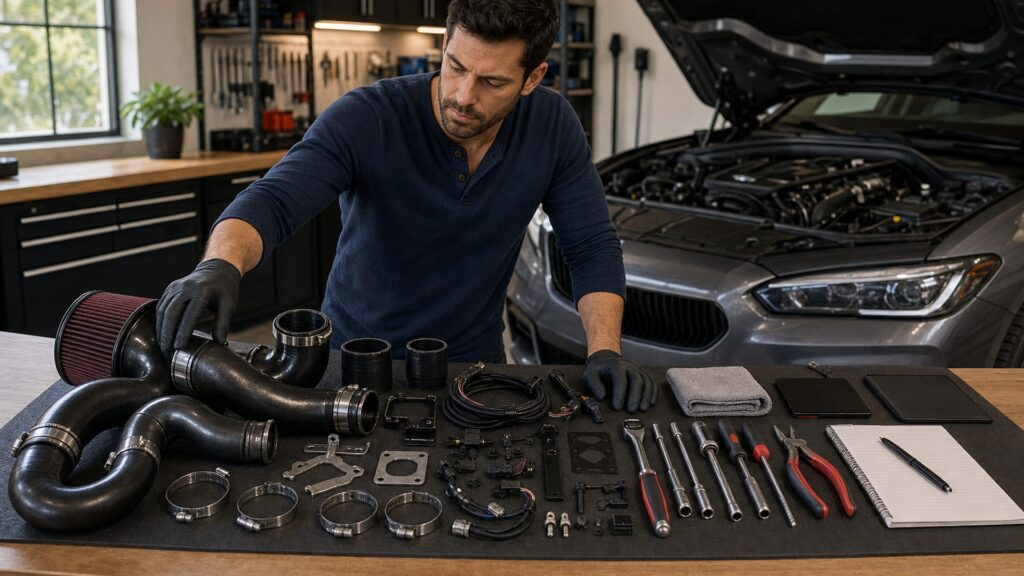
Buying framework
Scope the commissioned result, not the unopened box
Installation ends only when hardware, fluids, wiring, software, alignment, diagnostics, and functional tests meet written acceptance criteria.
Decompose the operations: List access, removal, transfer, cleaning, measurement, modification, assembly, fluid, wiring, programming, calibration, adjustment, and test steps.
Mark irreversible actions: Identify every cut, drill, weld, grind, depin, adhesive bond, security unlock, flash, and disposal of stock hardware.
Assign dependencies and owners: Match procedures, parts, fasteners, consumables, tools, specialists, calibrators, licenses, transport, and support to each operation.
Plan recovery and downtime: Define stop points, protected storage, disabled-vehicle transport, replacement lead times, rollback, and what happens when fit or software differs.
Who this is for
Match project complexity to workspace and support
Home maintenance, specialist installation, fabrication, and multi-vendor calibration demand different facilities and risk controls.
Prepared DIY installers: Choose tasks covered by their lifting, torque, measurement, electrical, fluid, programming, and diagnostic competence with safe workspace and procedures.
Shop-installed buyers: Confirm quoted scope, exclusions, subcontractors, calibration, alignment, fluids, taxes, storage, transport, warranty, and acceptance documentation.
Fabrication projects: Require measured drawings, material and process choices, fixtures, heat control, corrosion protection, inspection, and replacement strategy.
Daily-driver owners: Prioritize predictable parts availability, reversible stages, short disabled periods, quiet troubleshooting, service access, and a backup transportation plan.
What to pay attention to
Complexity metrics that predict project completion
Count distinct operations, specialty interfaces, irreversible steps, external handoffs, and commissioning tests rather than hardware pieces alone.
Build Burden
Access, labor, tools, safety, fabrication, wiring, fluids, fasteners, workspace, and downtime.
Commissioning Burden
Programming, coding, calibration, alignment, bleeding, priming, scans, logs, tests, documentation, and support.
Access and transfer work: Record panels, subframes, exhaust, cooling, hubs, interior, trim, sensors, lines, brackets, shields, and stock parts that must move.
Fastener and fluid control: Identify one-time hardware, torque-angle procedures, sealants, gaskets, thread preparation, fluid specifications, fill temperature, bleeding, and disposal.
Electrical and network work: Demand pinouts, terminal tools, fuse protection, grounds, routing, sealing, current limits, module communication, sleep behavior, and diagnostics.
Fabrication and clearance: Measure stack-up, movement, heat, steering, suspension travel, driveline angle, exhaust expansion, tool access, and corrosion treatment.
Software and acceptance: Define power supply, security access, module IDs, backups, flashing, coding, relearns, alignment, scans, logs, leak checks, road tests, and stop limits.
Avoid these traps
Project estimates that omit the work most likely to stop progress
The difficult part is often the interface after hardware placement, not the visible installation shown in marketing.
Treating bolt-on as no-adjustment: Slotted mounts, exhaust joints, belt alignment, hose routing, sensor position, preload, and clearances still require measurement and commissioning.
Ordering only the headline kit: Missing gaskets, fasteners, fluids, heat shielding, wiring, adapters, tools, alignment, or calibration can strand a disassembled vehicle.
Scheduling vendors in the wrong order: Fabrication, coating, mechanical work, wiring, alignment, programming, and calibration may depend on one another and create repeated teardown.
Skipping future service simulation: A finished layout can block filters, drains, plugs, belts, battery access, jacking, inspection, or removal of the part most likely to fail.
Decision guidance
Choose the complexity level you can actually commission
The right part fits the available facility, competence, support chain, downtime, and future service plan—not merely the budget.
If the procedure contains an unfamiliar safety-critical task: Use a qualified specialist or choose a lower-complexity design; do not learn braking, restraint, lifting, fuel, or high-voltage work by improvisation.
If several vendors share responsibility: Require exact handoff data, specifications, dates, acceptance tests, and one party responsible for resolving interface failures.
If the vehicle cannot remain disabled: Use reversible stages with verified inventory and appointments, or postpone until transport, workspace, and replacement lead times are covered.
If service access becomes poor: Choose a modular alternative or budget documented removal time and consumables rather than accepting an unmaintainable layout.
Ownership & compatibility
Preserve the information needed to service the finished build
The installation record becomes the future diagnostic map after technicians, software, vendors, and configurations change.
Create an as-built package: Store instructions, diagrams, pinouts, part and software IDs, torque values, fluids, alignments, calibration files, photos, scans, and test logs.
Inspect after commissioning: Recheck leaks, fasteners, routing, abrasion, heat exposure, clearances, fluid levels, faults, alignment, and logged limits after early heat cycles.
Plan removal before failure: Label connectors and lines, retain stock parts and tools, document access order, keep licenses transferable, and record every one-time consumable needed again.
FAQ
Performance installation complexity questions
These answers cover labor estimates, bolt-on claims, tools, fabrication, software, shops, downtime, and records.
What does bolt-on really mean?
How should I estimate installation labor?
Which tasks should not be attempted without training?
Why do some parts require calibration after physical installation?
What should a professional installation quote include?
How can I reduce project downtime?
When is custom fabrication justified?
What commissioning tests should follow a performance installation?
What records should stay with a modified vehicle?
Bottom line
Complexity is manageable when every operation has an owner
Scope the complete commissioned state, expose irreversible dependencies, and preserve the as-built record required for future service and recovery.
Count operations: Include access, fluids, wiring, fabrication, programming, calibration, alignment, and final tests.
Control the handoffs: Assign procedures, tools, specialists, dependencies, acceptance results, downtime, and escalation.
Protect future service: Maintain access, stock parts, licenses, documentation, inspection intervals, and a realistic rollback path.
Reading Shortcuts
Move from the measured problem to a documented commissioning scope that can be installed and verified.
Decision Reminders
Keep the complete commissioning scope in view while comparing parts.
- Scope: Commissioned result, not box contents.
- Access: List every removal and transfer.
- Irreversible: Mark cuts, flashes, and fabrication.
- Dependencies: Parts, tools, vendors, licenses.
- Acceptance: Scan, align, log, and inspect.
- Service: Preserve records and rollback.
Glossary Snippets
Terms that separate useful performance from apparent compatibility.
When to Use a Top 10 Review
Use a product roundup only after the required function and commissioning scope limits are known.
- Problem defined: The visibility or mobility failure is specific.
- Vehicle mapped: Interfaces and limits are documented.
- Format chosen: The correct product family is settled.
- Evidence available: Finalists can be compared on relevant tests.
Have finalists already? Open a Comparison for a closer tradeoff.
When to Use a Comparison
Compare finalists that solve the same defined commissioning scope problem on the same vehicle.
- Application: Both match the exact vehicle and function.
- Performance: Evidence addresses the operating problem.
- Integration: Mounting and system effects are understood.
- Ownership: Inspection and service demands are acceptable.
Need a broader field? Use a Top 10 to form a shortlist.