
Perfume Buying Guide: How to Choose the Right One
Choosing perfume begins with how you want to smell at a specific distance and for a realistic number of hours. Note family preferences, disliked materials, setting, climate, and budget before visiting a counter.
Smell on paper to organize candidates, then wear finalists separately on skin. The opening is only one stage; heart, base, projection, comfort, and the next-day impression all belong in the decision.
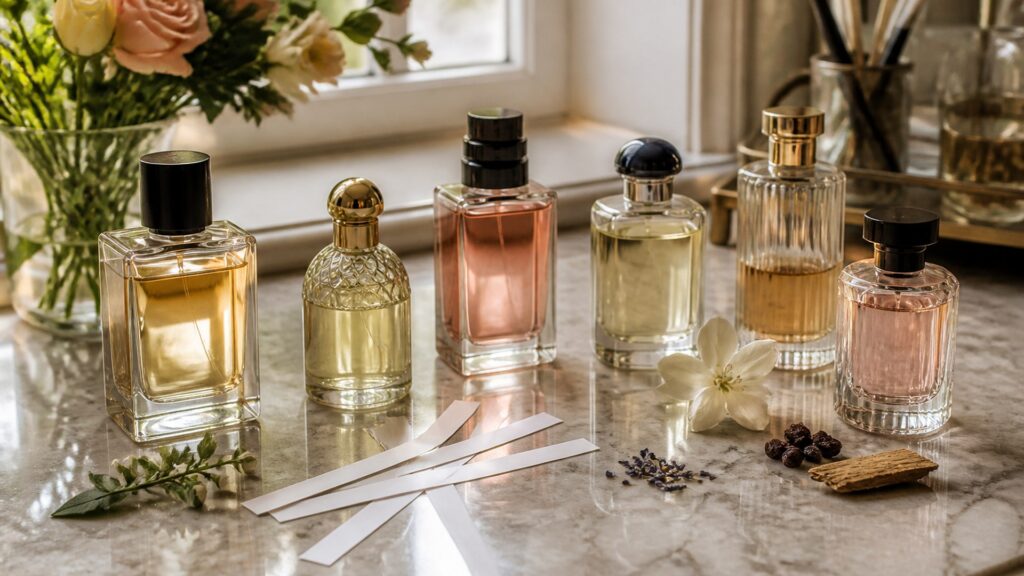
Buying framework
Define the general selection job before comparing perfumes
Build a vocabulary from concrete impressions such as dry cedar, tart citrus, powdery iris, damp earth, or warm vanilla.
Recreate the setting: Concentration names provide rough guidance, but formula design and dose often matter more than eau de parfum wording.
Write a pass condition: Test no more than a few serious candidates per visit so olfactory fatigue does not flatten meaningful differences.
Set the rejection line: Wear each finalist through commuting, meals, indoor heat, and outdoor air before judging its usefulness for real life.
Use profiles
Match the perfume to the person and frequency
Ask another person about projection at conversational distance; the wearer’s nose can adapt while the surrounding scent remains strong.
The low-maintenance buyer: Check the authorized retailer, batch condition, seal, and return policy before treating a discount as genuine value.
The careful experimenter: A versatile bottle suits recurring settings, whereas an artistic statement may justify itself through occasional but memorable wear.
The targeted upgrader: Do not buy solely for compliments, influencer enthusiasm, note lists, or an attractive opening that disappears quickly.
Specifications
Read perfume specifications through real use
Spray clothing only after checking stain risk and material guidance, since oils and dyes can mark delicate fabric.
Evidence from the first trial
Store perfume upright in a stable, dark cabinet rather than displaying it beside a sunny window or hot bathroom.
Evidence after repetition
Sample first when the bottle is costly, the composition is unfamiliar, or returns exclude opened fragrance.
Working behavior: The correct choice remains pleasant after hours, fits the intended setting, and does not require excessive dosing to feel complete.
Contact and comfort: Build a vocabulary from concrete impressions such as dry cedar, tart citrus, powdery iris, damp earth, or warm vanilla.
Package and control: Concentration names provide rough guidance, but formula design and dose often matter more than eau de parfum wording.
Common mistakes
Avoid shortcuts that distort the general selection decision
Test no more than a few serious candidates per visit so olfactory fatigue does not flatten meaningful differences.
Rewarding the loudest claim: Wear each finalist through commuting, meals, indoor heat, and outdoor air before judging its usefulness for real life.
Testing under ideal conditions: Ask another person about projection at conversational distance; the wearer’s nose can adapt while the surrounding scent remains strong.
Ignoring the boundary: Check the authorized retailer, batch condition, seal, and return policy before treating a discount as genuine value.
Decision guidance
Decide when basic, premium, or no purchase makes sense
A versatile bottle suits recurring settings, whereas an artistic statement may justify itself through occasional but memorable wear.
Choose a basic option: Do not buy solely for compliments, influencer enthusiasm, note lists, or an attractive opening that disappears quickly.
Upgrade for evidence: Spray clothing only after checking stain risk and material guidance, since oils and dyes can mark delicate fabric.
Wait when uncertainty remains: Store perfume upright in a stable, dark cabinet rather than displaying it beside a sunny window or hot bathroom.
Ownership & compatibility
Keep the perfume reliable after purchase
Sample first when the bottle is costly, the composition is unfamiliar, or returns exclude opened fragrance.
Build the reset step: The correct choice remains pleasant after hours, fits the intended setting, and does not require excessive dosing to feel complete.
Watch compatibility: Build a vocabulary from concrete impressions such as dry cedar, tart citrus, powdery iris, damp earth, or warm vanilla.
Know the retirement signal: Concentration names provide rough guidance, but formula design and dose often matter more than eau de parfum wording.
FAQ
Questions about perfumes for general selection
Test no more than a few serious candidates per visit so olfactory fatigue does not flatten meaningful differences.
What should I check first when choosing a perfume for general selection?
How long should I test the perfume?
When is a more expensive perfume worthwhile?
Bottom line
Finish the general selection choice with observable proof
Wear each finalist through commuting, meals, indoor heat, and outdoor air before judging its usefulness for real life.
Restate the actual role: Ask another person about projection at conversational distance; the wearer’s nose can adapt while the surrounding scent remains strong.
Rehearse an ordinary day: Check the authorized retailer, batch condition, seal, and return policy before treating a discount as genuine value.
Write the purchase reason: A versatile bottle suits recurring settings, whereas an artistic statement may justify itself through occasional but memorable wear.
Reading Shortcuts
Move directly to the general selection decision stage you need.
Decision Reminders
Keep the evidence for general selection visible while comparing.
- Role: The perfume serves the named task.
- Proof: The trial observes harmonious development, controlled diffusion, comfortable wear, and satisfying dry-down.
- Care: Protect the flacon from sunlight, heat, humidity, and loose caps.
Glossary Snippets
Useful language for comparing perfumes.
When a Top 10 List Helps
Use rankings to discover credible perfumes, then screen them for general selection.
- The format is undecided: A broad list reveals plausible forms and price levels.
- A shortlist is needed: Rankings narrow discovery but do not replace fit testing.
Have finalists already? Open the comparison section.
When a Direct Comparison Helps
Compare finalists after establishing their suitability for general selection.
- Two candidates remain: Side-by-side evidence exposes meaningful tradeoffs.
- An upgrade is uncertain: Compare whether added cost corrects the original weakness.
Still exploring? Start with the Top 10 section.