
Professional & Salon Beauty Products Buying Guide for Salons
A salon purchase has to succeed repeatedly, not just impress during one trial. The useful question is whether a formula, implement, dispenser, or electrical tool fits a defined service while supporting predictable application, fast station reset, controlled handling, staff consistency, and reliable replenishment. A product that adds minutes or ambiguity to every appointment can cost more than its invoice suggests.
Build the shortlist from the service menu and the room around it. Trace where stock is stored, how a dose reaches the client, what becomes single-use or reusable, how the item is cleaned, and which staff must learn the process. For powered equipment, verify the nameplate and facility requirements instead of assuming that a fitting plug settles compatibility.
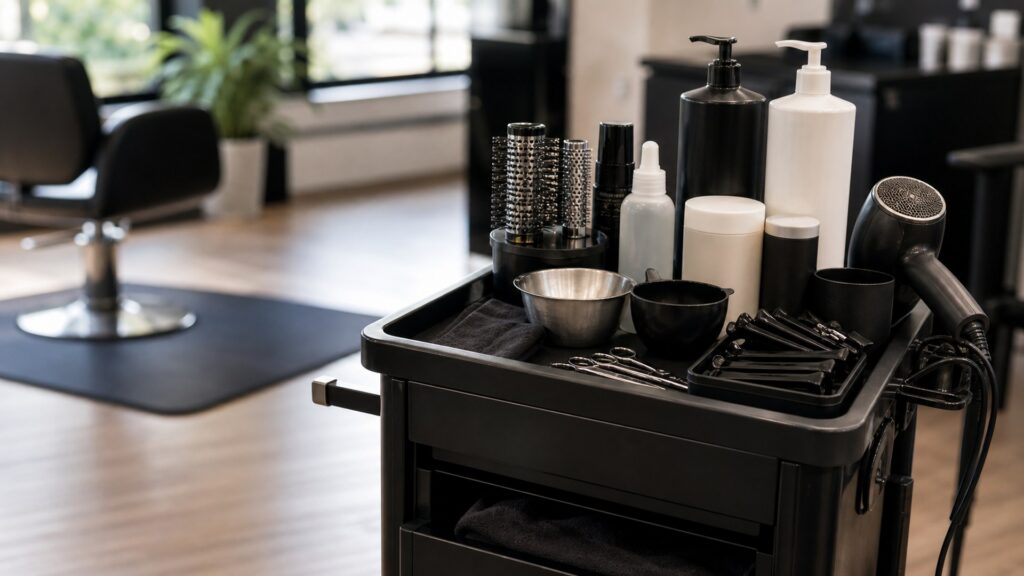
Buying framework
Start with the service path, not the catalog
Follow each product from receiving through application, reset, and reorder. This exposes labor, hygiene, facility, and supply constraints before they become recurring operating problems.
Name the billable service step: Tie the item to a preparation, application, processing, finishing, or cleanup step on the current service menu. Avoid inventory that lacks an owner, station, and repeatable purpose.
Time the entire turnover: Include dispensing, mixing, setup, client contact, cleanup, drying, and room restoration. A fast application can still create a slow chair reset.
Trace every contact point: Map hands, pumps, jars, bowls, applicators, linens, surfaces, and unused product. Choose packaging and tools that make the salon's cross-contact controls straightforward to follow.
Require a documented care path: Before buying a reusable item, locate its cleaning instructions, material limitations, and any compatible disinfection guidance. Then reconcile those directions with the item's use and applicable local requirements.
Test the facility and supply chain: Confirm storage zones, ventilation needs, electrical ratings, duty cycle, refill availability, lead time, and service support. Operational compatibility is part of product performance.
Who this is for
Different salon models expose different weak points
Service mix and workflow determine which constraints dominate. These profiles help operators identify the costs most likely to hide behind unit price.
The high-turnover styling floor: Back-to-back chairs make quick dispensing, cord control, heat-tool cooldown, and predictable reset essential. Durable pumps and equipment rated for the intended operating pattern matter more than elaborate accessories.
The private treatment room: The room must transition between consultation, service, and documented cleanup without mixing clean and used items. Closed storage, measured doses, quiet equipment, and reachable handoff surfaces deserve close scrutiny.
The multi-station color operation: Shared backbar stock creates portioning, labeling, shade-system, mixing, and reorder challenges. Favor systems that staff can dose consistently and whose companion components remain available together.
The booth-rental or shared-space salon: Responsibility for stock, cleaning, electrical loads, and tool storage may be divided among independent professionals. Purchases need clear ownership and compatibility with the facility's written rules rather than informal assumptions.
The broad-menu salon: Hair, nail, skin, or other licensed services can involve different contact classifications and room needs. Keep protocols and zones service-specific instead of forcing one storage shelf or reprocessing method across unrelated items.
What to pay attention to
Specifications become operating instructions
Salon-relevant specifications describe dose control, material limits, workflow, electrical demand, and replenishment. Read them as inputs to a written process rather than isolated selling points.
Service workflow and hygiene control
Evaluate how the product moves through dispensing, contact, cleanup, and reset.
Facility fit and supply continuity
Confirm the room, circuit, storage, staffing, and replenishment system can support repeated use.
Package access and dose control: Pumps, squeeze tubes, narrow-neck bottles, jars, sachets, and cartridges create different handling routes. Compare measured output, one-handed use, closure protection, and whether unused material can remain uncontaminated.
Usable quantity per service: Convert package volume into realistic doses, then include priming loss, mixing residual, and discard requirements. The largest container is economical only if stock is used safely within its labeled life.
Cleaning and material documentation: Look for item-specific instructions covering disassembly, detergents, water exposure, contact time, drying, and prohibited chemicals or temperatures. Vague care language leaves the salon to guess at material compatibility.
Single-use identification: Packaging should clearly distinguish disposable applicators, absorbent items, and components that are not designed for reprocessing. Budget them per service and place disposal within the workflow.
Electrical nameplate ratings: Verify voltage, frequency, input current or wattage, plug, and applicable listing information against the salon location. Adapters do not convert incompatible electrical requirements.
Duty cycle and thermal management: Continuous operation, required cooling intervals, blocked vents, and ambient heat can change equipment suitability during a full book. Compare the manufacturer's operating limits with peak appointment cadence.
Traceability and replenishment data: Lot or batch identification, expiry or period-after-opening information, case quantity, lead time, and distributor continuity support recalls, rotation, and reorder planning.
Avoid these traps
Consumer logic breaks under salon repetition
The most expensive mismatches often appear after several clients, multiple users, or a delayed shipment. Correct these assumptions before standardizing a product.
Buying bulk before measuring usage: A low price per ounce ignores expiry, open-container life, over-dispensing, and slow-moving services. Pilot the dose and weekly consumption before setting case quantities.
Treating every reusable tool alike: Materials, construction, contact type, and local rules can require different processes. Use the manufacturer's item-specific directions and the applicable classification instead of one universal soak routine.
Allowing direct access to shared jars: Repeated fingers or used applicators create an avoidable contact path. Prefer protected dispensing or establish a documented method for removing a service portion without returning product.
Training by demonstration only: A single walk-through does not preserve ratios, timing, settings, cleaning steps, or exceptions across shifts. Convert the chosen product into a concise station protocol and competency check.
Assuming the outlet settles the electrical question: A plug can fit while voltage, frequency, circuit load, ventilation, or duty cycle remains unsuitable. Compare the full nameplate and manufacturer instructions with the facility.
Decision guidance
Choose by workflow consequence
Use the service step and its highest-risk operating constraint to narrow the format. The aim is not one universal professional line, but a controlled system staff can repeat.
If several staff share backbar formulas: Favor protected pumps, tubes, or measured dispensing that can be standardized at the station. Record dose per service and prohibit returning removed product to the original container.
If appointments turn over quickly: Prioritize short, documented reset sequences, accessible cleaning surfaces, and tools that can be fully processed before the next booked use. Add duplicate implements only after confirming the complete reprocessing path.
If a service uses disposable contact items: Select clearly identified single-use applicators in pack sizes that match volume and storage. Include opening, placement, and disposal in the station protocol rather than leaving loose supplies exposed.
If equipment runs repeatedly all day: Compare nameplate ratings, duty cycle, ventilation clearances, cord placement, and service availability with peak demand. Ask a qualified professional about facility capacity when the circuit or installation is uncertain.
If the menu changes frequently: Choose smaller opening quantities, modular storage, and distributors with dependable replenishment while demand is being learned. Set reorder points only after actual service consumption and lead time are known.
If consultation reveals a condition outside scope: Do not use a product sale or service adjustment as a diagnosis. Follow licensing and salon protocols, document appropriately, and refer the client to a qualified healthcare professional when indicated.
Ownership & compatibility
Turn the purchase into a controlled salon system
Receiving the product begins the operating work. Zoning, records, training, inspection, and replenishment keep the original selection usable across staff and shifts.
Receive and rotate stock: Record supplier, date, lot or batch, expiry, and opening information where relevant. Use a clear first-expiring-first-out practice and quarantine damaged, leaking, or recalled stock.
Zone the storage: Separate unopened inventory, active backbar, cleaned implements, used items awaiting processing, chemicals, linens, and cooling electrical tools. Labels and physical boundaries should make the correct return point obvious.
Train to one documented protocol: Write the dose, sequence, settings, timers, protective steps, cleanup, and escalation points for each service use. Retrain when the product, equipment, directions, or applicable rule changes.
Inspect and maintain equipment: Follow documented cleaning and maintenance intervals, inspect cords and housings, preserve ventilation, and remove damaged equipment from use. Keep service records when required by policy, warranty, or regulation.
Set reorder points from evidence: Track services per week, usable doses, safety stock, delivery variability, and shelf life. Recalculate after seasonal menu changes rather than allowing automatic orders to accumulate excess stock.
FAQ
Salon purchasing and operations questions
These answers address shared-use controls, documentation, inventory, electrical fit, and professional boundaries.
Are professional-size containers always cheaper per salon service?
How should salons prevent cross-contact with shared products?
Can one disinfectant be used for every salon implement?
When should a salon choose single-use applicators?
What belongs in a staff product protocol?
How should a salon set product reorder points?
Does matching the plug make salon equipment compatible?
How should salons evaluate equipment duty cycle?
Where should a product consultation stop?
Bottom line
Buy the process, not only the product
The strongest salon choice supports a named service, a controllable contact path, a documented reset, and dependable supply. Price becomes meaningful only after labor, waste, training, storage, and facility demands are visible.
Anchor to the menu: Give every item a service step, owner, station, and expected rate of use.
Control shared handling: Specify dispensing, single-use boundaries, item classification, and documented reprocessing.
Verify the room: Check storage zones, ventilation, nameplate ratings, duty cycle, and circuit suitability.
Plan continuity: Train consistently, track usable doses, rotate stock, and trigger reorders from actual demand.
Reading Shortcuts
Move through the operational questions behind a salon purchase.
Decision Reminders
Keep the shortlist grounded in repeated salon use.
- Service: Tie the purchase to a named menu step.
- Turnover: Count setup, contact, cleanup, drying, and reset.
- Contact: Control shared packaging and applicator paths.
- Documentation: Require item-specific cleaning and operating instructions.
- Facility: Verify storage, ventilation, nameplate, and duty cycle.
- Supply: Set reorder points from measured use and lead time.
Glossary Snippets
Operational terms used in salon procurement.
When to Use a Top 10 Review
Use rankings after defining the service and facility constraints.
- Service fixed: Remove items without a defined menu role.
- Workflow mapped: Keep formats that support controlled turnover.
- Documents found: Confirm care and operating instructions.
- Supply checked: Compare usable cost and replenishment.
Already comparing finalists? A Comparison can isolate the operating difference.
When to Use a Comparison
Compare finalists by salon workflow, not feature count.
- Dispensing differs: Compare dose and shared contact paths.
- Reset differs: Time cleaning, drying, and storage.
- Ratings differ: Check electrical and duty-cycle demands.
- Supply differs: Model usable cost, lead time, and support.
Still exploring? Start with a Top 10 after documenting the service need.