
Resistance Bands Buying Guide for Compact Gyms
Resistance bands can pack into a small bag while requiring a much larger working area. The user, stretched elastic, handles and anchor direction all occupy space during the intended task. A shorter loop may fit a particular placement, but it does not automatically replace a longer band or reduce the clearance needed for another movement.
Identify the room’s actual constraint before choosing a compact kit. Compare useful formats, active length, accepted supports and the complete setup and put-away routine. This guide helps distinguish storage savings from working-space requirements without assuming a folded band’s dimensions describe its exercise path, or that an improvised knot is an appropriate way to make equipment fit a smaller room.
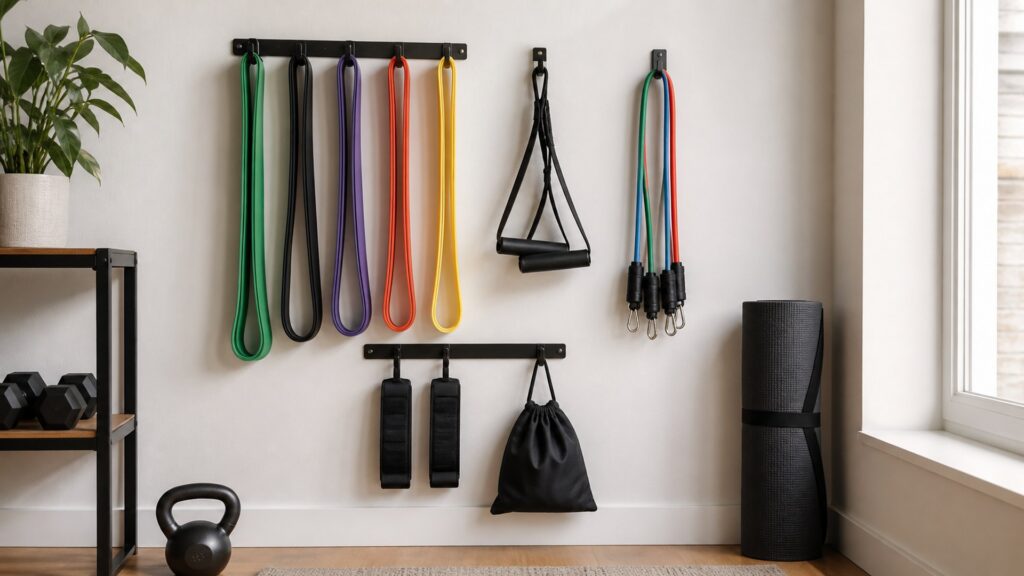
Buying framework
Measure working space before storage volume
A useful compact purchase must serve the taught task within an accepted complete arrangement.
Locate the real bottleneck: Distinguish packed storage, anchor access, elastic travel and the user’s movement path. A smaller bag changes only one of those limits and may leave the actual obstruction untouched.
Map the intended contact and direction: Identify the taught movement, relevant gripping or body placement, and whether an external support is required. Those conditions choose the format before compactness decides between suitable products.
Follow the entire elastic path: Include the unstretched arrangement, extension through the task and controlled return. The working segment must suit the actual movement within the product limits rather than be shortened solely to fit furniture.
Count the complete kit: Locate unused bands, handles, straps and accepted storage components. A room plan should include what stays behind while one band is being used and how it is put away afterward.
Who this is for
Small gyms with different band constraints
Use the actual task and support availability to choose what belongs in the compact collection.
A taught task needs a short body-contact loop: Compare the actual size and permitted placement. Its compact closed form is useful for that role, not evidence that it substitutes for every longer elastic path.
A strip or consecutive-loop form suits the contact: Check the relevant active segment and gripping instructions. A simple format can reduce accessory inventory while still needing adequate room for the actual task.
One station needs handled tubing and an anchor: Compare the complete accepted setup, not just the tube bag. Allow room for the user, elastic direction and attachment access with the station in normal use.
Suitable equipment exists but the room path fails: Reposition to an accepted arrangement or revise the intended station before replacing useful bands. A shorter product helps only if its form and travel still serve the taught task.
What to pay attention to
Six checks for compact operation
Use the actual product and room arrangement rather than a universal minimum-area rule.
Space used while working
Check active length, permitted travel, contact and the actual support direction.
Space used around the session
Account for attachment access, unused components, detachment and accepted storage.
Resting and active length: Identify the measurement convention and the segment stretched between relevant contacts. A listed loop length or full clip-to-clip tube dimension is not automatically the same as the active segment in use.
Working travel and extension limit: Compare the intended path with the product’s allowed operation. Room restrictions do not authorize extra stretch, arbitrary shortening or a different gripping arrangement.
Support location and access: Check accepted attachment height, direction and real support conditions where relevant. A door or rack can affect the room’s usable path even when the stored band itself occupies little space.
Grip, handle and loop geometry: Compare the physical contact required by the task. A shorter loop, a flat strip and a handled tube provide different contact arrangements rather than interchangeable compact versions of one product.
Routing and complete accessory contact: The Bodylastics setup manual assigns different roles to padded loops, rings and clips. That model-specific example shows why a compact-looking shortcut cannot replace the complete accepted attachment operation.
Packed kit and detached storage: Count handles, anchors and unused elastic with their accepted storage conditions. Include detachment and inspection rather than interpreting the dimensions of one folded band as the whole ownership footprint.
Avoid these traps
Compactness shortcuts that change the task
A useful saving should reduce the real constraint without creating another unresolved condition.
Comparing only carry-bag dimensions: Packed volume omits the user and elastic path. Use actual working configurations before treating portability as evidence that the task fits the room.
Choosing the shortest band regardless of contact: A short loop can be a different product role rather than a space-saving substitute. Match intended placement and usable travel before comparing lengths.
Tying or wrapping elastic to recover room: Use only length adjustments and contacts explicitly accepted for the particular product. An improvised knot or furniture wrap can change both the force arrangement and the contact conditions.
Ignoring a shared door or passage: A compact kit can still occupy access needed by other people. Establish the accepted operating arrangement and household control rather than assuming small equipment creates an unobstructed station.
Decision guidance
Choose compactness at the useful stage
Keep the correct elastic role and accepted setup inside the comparison.
Choose a short loop for its established placement: Use appropriate dimensions and level for that taught task. Accept that another movement may require a separate longer form rather than forcing the loop into a new role.
Choose a suitable strip or consecutive-loop form for simple contact: Confirm active length and allowed gripping. Fewer accessories can simplify storage, but the working path still needs to fit.
Choose a handled kit when the complete station works: Include accepted supports and every contact interface. Accept accessory storage and setup work alongside the relevant grips and resistance choices.
Keep suitable bands and change layout where that solves the problem: Preserve useful travel and contact when another accepted station is available. Buy a different format only when it serves the actual task within the real room.
Ownership & compatibility
Keep the working path available
Compact storage should support an understandable next setup rather than hide condition or mix components.
Keep band and accessory identity clear: Retain the exact chart and accepted interfaces. Store components so similar colors or clips do not obscure which system and contact arrangement they belong to.
Inspect before the next complete setup: Check elastic and contact areas under the product instructions. Resolve damage or unreliable attachments rather than compensating for them with a different short-room arrangement.
Detach and store as directed: Preserve accepted conditions and keep loose components out of the exercise path. Reassess room access when another machine, bench or stored item is added.
FAQ
Questions that product listings leave open
Resolve small-room details that packed dimensions cannot answer.
Does a loop’s listed length always mean its circumference?
Can a shorter band provide the same task just because its color matches?
Should a small room use only exercises without an anchor?
Can a door anchor be placed wherever the room leaves a gap?
Does folding a band tightly make it suitable for any drawer?
Can one band kit provide several simultaneous small stations?
Does a longer band always require more exercise space?
Will moving a bench resolve all band clearance problems?
How should two equally compact kits be compared?
Bottom line
Approve the whole compact arrangement
The final choice should solve the actual space constraint while preserving a useful task.
Measure the relevant path: Separate packed dimensions from active length, support direction and the user’s working area.
Confirm the complete accepted contact: Choose format, grips and attachments from product instructions rather than a space-saving shortcut.
Keep the useful kit proportionate: Add only the required levels and components. Retain suitable bands when an accepted layout change resolves the limitation.
Reading Shortcuts
Separate small storage from the actual working elastic path.
Decision Reminders
Checks for active length, contact and support access.
- Working path: Packed size omits user and elastic travel.
- Correct role: A short loop is not every longer band’s substitute.
- Allowed contact: Do not improvise length adjustments to fit furniture.
Glossary Snippets
Terms that distinguish packed and working dimensions.
When to Use a Top 10 Review
Shortlist useful arrangements that fit the real room.
- Compare useful formats: Match the task before the smallest bag.
- Count all components: Include anchors, handles and unused elastic.
Already down to 2-3 options? A Comparison is usually faster than reading broad buying advice.
When to Use a Comparison
Compare the stage where space is actually limited.
- Compare real access: Inspect the accepted support and household path.
- Compare operation: Follow setup, movement, return and put-away.
Still exploring? Start with a Top 10 to identify the right category first.