
Resistance Bands Buying Guide for Garage Gyms
A garage can offer useful exercise space while presenting a poor storage location for a particular resistance band. Sunlight, temperature extremes, workshop debris and sharp contacts need to be considered separately from the elastic level required by the task. An existing rack or tool-storage wall also does not automatically provide an accepted band attachment.
Evaluate where the complete kit will be kept, where it will operate and what changes when vehicles or workshop equipment return. Suitable bands may remain useful with a different storage location or documented support arrangement. This guide connects elastic condition, accepted contacts and daily garage access so the purchase solves a real limitation rather than relying on a garage-ready label.
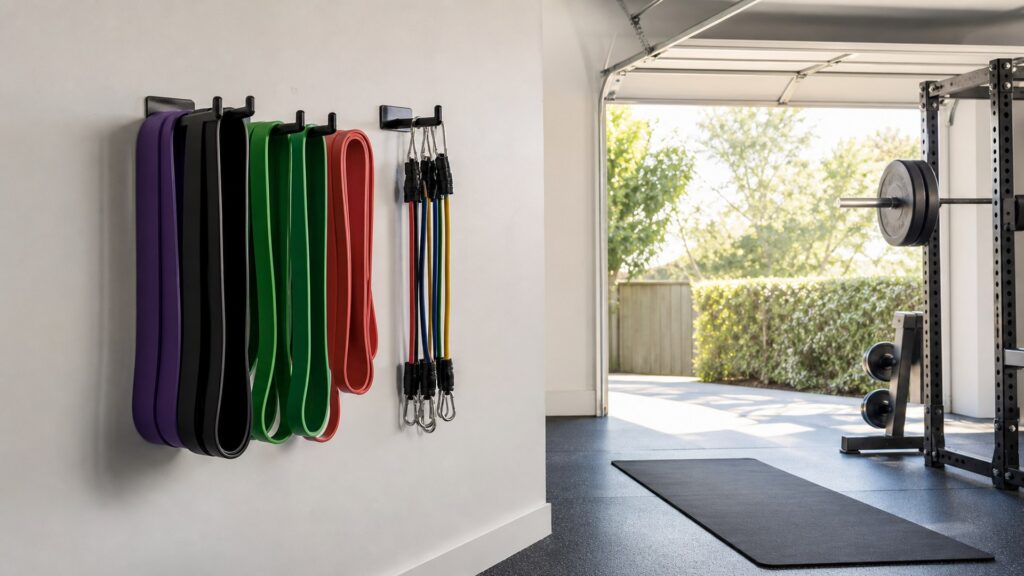
Buying framework
Separate garage use from garage storage
The equipment needs suitable conditions both during the task and between sessions.
Describe the actual exposure: Identify direct sun, heat, extreme temperatures and moisture around the proposed location. A garage name or an enclosed bag does not establish that the exact product’s storage requirements are met.
Trace contact with workshop surfaces: Look at the intended elastic path, storage edges and nearby tools or debris. A useful exercise area can still expose a band to abrasive or sharp contact that requires a different arrangement.
Identify the accepted support: Confirm the exact rack, accessory or anchor instructions where an external support is needed. Existing metalwork and convenient hooks are separate from a documented band-use arrangement.
Follow the full garage turnover: Include removing attachments, storing the kit and restoring vehicle or workshop access. A setup that works only while the garage is empty may involve more recurring work than its small bag suggests.
Who this is for
Different garage conditions lead to different purchases
Start with the task and the actual location rather than assuming a special band coating resolves everything.
A simple band serves the taught contact: Compare useful dimensions and resistance along with care requirements. Fewer separate components can simplify ownership while the elastic still needs accepted surfaces and storage conditions.
Handled tubing serves an accepted station: Compare the complete support and connector arrangement, not only the tube. Include detached storage and the practical assembly routine when the garage changes back to other uses.
An identified rack supports a documented band role: Verify the exact accepted accessory and configuration. Retain useful bands when a properly documented interface resolves the actual gap instead of treating another force level as the solution.
Garage storage cannot meet product guidance: Compare a suitable alternate location and the transfer routine. Existing bands may remain appropriate when storage changes, provided the intended use and complete condition checks are also satisfied.
What to pay attention to
Six checks for the real garage environment
Useful information connects the elastic product with exposure, contacts and recurring access.
Elastic exposure and contact condition
Compare actual storage requirements, construction and surrounding surfaces.
The occupied garage and complete setup
Compare accepted supports, working travel and daily put-away work.
Exact storage guidance: The official THERABAND professional instructions specify cool, dry storage away from direct sunlight and temperature extremes for their covered products. Check the actual model’s requirements rather than inventing one universal garage temperature threshold.
Material and construction disclosure: Identify the exact elastic and any sleeve or covering. A visible outer layer does not establish the underlying material, remove care requirements or prove acceptance for heat, sunlight or chemical exposure.
Working and stored contact surfaces: Check edges, tools and debris around both the elastic path and put-away location. Follow product-specific contact restrictions rather than assuming a coated rack or storage peg cannot cause wear.
Rack and attachment family: Rogue’s equipment-family restriction for Monster Band Peg 2.0 illustrates the need to identify the actual rack and accessory. Garage ownership does not broaden an accessory’s documented compatibility.
Usable length and force conditions: The garage still needs appropriate band geometry and resistance for the taught task. A large open floor does not determine the useful level or authorize extra stretch beyond the product’s limits.
Care and transfer routine: Check approved cleaning, detachment and storage operations alongside vehicle access. A kit stored elsewhere may add recurring transfer work while making the required storage conditions achievable.
Avoid these traps
Garage assumptions that leave ownership unresolved
A relevant feature should address an observed condition instead of creating blanket exposure permission.
Buying from a garage-ready description: Ask what the exact instructions allow. A broad setting label does not state acceptable temperature, sunlight, moisture or contact conditions for the particular elastic and components.
Treating a sleeve as maintenance-free protection: A covering changes what is visible but does not independently establish internal condition or accepted exposure. Follow inspection and care guidance for the whole product rather than judging only the outer surface.
Using workshop products as band care: A treatment intended for metal tools or a barbell is not automatically suitable for elastic. Use the band maker’s approved cleaning method rather than extending another object’s care routine to the kit.
Leaving a working arrangement across garage traffic: Vehicle, door and tool access can change the usable path after exercise. Include the complete accepted detachment and storage process rather than assuming compact elastic can remain wherever it was used.
Decision guidance
Solve the actual garage limitation
The useful outcome may involve a band, a documented interface or a different storage location.
Choose a task-matched form when conditions fit: Compare useful contact, length and resistance before adding accessories. Accept the product’s inspection and storage work even when the form itself is simple.
Choose a complete kit for a workable station: Confirm every intended support and component role, then follow its full daily operation. Accept setup and put-away work when it fits the real garage schedule.
Choose exact rack accessories where documentation supports them: Resolve the identified equipment interface without assuming a matching part approves every application. Keep rack, installation and elastic-use instructions connected to the actual configuration.
Move storage when exposure is the unresolved problem: Use an accepted alternate location and realistic transfer routine. Retain appropriate bands when a location change addresses the limitation more directly than another material or higher force label.
Ownership & compatibility
Reassess condition as the garage changes
Storage and traffic decisions need to remain appropriate after the initial purchase.
Inspect elastic and relevant contacts: The cited professional instructions require inspection and rejection of torn, punctured or nicked elastic. Use the actual product’s process and address damage rather than concealing it under a new wrap or grip.
Clean and put away by product guidance: The same instructions specify mild soap and warm water, drying and detached storage for their covered products. Treat that as a product example, not permission to apply every cleaning method to every elastic system.
Review changed garage conditions: New tools, storage shelves, seasonal exposure or a different vehicle can alter surfaces and access. Recheck the actual location and accepted operating path rather than relying on the original room plan.
FAQ
Questions that product listings leave open
Resolve storage and support details before buying a garage-specific kit.
Can bands be stored in any garage if they are inside a bag?
Does a fabric sleeve prove that elastic can tolerate direct sunlight?
Can I hang bands from an ordinary workshop tool hook?
Does owning a power rack mean a band anchor is already available?
Should garage bands be cleaned with the same products as my barbell?
Will moving storage indoors make every garage exercise arrangement acceptable?
Can a band remain attached between sessions to save time?
Is there one maximum garage temperature for all resistance bands?
Should I replace suitable bands because I changed where I train?
Bottom line
Approve the location as well as the kit
The final choice should connect a useful band role with realistic garage ownership.
Match storage to actual guidance: Check exposure and surfaces for the exact product, including any alternate storage location.
Confirm the complete working arrangement: Keep useful force and contact separate from exact rack or anchor compatibility and full garage access.
Plan recurring care and turnover: Include inspection, approved cleaning, detachment and put-away. Keep suitable bands when a location or component change solves the actual problem.
Reading Shortcuts
Connect useful band roles with real exposure and garage turnover.
Decision Reminders
Garage checks for storage, contacts and accepted supports.
- Exact conditions: A garage label does not approve exposure.
- Useful support: Identify accepted rack or anchor components.
- Recurring turnover: Include detached storage and vehicle access.
Glossary Snippets
Terms distinguishing environment from elastic level.
When to Use a Top 10 Review
Shortlist arrangements the real garage can support.
- Compare actual exposure: Use exact storage and care instructions.
- Compare practical operation: Include garage access and put-away work.
Already down to 2-3 options? A Comparison is usually faster than reading broad buying advice.
When to Use a Comparison
Compare complete use and put-away under actual conditions.
- Compare accepted contacts: Check supports and surrounding surfaces.
- Compare alternatives: Retain useful bands with a suitable storage change.
Still exploring? Start with a Top 10 to identify the right category first.