
Resistance Bands Buying Guide for Heavy Lifting
Choosing resistance bands for heavy lifting involves more than finding the largest force label. The intended strength task, band extension, grip or support contact and complete attachment arrangement determine whether that number describes anything useful. A high-resistance loop and a set of clipped tubes can reach their advertised values under different conditions and use different interfaces.
Separate the elastic requirement from the support requirement before comparing products. A band’s stated force does not rate a rack, peg, handle or anchor, and added resistance is a different role from assistance. This guide focuses on force conventions, physical band dimensions and documented equipment compatibility so the purchase addresses the actual limitation.
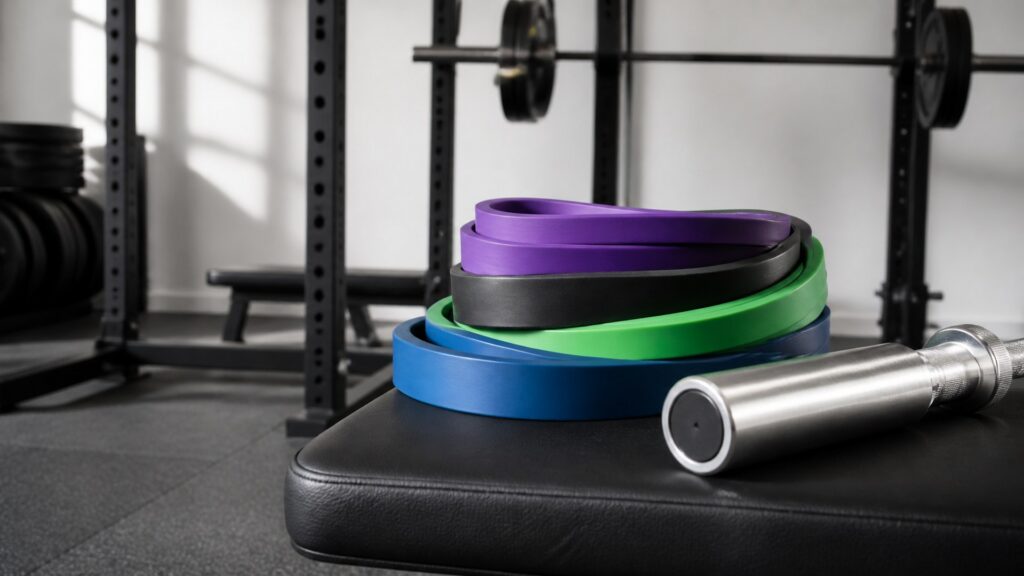
Buying framework
Identify what needs to handle the force
Evaluate the elastic and the supporting arrangement as connected but separately documented parts.
Name the actual strength role: Establish the taught application and appropriate loading. Added resistance, assistance and a standalone elastic movement use force differently; a large label cannot establish permission or suitability for all three.
Locate the real limitation: Distinguish insufficient relevant resistance from awkward contact, missing components or an unsuitable support. A stronger band does not resolve a peg mismatch or a loop that cannot be used as intended.
Read force under its stated conditions: The Rogue Monster Bands listing describes resistance as an estimate at a stated stretched condition. Compare conventions and useful extension rather than treating a nominal band value as a constant external mass.
Follow the entire force arrangement: Identify the band, contacts, connectors, support and full working path. Each relevant instruction must fit the actual configuration; a documented elastic use does not independently approve the equipment supporting it.
Who this is for
Different reasons to consider a stronger arrangement
Choose around the task and equipment evidence instead of treating high resistance as a single product class.
A documented loop application needs a useful level: Compare force reference and physical width, thickness and length. The selected loop must suit its contact arrangement as well as the appropriately established resistance requirement.
A matched tube system permits combined strands: Compare only the combinations accepted for its intended handles and connectors. More selections can be useful, while each extra strand adds identification, assembly and inspection work.
A rack-based application is already specified: Identify the exact rack and band accessory family along with installation and use instructions. Confirm that the complete arrangement serves the task before adding resistance to it.
Existing equipment has an unresolved interface: Keep the purchase focused on the actual gap. Suitable elastic may remain useful after a documented component or layout issue is resolved; more force can leave that original issue unchanged.
What to pay attention to
Six checks beyond the largest pound figure
The useful specification describes an actual elastic configuration and its accepted equipment contacts.
Elastic force and physical contact
Read the force reference alongside dimensions, active length and actual travel.
Complete equipment permission
Verify exact interfaces, accepted combinations and the supporting system separately.
Force convention and exact band identity: Check the reference condition, whether the figure describes one strand or a combination, and any stated variation. Retain exact model identification rather than relying on color or package totals.
Physical width and thickness: The Monster Bands range uses different band cross-sections within a common listed loop length. Wider or thicker elastic changes the physical contact to evaluate even before force suitability is considered.
Relevant length and complete travel: Check the active segment and extension throughout the intended task within exact product limits. The strongest listed level can still be unsuitable when its geometry conflicts with the required movement.
Peg and rack family compatibility: Rogue’s Monster Band Peg 2.0 page restricts that accessory to specified Monster equipment and excludes Monster Lite, Infinity and Econ. A peg fitting a hole is not equivalent to documented system compatibility.
Accepted connector and combination roles: For clipped systems, establish the intended handle, ring and attachment arrangement and any allowed combined use. A kit containing several bands does not itself authorize attaching all of them together.
Contact surfaces and replaceable parts: Identify where the elastic meets a grip, peg or anchor and how those areas are inspected. Useful replacement information matters when a damaged interface could otherwise make the remaining kit difficult to use correctly.
Avoid these traps
High-resistance comparisons that miss the constraint
Keep force marketing from standing in for task suitability or equipment documentation.
Using a band label as a support rating: The force reference describes the elastic under stated conditions. It does not certify a rack, anchor, floor installation or connector for the complete arrangement being considered.
Treating every band peg as interchangeable: Accessory families can have explicit exclusions despite visual similarity. Identify the exact supporting equipment and its accepted parts instead of judging compatibility from hole diameter or appearance alone.
Adding strands because the clips still close: An accepted combination needs the system’s instructions, intended contacts and useful force conditions. Remaining space in a connector cannot establish that another strand belongs in the assembly.
Solving difficult contact with more resistance: A wide loop, cramped grip or unsuitable routing is a geometry problem. Compare appropriate contact arrangements before increasing force or improvising a fold, knot or wrap.
Decision guidance
Buy the component that resolves the actual gap
Choose a stronger arrangement only when its full operation remains appropriate.
Choose a single suitable loop for a documented role: Confirm dimensions, contact and relevant force conditions. Accept its particular geometry rather than assuming one very strong loop can replace several distinct forms or loading arrangements.
Choose accepted combined tubing for useful selections: Use the exact system’s permitted components and combinations. Accept the extra connector and recordkeeping work when those selections fill a real appropriately established resistance gap.
Choose rack accessories for the identified equipment: Follow the complete equipment and installation requirements. A matching accessory can resolve a specific interface without independently establishing every banded exercise or loading condition.
Retain a suitable band when force is not the problem: Resolve documented contact or support shortcomings first. Another elastic level is useful when the actual task needs it, not merely because the existing setup is inconvenient.
Ownership & compatibility
Maintain the whole high-resistance arrangement
Elastic identity and attachment condition remain relevant after the initial compatibility check.
Inspect working contacts and elastic: Use the exact guidance for band surfaces, connectors and supports. Address damage through the relevant replacement process rather than moving the contact to hide wear or adding another wrap.
Keep a complete configuration record: Retain band identity, accepted combinations and the force reference used for comparison. Replacing one apparently similar strand or connector can change the documented arrangement.
Recheck equipment changes: A different rack, peg family, handle or anchor needs its own compatibility review. An arrangement accepted on the previous equipment does not automatically transfer to a new support.
FAQ
Questions that product listings leave open
Resolve force and equipment details before choosing a larger label.
Does a band marked with a pound value reproduce that barbell load?
Does a higher force label mean a thicker band in every range?
Can a peg be used on any rack with a matching hole?
Is an accepted band peg enough to approve the complete station?
Can I combine two loops because a tube kit permits stacking?
Does more resistance always provide more useful pull-up assistance?
Can I shorten the band to get its advertised force sooner?
Should all bands in a matched pair have the same color?
What if the seller does not publish the force reference?
Bottom line
Confirm force, contact and support together
A useful heavy-lifting purchase answers a specific elastic or equipment requirement.
Establish the role and relevant force: Keep added resistance and assistance distinct and compare stated reference conditions.
Check the complete geometry: Include band dimensions, active length, intended contacts and full travel within product instructions.
Document every equipment interface: Use exact compatible support components and permitted combinations. Retain suitable elastic when another part is the actual limitation.
Reading Shortcuts
Separate the elastic requirement from equipment compatibility.
Decision Reminders
High-resistance checks covering force conditions and actual contacts.
- Force scope: A band value does not rate its support.
- Exact family: Confirm rack and accessory compatibility.
- Complete path: Check contact and travel at the chosen level.
Glossary Snippets
Terms for comparing an identified complete arrangement.
When to Use a Top 10 Review
Shortlist products for a documented strength role.
- Compare useful force: Keep the stated extension convention visible.
- Compare physical contact: Include width, thickness and intended routing.
Already down to 2-3 options? A Comparison is usually faster than reading broad buying advice.
When to Use a Comparison
Compare reference conditions and accepted supporting equipment.
- Compare complete systems: Verify each relevant equipment interface.
- Compare ownership work: Count contacts and permitted combinations.
Still exploring? Start with a Top 10 to identify the right category first.