
Safety & Emergency Gear Buying Guide for Family Vehicle Safety
Family vehicle safety is a repeated-use system, not a one-time equipment purchase. The correct restraint depends on the child’s age and size, its own limits, the vehicle seating position, belt or anchor instructions, airbag zones, and whether every caregiver can reproduce the installation and harness fit.
Create an occupant map for each regular vehicle. Record restraint stage, seating position, installation method, tether use, medical needs, emergency contacts, and who checks children. Keep children in the appropriate stage until they outgrow its stated limits, and seek certified child passenger safety help when needed. Add accessible warmth, water, medication, communication, pet control, and secured cargo without placing loose equipment in occupant space. Reassess after growth, recalls, crashes, vehicle changes, and caregiver handoffs.
Buying framework
Map every occupant, seat, and caregiver
Family safety becomes reliable when restraint fit, vehicle installation, daily use, medical needs, and handoffs are documented for each person.
Create the occupant record: List age, height, weight, development, medical and sensory needs, restraint limits, emergency contacts, and safe caregiver instructions.
Map the vehicle seating positions: Check belts, lower anchors, tether anchors, head restraints, airbags, seat contour, buckle access, adjacent restraints, and manual restrictions.
Separate installation from daily use: Verify belt or lower-anchor installation, recline and tether, then teach harness height, snugness, chest clip, buckle, clothing, and visual checks.
Plan changing situations: Cover carpools, grandparents, rideshares, travel seats, school pickup, rental vehicles, roadside waits, heat, medication, and replacement after crashes.
Who this is for
Choose systems that every family caregiver can use correctly
Infants, growing children, teens, pregnant occupants, older adults, disabilities, and pets require distinct fit and supervision.
Infants and young children: Select age- and size-appropriate rear-facing or harnessed restraints that fit the vehicle and can be installed and used correctly every trip.
Booster-age children: Continue the appropriate booster until the adult belt fits correctly in the specific seating position and the child can maintain position throughout the ride.
Passengers with medical or mobility needs: Coordinate appropriate restraint, transfer, medication, equipment securement, emergency information, and professional guidance without improvising safety-system modifications.
Families traveling with pets: Use a vehicle-appropriate restraint or contained area, protect egress and child-seat access, secure food and supplies, and never rely on an unrestrained animal during a crash.
What to pay attention to
Family safety specifications measured by correct repeatable use
Crash protection depends on fit, installation, occupant positioning, compatibility, and behavior—not added padding or a longer accessory list.
Occupant Protection
Restraint stage, harness or belt fit, seating position, airbags, tether, anchors, head support, and daily use.
Emergency Continuity
Caregiver information, communication, medical needs, temperature, roadside shelter, egress, pets, cargo, recalls, and replacement.
Child and product limits: Verify mode-specific height, weight, age guidance, torso or fit requirements, harness slots, crotch buckle, recline, expiration, and manufacturer instructions.
Vehicle installation path: Confirm allowed seating position, seat belt locking, lower-anchor and tether locations and limits, seat geometry, buckle behavior, airbags, and neighboring-seat interaction.
Daily harness or belt fit: Check flat straps, correct height, snugness, chest-clip position where present, lap and shoulder path, coat bulk, posture, and buckle access.
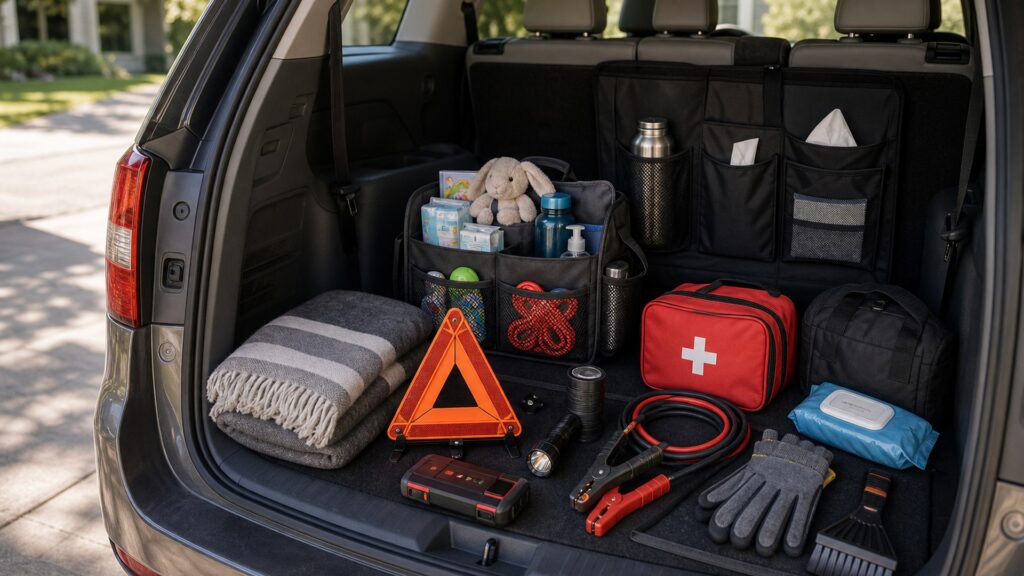
Cargo and equipment restraint: Secure strollers, tools, emergency kits, mobility devices, tablets, pet carriers, bottles, and sports equipment so they cannot strike occupants or block exits.
Recall and crash lifecycle: Register restraints, monitor vehicle and product recalls, follow manufacturer and NHTSA crash-replacement guidance, track expiration, and document hand-me-down history.
Avoid these traps
Family safety products that create confidence without correct use
Convenience accessories, early transitions, and inconsistent caregivers can undermine a compliant restraint and vehicle safety system.
Moving to the next stage too early: Keep children in the current appropriate restraint mode until they exceed its stated limits rather than advancing for convenience or age alone.
Adding unapproved accessories: Pads, clips, covers, mirrors, protectors, toys, and routing devices can alter fit, introduce projectiles, or conflict with restraint instructions.
Assuming one installation works in every car: Seat contours, belts, anchors, airbags, buckle geometry, head restraints, and adjacent passengers differ across vehicles and seating positions.
Leaving family gear unsecured: A stroller, water bottle, tablet, tool kit, pet, or grocery item can become a projectile, obstruct a buckle, or block emergency egress.
Decision guidance
Choose the restraint and plan caregivers can repeat correctly
The best product fits the child, vehicle, seating position, and real family routine with clear instructions and available inspection help.
If two restraints compete for space: Test approved configurations in the actual vehicle, preserve independent secure installation and buckle access, and avoid forcing products beyond instructions.
If a caregiver cannot reproduce use: Simplify the approved setup, label noncritical reminders without altering equipment, provide hands-on teaching, and schedule a certified child passenger safety check.
If the adult belt does not fit correctly: Continue an appropriate booster within its limits in that seating position rather than allowing the child to slouch, route the belt incorrectly, or move prematurely.
If emergency supplies crowd occupants: Reduce and relocate restrained cargo while keeping critical medication, communication, and identification accessible; never trade crash safety for kit volume.
Ownership & compatibility
Recheck family safety whenever people or routines change
Growth, seasonal clothing, new caregivers, school schedules, travel, crashes, recalls, and different vehicles can invalidate yesterday’s setup.
Run monthly fit checks: Review child growth, restraint mode and limits, installation movement at the belt path, tether, harness or belt fit, wear, labels, and missing parts.
Standardize caregiver handoffs: Share written contacts, medical needs, pickup authority, restraint instructions, keys, location tools, roadside plan, and who confirms every occupant is present.
Review after events: Check recalls and manufacturer guidance after crashes, drops, contamination, damaged parts, lost labels, vehicle repair, airbag work, or an unknown-use history.
FAQ
Family vehicle safety questions
These answers cover restraint stages, installation, boosters, caregivers, coats, recalls, crashes, pets, and cargo.
How do I choose the right car seat for my child?
How long should a child remain rear-facing?
Should I install a car seat with lower anchors or the seat belt?
Why is the top tether important for a forward-facing seat?
When is a child ready to stop using a booster?
Can a child wear a thick winter coat in a harness?
Should a car seat be replaced after a crash?
How should grandparents or other caregivers be prepared?
How should pets and family cargo be secured?
Bottom line
Family vehicle safety succeeds on every ordinary trip
Fit each occupant, install according to both manuals, teach every caregiver, secure everything else, and review the system whenever the family changes.
Map the people and seats: Match age, size, needs, restraint mode, vehicle position, anchors, belts, airbags, and neighboring occupants.
Make use repeatable: Separate installation from daily fit, train caregivers, register products, and use certified inspection support.
Control every change: Review growth, clothing, cargo, pets, recalls, crashes, vehicles, medical needs, and caregiver handoffs.
Reading Shortcuts
Move from the credible risk to a documented occupant safety map that can be maintained and verified.
Decision Reminders
Keep the complete occupant safety map in view while comparing equipment.
- Occupant: Age, size, development, needs.
- Vehicle: Seat, belt, anchors, airbags.
- Use: Installation and daily fit differ.
- Caregiver: Every adult repeats the plan.
- Cargo: Restrain gear and pets.
- Review: Growth, recalls, crashes, changes.
Glossary Snippets
Terms that separate useful performance from apparent compatibility.
When to Use a Top 10 Review
Use a product roundup only after the required capability and occupant safety map limits are known.
- Problem defined: The visibility or mobility failure is specific.
- Vehicle mapped: Interfaces and limits are documented.
- Format chosen: The correct product family is settled.
- Evidence available: Finalists can be compared on relevant tests.
Have finalists already? Open a Comparison for a closer tradeoff.
When to Use a Comparison
Compare finalists that solve the same defined occupant safety map need for the same vehicle and occupants.
- Application: Both match the exact vehicle and function.
- Performance: Evidence addresses the operating problem.
- Integration: Mounting and system effects are understood.
- Ownership: Inspection and service demands are acceptable.
Need a broader field? Use a Top 10 to form a shortlist.