
Safety & Emergency Gear Buying Guide for Nighttime Breakdown Scenarios
Darkness changes detection and judgment. A stopped vehicle may blend into the background until headlights reach it, while glare from an exposed work light can erase depth cues and hide approaching traffic. A dead vehicle battery can remove hazards, cabin light, charging, and communication together.
Prepare separate systems for being seen, seeing a task, and contacting help. First reach the safest practical location and assess whether anyone should exit. Use vehicle hazards when appropriate, but keep independent reflective and powered visibility. Store a low-glare hands-free light and charged communication within reach. Practice describing road, direction, mile marker or coordinate, shoulder side, vehicle, occupants, and hazards. Night repair is optional; protected waiting and professional assistance are often safer.
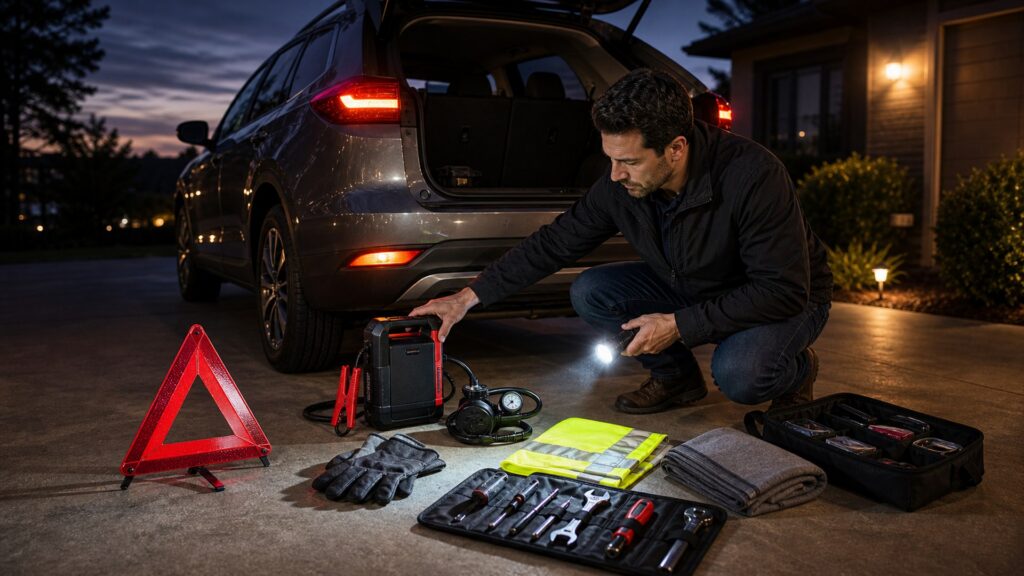
Buying framework
Separate visibility, task light, and communication
Each job needs its own power, placement, and safe-use rule so one failure or bright source does not remove the entire response.
Control and stop: Respond smoothly, use appropriate signals, and reach the safest practical visible location without abrupt action or continuing on damaged equipment.
Assess before exiting: Consider traffic speed, shoulder, curves, barriers, darkness, weather, fire, crime risk, injuries, and official guidance.
Establish independent light and contact: Keep accessible reflective visibility, battery warning light, hands-free task light, phone power, and location information outside one vehicle-battery failure.
Choose protected waiting: Use restraints or a safer external location as conditions require, maintain communication, conserve power, and avoid exposed repairs that darkness makes harder.
Who this is for
Night risks change by roadway and occupants
Urban shoulders, rural darkness, motorcycles, families, work vehicles, and mobility needs require different detection and waiting strategies.
High-speed highway drivers: Prioritize rapid accurate calls, protected waiting, multi-angle vehicle visibility, and avoiding marker placement or repair near live traffic.
Rural night travelers: Add longer independent runtime, location backup, weather shelter, coverage-aware communication, and verified roadside response expectations.
Families and vulnerable travelers: Keep warmth, medicine, light, contact information, restraint continuity, and reassurance accessible without sending occupants outside into traffic.
Work and delivery drivers: Coordinate required warning devices, high-visibility PPE, fleet contact, cargo hazards, customer locations, and company nighttime incident procedures.
What to pay attention to
Nighttime visibility specifications that support recognition
Maximum lumens alone cannot describe viewing angle, glare, reflection, runtime, stability, controls, and safe placement.
Be Seen
Vehicle lights, retroreflection, active beacons, garments, viewing angle, stability, weather, traffic, and placement.
See and Communicate
Beam pattern, color rendering, glare, hands-free use, power, location, contacts, weather shelter, and runtime.
Reflective performance: Assess clean reflective area, orientation, approach angles, folds, garment coverage, headlight dependence, weather, and secure storage.
Active warning light: Compare intensity modes, horizontal and vertical viewing, flash pattern, stability, magnet or mount limitations, runtime, ingress protection, and controls.
Task beam: Choose broad controlled close-range light, stable hands-free aim, low mode, glove operation, battery state, and placement that avoids blinding traffic or the user.
Power architecture: Use charged vehicle and independent sources, compatible cables, protected spare cells where appropriate, storage-temperature compliance, and a rotation schedule.
Location communication: Prepare road and direction, nearest exit, marker, coordinate, shoulder side, vehicle description, occupant status, active hazards, callback number, and destination needs.
Avoid these traps
Nighttime visibility gear that creates a false safe zone
Light can improve detection but cannot stop an impaired, distracted, or fast driver from entering the shoulder.
Walking downstream to place devices automatically: Darkness and traffic may make deployment more dangerous than remaining protected; follow applicable rules and scene guidance.
Aiming a work light toward traffic: Uncontrolled glare can reduce visual information for approaching drivers and destroy the user’s dark adaptation.
Depending on phone flash alone: It occupies the communication device, offers limited runtime and hands-free control, and can leave the user without light during a call.
Storing all batteries at zero maintenance: Self-discharge, cold, heat, corrosion, swelling, and forgotten use can disable every nominally independent light together.
Decision guidance
Choose equipment that improves detection without increasing exposure
Prioritize a safe stop and accurate call, then add independent visibility and task light that can be used from protected positions.
If the shoulder offers no separation: Communicate the immediate traffic hazard and follow emergency guidance rather than leaving the vehicle to stage equipment.
If the vehicle electrical system is failing: Conserve critical functions and switch communication and visibility to maintained independent power before the cabin becomes fully dark.
If glare hides the scene: Lower and shield task light, use a wider low-output beam, move reflective surfaces, and stop the task when traffic awareness is compromised.
If location is uncertain: Use multiple clues—road, direction, recent exit, marker, map coordinate, landmark, and vehicle description—before a responder is dispatched.
Ownership & compatibility
Maintain nighttime equipment in darkness, not at a desk
A daylight inventory cannot reveal confusing controls, reflected glare, low battery, unstable placement, or unreachable storage.
Run a parked night drill: From normal seats, activate hazards, retrieve phone power and lights, read labels, share location, don reflective gear, and access weather supplies.
Inspect power and optics: Clean lenses and reflectors, charge or replace cells, check corrosion and swelling, test every mode and runtime, and verify storage-temperature limits.
Revise after use: Record unsafe glare, poor angles, weak signal, confusing controls, inaccessible items, depleted power, response delays, and vehicle-battery behavior before repacking.
FAQ
Nighttime breakdown safety questions
These answers cover visibility, warning lights, reflective equipment, flashlights, power, location, waiting, repairs, and night drills.
What should I do first if my vehicle breaks down at night?
Are flashing beacons safer than reflective triangles?
How bright should an emergency flashlight be?
Should I wear a reflective vest during a roadside incident?
How can I keep lights working if the car battery dies?
What location details help responders find me at night?
Is it safe to change a tire at night?
Should passengers remain inside during a nighttime breakdown?
How should nighttime emergency lights be tested?
Bottom line
At night, visibility supports judgment—it does not replace it
Stop as safely as possible, call accurately, use independent low-glare equipment, and minimize every moment occupants spend exposed to traffic.
Separate the jobs: Use distinct systems for vehicle conspicuity, personal visibility, task lighting, communication, and backup power.
Control glare and exposure: Place and aim equipment for recognition without blinding anyone or creating unnecessary roadside movement.
Practice after dark: Verify access, runtime, angles, location messages, protected waiting, and the decision to call rather than repair.
Reading Shortcuts
Move from the credible risk to a documented dark-scene response that can be maintained and verified.
Decision Reminders
Keep the complete dark-scene response in view while comparing equipment.
- Stop: Control first, then assess.
- Seen: Multi-angle reflection and active light.
- See: Low-glare hands-free task beam.
- Power: Independent and maintained sources.
- Locate: Direction, marker, coordinate, hazards.
- Wait: Protection often beats night repair.
Glossary Snippets
Terms that separate useful performance from apparent compatibility.
When to Use a Top 10 Review
Use a product roundup only after the required capability and dark-scene response limits are known.
- Problem defined: The visibility or mobility failure is specific.
- Vehicle mapped: Interfaces and limits are documented.
- Format chosen: The correct product family is settled.
- Evidence available: Finalists can be compared on relevant tests.
Have finalists already? Open a Comparison for a closer tradeoff.
When to Use a Comparison
Compare finalists that solve the same defined dark-scene response need for the same vehicle and users.
- Application: Both match the exact vehicle and function.
- Performance: Evidence addresses the operating problem.
- Integration: Mounting and system effects are understood.
- Ownership: Inspection and service demands are acceptable.
Need a broader field? Use a Top 10 to form a shortlist.