
Safety & Emergency Gear Buying Guide for Roadside Emergency Prep
The first roadside task is not opening a tool kit. It is controlling the vehicle, reaching the safest practical location, protecting occupants from traffic and fire, and communicating where help is needed. A narrow shoulder, blind curve, extreme weather, or damaged high-voltage system can make self-help unreasonable.
Rehearse the incident sequence for the roads you use: recognize the problem, signal, stop, assess, call, and choose whether to wait or act. Verify the vehicle’s tire equipment, jack points, wheel hardware, battery procedure, tow provisions, and roadside coverage. Store immediate light, phone power, medical information, and visibility gear within reach. Use mechanical tools only when the scene, procedure, ground, weather, and your competence support the task safely.
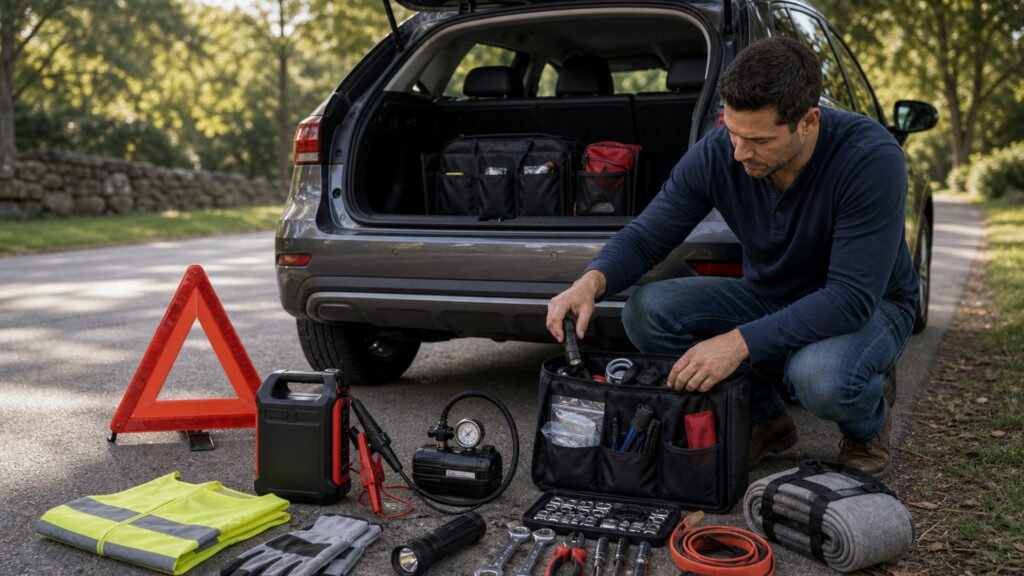
Buying framework
Prepare for the roadside sequence, not one repair
Equipment should support a controlled stop, protected occupants, an accurate call, safe assessment, and a clean professional handoff.
Recognize and control: Respond to warnings, tire change, smoke, vibration, or power loss without abrupt steering or braking; follow the vehicle’s emergency guidance.
Stop in the safest practical place: Consider shoulder width, barrier, curve, slope, traffic speed, fire, weather, visibility, and whether remaining in the lane creates greater danger.
Protect and communicate: Use restraints, hazards, appropriate visibility, precise location, occupant status, vehicle description, and hazards before considering outside work.
Choose self-help or handoff: Attempt only a documented compatible task when scene and skill permit; otherwise give roadside or emergency responders complete information.
Who this is for
Match roadside equipment to roads and vehicle systems
Dense highways, rural routes, vehicles without spares, EVs, and mobility-limited occupants create different response constraints.
Highway commuters: Prioritize safer waiting, hands-free location communication, conspicuity without lane exposure, rapid roadside coverage, and avoiding repairs near fast traffic.
Rural drivers: Add route location practice, extended water and weather supplies, stronger communication resilience, realistic response time, and vehicle-specific tire capability.
Vehicles without full-size spares: Understand sealant and compressor limits, run-flat instructions, tow requirements, replacement availability, and damage that requires professional transport.
EV and hybrid drivers: Follow manufacturer high-voltage, lifting, tire, battery, neutral, towing, fire, and shutdown guidance; generic jump or tow assumptions can cause damage or injury.
What to pay attention to
Roadside gear specifications tied to safe deployment
Compatibility, reach, visibility, operating range, and instructions determine whether equipment helps during a real stop.
Scene Control
Stopping, traffic separation, conspicuity, lighting, communication, location, occupants, and emergency escalation.
Vehicle Mobility
Tires, inflation, jack and wheel tools, battery procedure, basic diagnostics, tow method, key access, and destination.
Visibility system: Compare reflective and active output, viewing angle, stability, weather resistance, runtime, activation, mounting, and whether placement avoids traffic exposure.
Tire capability: Inventory spare or mobility kit, inflator duty, gauge, sealant limits and date, jack, base, wheel tool, lock key, torque procedure, and damaged-tire exclusions.
Battery-start equipment: Match vehicle voltage and battery type, connection points, reverse-polarity protection, charge state, cable reach, temperature range, and manufacturer procedure.
Location and power: Keep charged communication, vehicle charger, backup energy, offline location methods, roadside numbers, medical information, and a practiced concise incident message.
Towing readiness: Record drivetrain, ground-clearance, parking release, neutral procedure, tow mode, designated points, key needs, destination, and any flatbed or dollies requirement.
Avoid these traps
Roadside preparations that increase exposure or delay help
Repair-focused buying can overlook the traffic scene, unavailable vehicle interfaces, and information a responder actually needs.
Beginning work before scene assessment: A usable jack or inflator does not make a shoulder stable, visible, level, separated from traffic, or safe in severe weather.
Buying universal tire tools: Wheel hardware, lock keys, jack points, ground clearance, spare fit, TPMS, sealant limits, and torque procedures vary by vehicle.
Standing behind the disabled vehicle: Approaching traffic can strike the vehicle or occupants; choose protected positions and follow official guidance for the specific roadway and incident.
Calling without location details: A road name alone may not identify carriageway, direction, nearest exit, mile marker, coordinate, landmark, shoulder side, or active hazard.
Decision guidance
Choose gear that shortens exposure and improves the handoff
The best roadside purchase helps occupants reach qualified assistance without creating a more dangerous work zone.
If the shoulder is narrow or traffic is fast: Stay protected as advised, call emergency or roadside services, communicate exact location and hazards, and avoid exposed repair or marker placement.
If tire damage exceeds the mobility system: Do not inject sealant or inflate when prohibited; arrange appropriate towing and provide tire size, vehicle clearance, drivetrain, and destination details.
If the vehicle will not start: Check safe obvious conditions and follow the exact battery procedure; stop for damage, odor, heat, high-voltage warning, or uncertain connection points.
If occupants cannot wait safely: Escalate for temperature, medical, traffic, fire, water, violence, or accessibility risk rather than treating the incident as an ordinary delayed tow.
Ownership & compatibility
Audit the roadside system with the actual vehicle
Tire changes, new phones, expired sealant, missing adapters, battery aging, and changed coverage can quietly invalidate the plan.
Run a parked inventory drill: Locate and identify the spare or sealant, jack points, tools, lock key, battery points, tow information, charging, lights, contacts, and storage access.
Inspect seasonally and before trips: Check charge, runtime, seals, dates, tire pressure, inflator, jack, corrosion, clothing, water, medications, documents, coverage, recalls, and weather suitability.
Update after every incident: Replace consumables, recharge devices, inspect used tools, record delays and unsafe assumptions, revise the handoff record, and repair the vehicle fault fully.
FAQ
Roadside emergency preparation questions
These answers cover safer stopping, warning devices, tires, batteries, towing, location, waiting, and professional assistance.
Where should I stop during a vehicle emergency?
Should I stay inside a disabled vehicle?
Are roadside warning lights better than reflective triangles?
Can tire sealant repair every flat?
What should a portable jump starter match?
What information should I give roadside assistance?
Do I need a full-size spare tire?
How can I wait safely in extreme weather?
When should I call emergency services instead of roadside assistance?
Bottom line
Roadside preparation should reduce time in danger
Control the stop, protect occupants, communicate precisely, and use vehicle tools only when the scene and procedure make self-help safe.
Stop deliberately: Vehicle control and the safest practical location come before opening the kit.
Call accurately: Share direction, marker, hazards, occupants, vehicle details, and required tow or repair support.
Limit exposure: Avoid unsafe roadside work, maintain the equipment, and hand the incident to qualified help when conditions demand it.
Reading Shortcuts
Move from the credible risk to a documented roadside sequence that can be maintained and verified.
Decision Reminders
Keep the complete roadside sequence in view while comparing equipment.
- Control: Respond smoothly and stop safely.
- Traffic: Exposure decides outside activity.
- Location: Direction, marker, landmark, hazard.
- Vehicle: Match tire, battery, and tow procedures.
- Handoff: Prepare coverage and vehicle details.
- Audit: Seasonal checks and parked drills.
Glossary Snippets
Terms that separate useful performance from apparent compatibility.
When to Use a Top 10 Review
Use a product roundup only after the required capability and roadside sequence limits are known.
- Problem defined: The visibility or mobility failure is specific.
- Vehicle mapped: Interfaces and limits are documented.
- Format chosen: The correct product family is settled.
- Evidence available: Finalists can be compared on relevant tests.
Have finalists already? Open a Comparison for a closer tradeoff.
When to Use a Comparison
Compare finalists that solve the same defined roadside sequence need for the same vehicle and occupants.
- Application: Both match the exact vehicle and function.
- Performance: Evidence addresses the operating problem.
- Integration: Mounting and system effects are understood.
- Ownership: Inspection and service demands are acceptable.
Need a broader field? Use a Top 10 to form a shortlist.