
Safety & Emergency Gear Buying Guide for Storage and Access
Emergency storage is part of safety. A heavy tool box behind a passenger can injure occupants, while a phone battery, medication, or glass tool may fail after months of heat. The best container is irrelevant if luggage blocks it or a damaged hatch will not open.
Assign every item a response window before choosing organizers. Keep communication, light, medical information, and any supported egress item reachable from the appropriate seat or safe exit. Restrain heavier supplies low and away from occupants. Separate water and food from fuel, chemicals, wet gear, batteries, and sharp tools. Label stable modules and test retrieval at night with normal passengers and cargo. Inspect temperature exposure, dates, charge, corrosion, leaks, and missing items on a calendar.
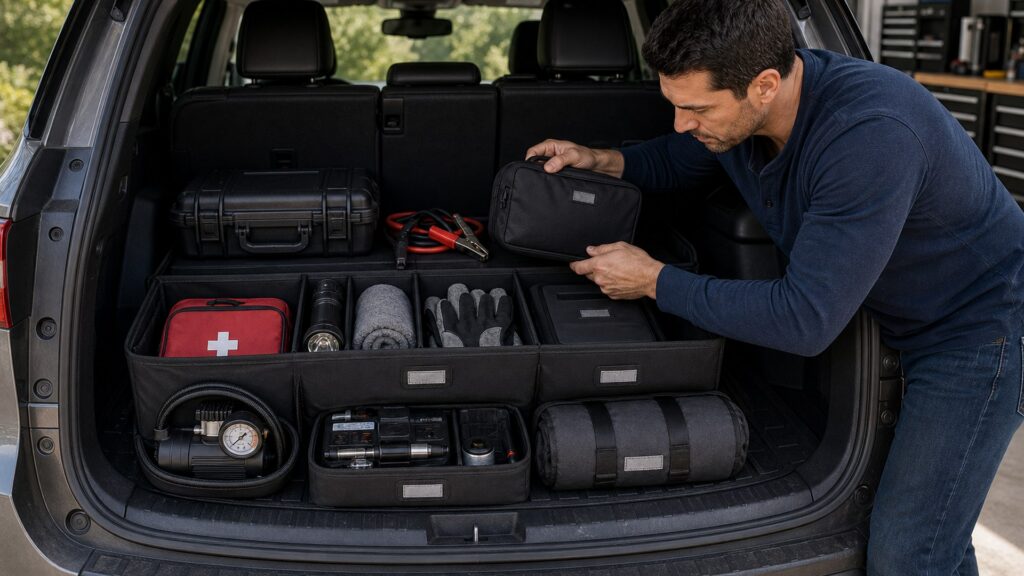
Buying framework
Zone gear by response time and safe retrieval
Immediate occupant needs, outside response tools, delay supplies, and maintenance equipment belong in different restrained locations.
Classify the response window: Mark items needed in seconds, minutes, during a prolonged wait, or only during planned inspection and restocking.
Map seats and exits: Identify who retrieves each item, which door or hatch is safest, and what remains accessible with child seats, wheelchairs, pets, or full cargo.
Design restraint and separation: Keep heavy equipment low and secured, protect sharp edges, and isolate food, medicine, water, fuel, chemicals, wet gear, and batteries.
Test disrupted access: Repeat retrieval in darkness, rain, with gloves, occupied seats, normal luggage, a blocked hatch, and one unavailable caregiver.
Who this is for
Storage needs change with cabin and users
Sedans, pickups, three-row vehicles, work vans, families, and mobility-limited occupants offer different safe volumes and access paths.
Sedans and hatchbacks: Use anchored low cargo zones, preserve spare-tire and emergency-release access, and keep immediate essentials separate from the trunk puzzle.
Pickups and open cargo areas: Protect from theft, water, dust, UV, temperature, bed movement, and impact while keeping emergency access independent of a packed bed.
Family and three-row vehicles: Preserve restraint function, rear egress, caregiver reach, stroller or luggage changes, and supplies for children without loose cabin objects.
Work and mobility vehicles: Coordinate partitions, mobility equipment, commercial loads, accessible controls, medical gear, and exit paths with vehicle upfit instructions.
What to pay attention to
Storage specifications that protect people and contents
Mount strength, closure, environment, internal organization, labeling, and access must be evaluated as one system.
Occupant Safety
Projectile control, airbags, belts, pedals, visibility, exits, child restraints, and mobility access.
Equipment Readiness
Temperature, water, dust, vibration, chemicals, charge, seals, dates, labels, inventory, and alternate retrieval.
Mount and closure: Assess rated attachment, load direction, latch retention, case strength, sharp edges, tool release, fastener inspection, and behavior when inverted.
Thermal suitability: Compare measured cabin or cargo extremes with medication, battery, water, food, sealant, adhesive, electronics, and extinguisher storage limits.
Environmental sealing: Select waterproofing or ventilation from moisture source, condensation, wet textiles, gas release, corrosion, dust, and cleaning requirements.
Internal control: Use fitted compartments, padding, caps, terminal protection, blade covers, chemical secondary containment, and labels readable in low light.
Inventory visibility: Maintain item, quantity, module, location, date, charge, seal, owner, inspection, and alternate-access information inside and outside the vehicle record.
Avoid these traps
Emergency storage that protects the organizer, not the occupants
A tidy case can still create crash loads, hide failures, contaminate supplies, or require unsafe roadside unloading.
Using seat pockets for heavy tools: Convenient reach does not justify placing dense or sharp objects where they can strike occupants or interfere with safety systems.
Sealing wet gear indefinitely: Moisture trapped with straps, gloves, textiles, metal, batteries, or paper causes mildew, corrosion, odor, and hidden deterioration.
Putting every item in one locked case: A single key, damaged hatch, buried case, or jammed latch can remove communication, medical, egress, and roadside capability together.
Labeling without fixed locations: Labels help only when modules return to the same restrained zone and inventory records are updated after borrowing or use.
Decision guidance
Choose storage that keeps critical gear independent
Prioritize occupant safety and immediate access, then add modular delayed-support capacity without blocking the vehicle’s normal systems.
If the item is needed before leaving the seat: Use an approved lightweight reachable location that does not affect restraints, airbags, controls, visibility, or child safety.
If cargo changes every trip: Anchor stable emergency modules outside the luggage stack and use a packing rule that preserves exits, spare access, and retrieval lanes.
If temperature limits cannot be maintained: Remove and carry the item seasonally or use an appropriate monitored method rather than trusting an insulated pouch indefinitely.
If one compartment is the only access: Split contacting help, illumination, occupant records, and exposure protection across safe independent zones.
Ownership & compatibility
Audit storage as carefully as the equipment
Mounts loosen, labels fade, bags migrate, batteries discharge, children grow, and borrowed supplies do not return automatically.
Run a monthly visual check: Confirm restraint, latches, exits, water or chemical leaks, corrosion, swelling batteries, missing gear, label legibility, and stable access.
Run a seasonal content audit: Review dates, temperature exposure, medication, water, food, clothing, charge, recalls, seals, vehicle changes, occupants, and route demands.
Restore immediately after use: Clean, dry, recharge, replace, record, and return every item to its fixed module; do not leave an opened kit apparently complete.
FAQ
Emergency gear storage questions
These answers cover cabin storage, cargo restraint, heat, medicine, batteries, water, labels, alternate access, and drills.
What emergency gear should stay within reach of the driver?
Can a loose emergency bag stay on the back seat?
How can I protect supplies from vehicle heat?
Where should prescription medicine be stored?
Should lithium battery packs remain in a vehicle?
How should drinking water be stored in a car?
Is a waterproof case always best?
Why should critical items be split between locations?
How should I test emergency gear access?
Bottom line
Storage decides whether emergency gear remains usable
Zone by urgency, restrain for crash loads, protect contents from the environment, and keep at least two safe paths to critical capabilities.
Protect occupants: No organizer may compromise restraints, airbags, controls, visibility, exits, or cargo safety.
Protect readiness: Match heat, moisture, chemicals, batteries, food, water, and medication to suitable storage and inspection.
Prove access: Use fixed modules, clear labels, updated inventory, and drills with realistic people, cargo, darkness, and blocked doors.
Reading Shortcuts
Move from the credible risk to a documented critical-access layout that can be maintained and verified.
Decision Reminders
Keep the complete critical-access layout in view while comparing equipment.
- Urgency: Seconds, minutes, or delay support.
- Restrain: Control container and contents.
- Access: Map seats, exits, and cargo.
- Climate: Know actual heat and freezing.
- Separate: Food, medicine, chemicals, wet gear.
- Audit: Locations, dates, seals, and charge.
Glossary Snippets
Terms that separate useful performance from apparent compatibility.
When to Use a Top 10 Review
Use a product roundup only after the required capability and critical-access layout limits are known.
- Problem defined: The visibility or mobility failure is specific.
- Vehicle mapped: Interfaces and limits are documented.
- Format chosen: The correct product family is settled.
- Evidence available: Finalists can be compared on relevant tests.
Have finalists already? Open a Comparison for a closer tradeoff.
When to Use a Comparison
Compare finalists that solve the same defined critical-access layout need for the same vehicle and users.
- Application: Both match the exact vehicle and function.
- Performance: Evidence addresses the operating problem.
- Integration: Mounting and system effects are understood.
- Ownership: Inspection and service demands are acceptable.
Need a broader field? Use a Top 10 to form a shortlist.