
Safety & Emergency Gear Buying Guide: How to Choose the Right One
Emergency gear is useful only when the scene permits its safe use. A driver stopped near fast traffic may need to remain belted and call for help rather than walk behind the vehicle placing equipment. Smoke, moving water, extreme weather, injuries, or damaged high-voltage components can change the response immediately.
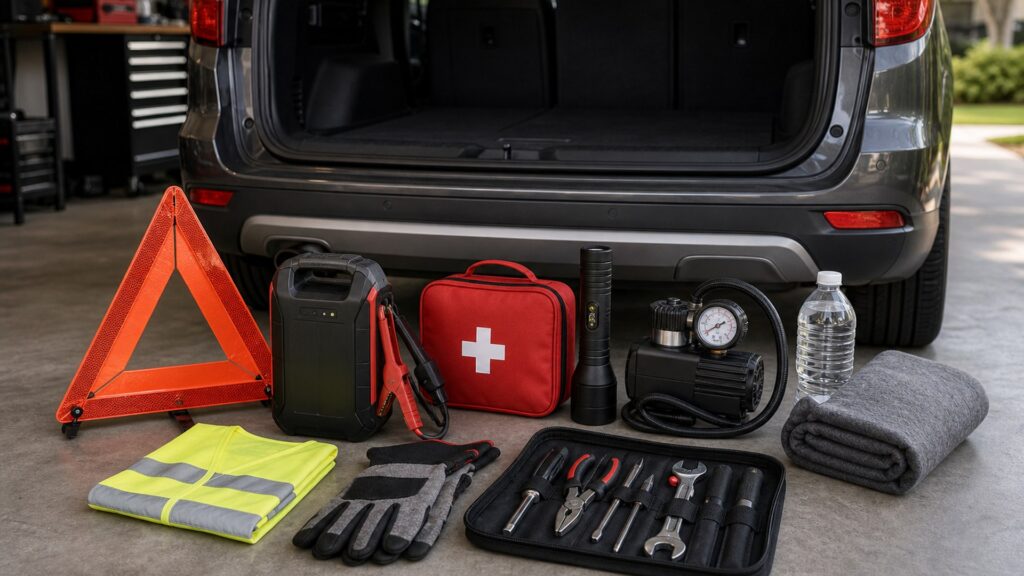
List credible scenarios for the vehicle, occupants, routes, climate, and trip length. For each, decide how to prevent escalation, communicate location, protect people, and summon qualified help. Choose equipment that matches the vehicle and trained users, then store it near the exit from which it can safely be retrieved. Inspect batteries, seals, dates, recalls, subscriptions, and heat damage on a schedule. Practice decisions and communication, not hazardous roadside improvisation.
Buying framework
Build capabilities around scenes, people, and safe decisions
A useful kit starts with what can happen, what the scene allows, who can act, and when self-help must stop.
List credible scenarios: Cover collision, tire or battery failure, medical issue, fire or smoke, extreme heat or cold, delay, lost communication, evacuation, and vehicle entrapment.
Size up the scene first: Decide safe location, restraint, egress, traffic exposure, fire, weather, water, unstable terrain, injuries, and whether equipment use would add risk.
Assign each capability: Match prevention, visibility, communication, stabilization, shelter, water, escape, and vehicle tools to a user, location, procedure, and backup.
Write escalation thresholds: Specify when to call emergency services, use professional roadside assistance, evacuate, shelter, or abandon a repair attempt.
Who this is for
Scale the system to occupants and operating environment
Urban commuters, remote travelers, families, and people with medical or mobility needs require different access, duration, and support.
Urban commuters: Prioritize reliable communication, high visibility, safe waiting, basic medical supplies, charging, roadside membership, and avoiding traffic exposure.
Remote and rural drivers: Add coverage-aware communication, route sharing, water, shelter, delay supplies, conservative vehicle tools, and longer professional-response planning.
Families and caregivers: Include child-restraint continuity, medications, temperature needs, sanitation, comfort that reduces unsafe wandering, contact cards, and supplies divided by caregiver access.
Older or mobility-limited travelers: Choose reachable lightweight equipment, simple controls, medical information, accessible egress, charging for assistive devices, and a plan that avoids strenuous roadside tasks.
What to pay attention to
Safety specifications tied to an actual response
Capacity, visibility, operating environment, storage, and instructions matter more than the number of pieces in a kit.
Immediate Protection
Scene assessment, restraints, egress, visibility, communication, first aid, fire avoidance, and professional response.
Sustained Safety
Shelter, water, food, medication, power, sanitation, information, storage environment, inspection, and replacement.
Visibility and placement: Evaluate day and night conspicuity, reflective area, stability, weather, activation, storage, and whether deployment can occur without entering unsafe traffic.
Communication resilience: Plan cellular coverage, emergency numbers, precise location, charging, power backup, contact information, accessibility, and a nonidentical alternative where warranted.
Medical scope: Match supplies to training, occupant conditions, prescriptions, bleeding and wound needs, temperature limits, expiration, and professional-care escalation.
Fire and egress fit: Select accessible escape and fire equipment from vehicle construction, glass, restraint release, fuel or high-voltage hazards, instructions, and evacuation priority.
Storage and inspection: Use restrained, labeled, temperature-appropriate locations; track batteries, seals, dates, corrosion, leaks, recalls, subscriptions, and missing items.
Avoid these traps
Emergency kits that encourage unsafe roadside action
Equipment can increase exposure when buyers focus on possessing tools instead of scene assessment and escalation.
Walking into traffic to deploy markers: Warning devices do not make a lane safe; location, visibility, barriers, weather, and official guidance determine whether leaving the vehicle is appropriate.
Buying an oversized first-aid assortment: Unfamiliar devices, expired contents, and poor storage do not replace training, emergency communication, medication planning, or professional care.
Storing everything beneath cargo: A kit trapped under luggage, a folded third row, or damaged hatch may be unavailable during the exact scenario it addresses.
Assuming one powered device is enough: A discharged phone, dead vehicle battery, damaged cable, lost signal, or inactive subscription can remove communication, navigation, light, and information together.
Decision guidance
Buy the capability that closes the highest-consequence gap
Prioritize scene safety and communication first, then occupant stabilization, exposure protection, and vehicle-specific self-help within safe limits.
If the stop location is unsafe: Remain or move according to official and vehicle guidance, use restraints and hazard signals where appropriate, communicate location, and avoid exposed repairs.
If occupants have time-critical needs: Store medications, medical information, communication, temperature protection, and caregiver instructions where the responsible person can reach them immediately.
If routes exceed cellular coverage: Add an appropriate independent communication and check-in plan with active service, power, contacts, location practice, and clear escalation.
If a tool requires unfamiliar force or exposure: Choose professional roadside support and safer waiting equipment rather than adding a jack, battery, fire, or recovery task beyond user competence.
Ownership & compatibility
Keep the kit ready through inspections and drills
Vehicle heat, freezing, vibration, battery drain, recalls, family changes, and forgotten borrowing degrade readiness silently.
Inspect on a calendar: Check contents, dates, seals, charge, leaks, corrosion, medication, water, food, clothing, documents, recalls, subscriptions, and vehicle compatibility.
Practice safe retrieval and calls: From normal seating, locate exits, lights, communication, medical information, visibility gear, and shelter; rehearse concise location and condition messages.
Debrief real use: Replace consumed items, document failures, clean or retire damaged equipment, revise access, and update scenarios when occupants, vehicle, routes, or climate change.
FAQ
Vehicle safety and emergency gear questions
These answers cover kit size, roadside visibility, first aid, fire equipment, communication, storage, and inspection.
What should every vehicle emergency kit contain?
Where is the safest place to store emergency gear?
Should I place warning triangles after every breakdown?
Do I need a fire extinguisher in my car?
How much first-aid gear is appropriate?
Are glass breakers effective on every vehicle window?
What backup communication should I carry?
How often should an emergency kit be inspected?
Should I attempt a tire change beside fast traffic?
Bottom line
The right kit supports the safest next decision
Build from scenarios, protect people from the scene, communicate early, and maintain only equipment occupants can access and use within trained limits.
Assess before acting: Traffic, fire, weather, terrain, injuries, and vehicle hazards decide whether equipment use is safe.
Close critical gaps: Prioritize communication, visibility, medical needs, exposure protection, egress, and qualified help.
Keep it operational: Restrain and label gear, inspect dates and power, practice retrieval, and update it with the people and vehicle.
Reading Shortcuts
Move from the credible risk to a documented scenario response system that can be maintained and verified.
Decision Reminders
Keep the complete scenario response system in view while comparing equipment.
- Scene: Assess hazards before equipment.
- People: Fit occupants and trained users.
- Access: Reach critical gear safely.
- Call: Location and escalation come early.
- Vehicle: Use compatible procedures and tools.
- Inspect: Dates, batteries, seals, recalls.
Glossary Snippets
Terms that separate useful performance from apparent compatibility.
When to Use a Top 10 Review
Use a product roundup only after the required capability and scenario response system limits are known.
- Problem defined: The visibility or mobility failure is specific.
- Vehicle mapped: Interfaces and limits are documented.
- Format chosen: The correct product family is settled.
- Evidence available: Finalists can be compared on relevant tests.
Have finalists already? Open a Comparison for a closer tradeoff.
When to Use a Comparison
Compare finalists that solve the same defined scenario response system need for the same vehicle and occupants.
- Application: Both match the exact vehicle and function.
- Performance: Evidence addresses the operating problem.
- Integration: Mounting and system effects are understood.
- Ownership: Inspection and service demands are acceptable.
Need a broader field? Use a Top 10 to form a shortlist.