
Seat Protection Buying Guide for All-Weather Interior Use
Heat, freezing moisture, road salt, sand, and wet clothing change what a seat protector must contain and how its backing behaves. For all-weather interior use, begin with the interfaces and restrictions that cannot be corrected by extra padding, stronger materials, faster charging, or more storage.
Build the four-season seat care decision from winter moisture, road-salt residue, and summer surface heat. Use the actual cabin, completed load, and governing care directions so each conclusion remains tied to this vehicle instead of a universal claim.
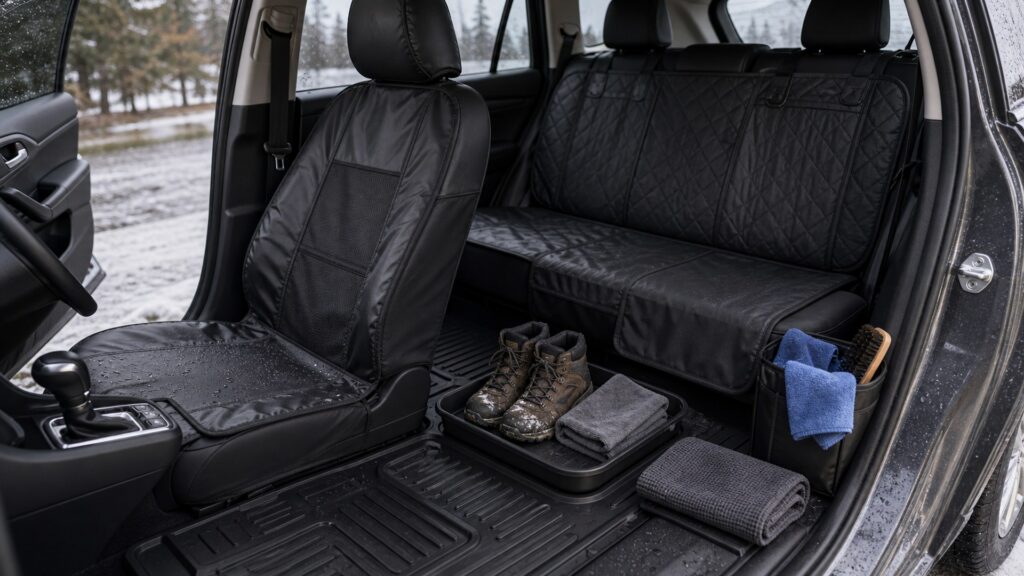
Buying framework
Set the decision order for seasonal upholstery protection
For four-season seat care, establish winter moisture before pricing and secondary features. The next gates cover road-salt residue, summer surface heat, and UV stability in the order a failed condition would end the installation.
Winter Moisture: Make winter moisture the first measurement. Meltwater from coats and boots needs a removable barrier that can be emptied before liquid migrates to seams. A candidate that misses winter moisture does not advance to comfort features.
Road-Salt Residue: Make road-salt residue the early compatibility screen. Salt crystals should be vacuumed or rinsed according to care directions before they abrade upholstery. Remove products that cannot demonstrate road-salt residue without altering original equipment.
Summer Surface Heat: Make summer surface heat the loaded-use trial. Dark impermeable covers can become much hotter than breathable fabric after a vehicle sits in direct sun. Keep the trial reversible until summer surface heat remains predictable under the complete load.
Uv Stability: Make UV stability the final pre-purchase gate. Sun-exposed textiles and elastomers should resist fading, cracking, and sticky surface changes. Approve the installation only after UV stability agrees with the governing care directions.
Who this is for
Match the design to the real routine
Match protection to the weather carried inside the cabin: winter brine, beach sand, rain-soaked clothing, and summer heat fail materials in different ways. Climate cycling and drying access matter as much as the top surface.
Snow-Belt Commuter: Prioritize winter moisture for this profile, then judge the four-season seat care observation with waterproof seam design under the longest ordinary session. Discard options that need repeated repositioning.
Hot-Climate Parker: Make summer surface heat the opening screen for this user. During the four-season seat care mock-up, add condensation drying and observe the complete movement, temperature, or contact range.
Coastal Outdoor User: Give this buyer a parked trial centered on UV stability and its controlling care directions. The four-season seat care choice advances only when mud containment stays visible and directly reachable.
Year-Round Family Driver: Favor reversible four-season seat care hardware for this routine. Photograph cold-flex backing in the accepted position and schedule a seasonal inspection review before the return or installation window closes.
What to pay attention to
Turn specifications into visible consequences
Useful all-season specifications describe behavior in a hot cabin, beneath wet clothing, and after abrasive winter residue. Convert each material or construction claim into a climate-specific check you can repeat in the parked vehicle.
Vehicle interface
Judge geometry, attachment, and access against seasonal upholstery protection.
Loaded operation
During the four-season seat care trial, include every regular occupant, device, cable, cargo item, or moving component that can alter mud containment.
Waterproof Seam Design: Sealed construction is useful only when stitching, edges, and attachment openings do not channel water underneath. Translate the published construction into a parked condition review that shows whether cold-flex backing changes under the full load. During four-season seat care, connect that observation to cold-flex backing and write down the usable boundary.
Condensation Drying: The practical limit for condensation drying appears during adjustment and cleaning. Lift damp protection so both layers dry fully; trapped moisture can create odor and surface changes. Note any interference with heated-seat guidance. Use the four-season seat care observation to decide whether heated-seat guidance stays within its permitted range.
Mud Containment: Treat the stated range for mud containment as a starting point. Raised edges help corral mud, but they must stay clear of buckles, controls, and passenger pressure zones. Verify access again after all nearby equipment is positioned. Photograph this four-season seat care condition after loading, with seasonal inspection scheduled for a later comparison.
Cold-Flex Backing: Material compatibility controls cold-flex backing more than a broad durability claim. A backing that stiffens in cold weather may slide, curl, or press against trim differently than it did in summer. Examine cold-flex backing directly because a universal label cannot establish four-season seat care compatibility. Replace a universal claim with direct four-season seat care evidence about winter moisture at the contacting faces.
Heated-Seat Guidance: A specification for heated-seat guidance matters only when it predicts loaded behavior. Follow the vehicle manual before covering a heated surface, especially with foam or waterproof materials. Record the first warning, obstruction, or loss of function. Keep the measured road-salt residue outcome with the four-season seat care notes for the final shortlist.
Avoid these traps
Shortcuts that hide incompatibility
All-weather does not mean maintenance-free. Problems begin when liquid is allowed to migrate around edges, abrasive debris is rubbed into the backing, or a heat-softened material remains pressed against a delicate finish.
Trusting the top surface alone: Water can bypass stitching and panel edges even when the face material does not absorb it. Lift the protector after a meaningful spill and inspect the cushion seams and lowest collection points.
Wiping gritty residue: Road salt crystals and beach sand scratch when rubbed. Vacuum loose material first, remove the panel carefully, and clean the backing away from the vehicle before treating the factory upholstery.
Sealing functional zones: A waterproof label does not permit sealing over a seat's functional zones. Leave deployment seams, ventilation openings, controls, restraint hardware, and manufacturer-identified sensor areas exactly as the vehicle instructions require.
Skipping hot-cabin inspections: Heat can soften backing and accelerate transfer long before the front face looks worn. Lift high-contact sections early in summer and discontinue use at the first tackiness, odor, imprint, or color change.
Decision guidance
Let the limiting condition prefer the design
Let the first failed four-season seat care boundary remove unsuitable barrier families. Price, appearance, and smart features belong only in comparisons where winter moisture and UV stability already pass.
If winter moisture defines the usable range: Use winter moisture to establish the four-season seat care shortlist. Among compatible choices, prefer the option that keeps condensation drying straightforward without extra pressure or unsupported hardware.
When summer surface heat creates the main exposure: Reproduce the worst seasonal summer surface heat condition during the four-season seat care trial. Advance only designs that also keep cold-flex backing visible, stable, and easy to examine.
Where mud containment must stay accessible: Reject an four-season seat care arrangement that hides, tensions, or reroutes mud containment. The surviving design should preserve heated-seat guidance without requiring a special user sequence.
If seasonal inspection controls ownership effort: Assess the cleaning, removal, and inspection work associated with seasonal inspection. Favor the four-season seat care candidate whose waterproof seam design can be rechecked without dismantling unrelated equipment.
Ownership & compatibility
Keep the installation inspectable and reversible
Weather protection needs a drying routine, not just a sealed top layer. Scheduled removal lets salt, condensation, pollen, and sand leave the vehicle before seasonal heat and pressure fix them against the upholstery.
Establish a dry baseline: Install protection on clean, fully dry upholstery and photograph the underside. This baseline makes new haze, dye transfer, salt residue, or backing changes visible during the first hot or wet weather inspection.
Respond to each exposure: Vacuum dry sand and salt before wiping, then use only approved cleaners. After rain, snow, or wet clothing, separate the layers and allow seams, straps, and the factory seat to dry completely.
Rotate the seasonal check: Inspect before winter salt, spring pollen, summer cabin heat, and autumn rain. Replace stiff clips, cracked coatings, stretched anchors, or curled edges before the next extreme-temperature cycle.
FAQ
Questions about seasonal upholstery protection
These answers resolve narrow compatibility and ownership questions that should be checked before or soon after installation.
What handles road salt and winter slush best?
Will a waterproof seat cover trap condensation?
How does summer heat affect seat protectors?
Which construction is practical for beach sand?
Can heated seats be used through protection?
What about ventilated or perforated seats?
How can muddy covers be cleaned without harming upholstery?
Do freezing temperatures make protectors brittle?
What is a useful seasonal inspection routine?
Bottom line
Prefer the fit you can verify
The defensible four-season seat care choice fits the specific vehicle, respects the controlling care directions, and makes seasonal inspection practical after installation.
Resolve the hard limits: Approve winter moisture and UV stability for the four-season seat care fit before comparing convenience.
Load the complete system: Observe waterproof seam design, mud containment, and nearby movement while the four-season seat care arrangement matches daily use.
Retain the evidence: Keep measurements, photographs, and care directions so seasonal inspection can detect a meaningful change.
Reading Shortcuts
Open the unresolved four-season seat care section: boundaries, specifications, user conditions, or focused questions.
Seasonal Upholstery Protection Checks
Complete the four-season seat care observations while stationary with the ordinary load present.
- Winter Moisture: Measure the available range.
- Road-Salt Residue: Follow the applicable care directions.
- Summer Surface Heat: Include the completed load.
- Uv Stability: Move nearby equipment fully.
- Waterproof Seam Design: Record the first conflict.
- Condensation Drying: Keep a reversible exit plan.
Glossary Snippets
Terms that describe the physical and operating limits behind four-season seat care.
When to Use a Top 10 Review
Use an four-season seat care ranking only after winter moisture and mud containment have removed incompatible barrier families.
- Winter Moisture: The primary boundary is known.
- Road-Salt Residue: The permitted interface is documented.
- Summer Surface Heat: The loaded condition has been reproduced.
- Uv Stability: The recurring ownership demand is understood.
Already down to 2–3 options? A Comparison is usually the faster next step.
When to Use a Comparison
Judge the final two choices with identical four-season seat care measurements, care directions, loads, and movement paths.
- Waterproof Seam Design: Both candidates preserve this function.
- Condensation Drying: Both remain stable under the seasonal load.
- Mud Containment: Both permit direct inspection.
- Cold-Flex Backing: The difference changes a real ownership outcome.
Still exploring? Start with a Top 10 to build a shortlist first.