
Seat Protection Buying Guide for Cabin Comfort Upgrades
Comfort depends on preserving the seat's intended contour, controls, temperature functions, and occupant space. For cabin comfort upgrades, begin with the interfaces and restrictions that cannot be corrected by extra padding, stronger materials, faster charging, or more storage.
This guide rebuilds the choice around cushion contour, side-bolster freedom, and breathable contact layer. Each recommendation becomes a vehicle-specific observation, a manufacturer-instruction check, or a repeatable ownership task rather than a universal promise.
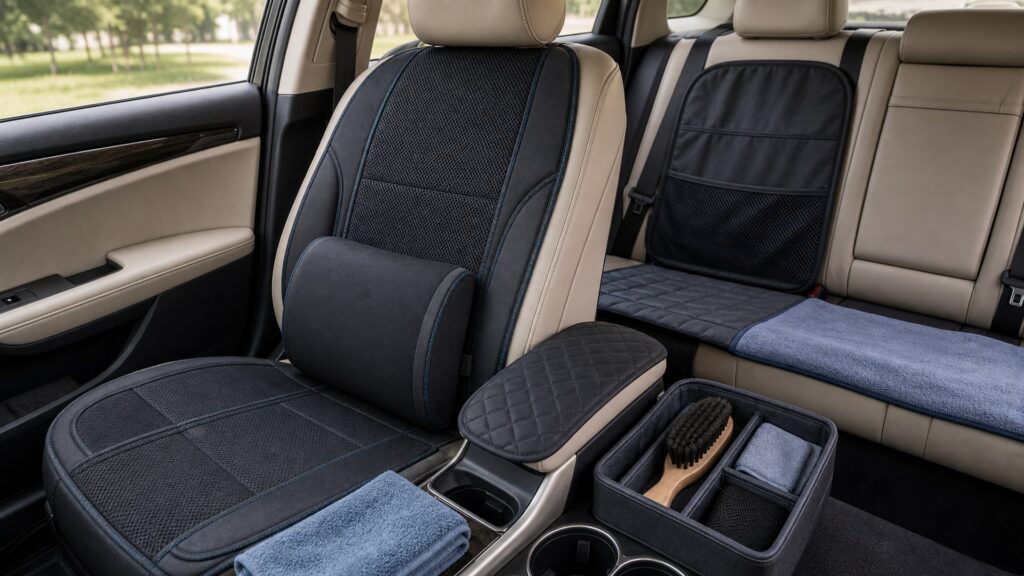
Buying framework
Set the decision order for comfort-focused upholstery coverage
Establish the non-negotiable boundaries before comparing convenience. These four gates determine whether a product belongs in the comfort-focused upholstery coverage shortlist.
Cushion Contour: Make cushion contour the first measurement. A thick pad can change thigh support or create a ridge where the factory cushion was designed to distribute pressure. A candidate that misses cushion contour does not advance to comfort features.
Side-Bolster Freedom: Make side-bolster freedom the early compatibility screen. Coverage should lie inside movable bolsters and stay clear of any marked side-airbag deployment seam. Remove products that cannot demonstrate side-bolster freedom without altering original equipment.
Breathable Contact Layer: Make breathable contact layer the loaded-use trial. A breathable textile may feel cooler than a sealed barrier, but liquid protection and airflow usually trade against each other. Keep the trial reversible until breathable contact layer remains predictable under the complete load.
Heated-Seat Permission: Make heated-seat permission the final pre-purchase gate. The vehicle manual decides whether an added layer may be used with the heating system and at which settings. Approve the installation only after heated-seat permission agrees with the governing instructions.
Who this is for
Match the design to the real routine
Different users place different demands on cushion contour, heated-seat permission, and edge pressure. Weight the profile that most closely matches the vehicle's repeated use.
Long-Distance Commuter: This profile should document cushion contour first, then observe ventilated-seat airflow through the longest regular trip or charging session. Convenience matters only after both boundaries remain stable.
Temperature-Sensitive Passenger: Daily conditions make breathable contact layer especially important for this user. Compare headrest attachment with the normal occupants or equipment present and reject a setup that needs repeated correction.
Premium-Upholstery Owner: Give this buyer a separate parked trial for heated-seat permission, including every instruction-defined exclusion. The result should remain valid when belt-buckle reach is visible, reachable, and under its ordinary load.
Shared-Driver Household: This profile benefits from a reversible arrangement centered on edge pressure. Photograph the accepted position and recheck wash-and-dry routine before the return period or installation commitment ends.
What to pay attention to
Turn specifications into visible consequences
Dimensions, ratings, and materials should predict an outcome at ventilated-seat airflow or surface temperature. A larger number has no value when it creates a new compatibility problem.
Vehicle interface
Judge geometry, attachment, and access against comfort-focused upholstery coverage.
Loaded operation
Observe the completed setup with normal occupants, devices, cables, or cargo present.
Ventilated-Seat Airflow: Dense foam or waterproof backing can cover perforations and reduce the effect of seat ventilation. Translate the published construction into a parked check that shows whether edge pressure changes under the full load.
Headrest Attachment: The practical limit for headrest attachment appears during adjustment and cleaning. Headrest straps need stable posts and must not pull the protector upward when the occupant shifts. Note any interference with surface temperature.
Belt-Buckle Reach: Treat the stated range for belt-buckle reach as a starting point. A passenger should be able to find and latch the buckle without digging beneath a flap or compressed edge. Verify access again after all nearby equipment is positioned.
Edge Pressure: Material compatibility controls edge pressure more than a broad durability claim. Rolled borders and seams should sit outside the main pressure zone so they do not become noticeable on a long trip. Inspect the contacting faces instead of relying on a universal label.
Surface Temperature: A specification for surface temperature matters only when it predicts loaded behavior. Dark waterproof materials can become hot in sun even when the cabin air has begun to cool. Record the first warning, obstruction, or loss of function.
Avoid these traps
Shortcuts that hide incompatibility
Most failures begin with an assumption about universal fit, unloaded behavior, or long-term care. Correct those assumptions while the seat protection can still be returned or repositioned.
Assuming side-bolster freedom will be universal: A category label cannot establish side-bolster freedom in this vehicle. Measure its complete range and confirm that belt-buckle reach stays accessible before accepting the installation.
Checking ventilated-seat airflow only while unloaded: An empty display hides pressure, sag, and blocked movement. Recreate the normal ventilated-seat airflow condition with every regular component or occupant in place.
Ignoring the instructions for heated-seat permission: Safety, electrical, and compatibility restrictions control heated-seat permission. Stop the comparison when the applicable vehicle or equipment manual does not permit the proposed arrangement.
Waiting for visible damage at wash-and-dry routine: Set a specific wash-and-dry routine interval before demanding use begins. Look for small changes in alignment, residue, temperature, access, or material condition rather than waiting for failure.
Decision guidance
Let the limiting condition choose the design
Use the first failed boundary to remove product families. Compare optional features only among configurations that satisfy comfort-focused upholstery coverage.
When cushion contour sets the boundary: Screen the entire product family by cushion contour before comparing price or appearance. Keep only candidates that preserve headrest attachment without an improvised attachment or pressure point.
If breathable contact layer narrows the shortlist: Recreate the most demanding ordinary condition for breathable contact layer. Among passing options, prefer the design that keeps edge pressure simple to observe and correct.
Where belt-buckle reach creates a conflict: Do not bury, reroute, or cover the interface involved in belt-buckle reach without documented permission. Choose a configuration that leaves surface temperature obvious and reachable.
When wash-and-dry routine decides ownership effort: Compare removal, cleaning, and inspection steps for wash-and-dry routine before buying. Favor the candidate whose ventilated-seat airflow can be checked without dismantling the entire setup.
Ownership & compatibility
Keep the installation inspectable and reversible
Heat, moisture, grit, repeated handling, and changes in equipment can alter edge pressure. Early inspection protects both the accessory and the vehicle.
First-week inspection: Revisit edge pressure after ordinary use and compare the original alignment or contact pattern. Clean both interfaces as directed, then stop use if pressure, heat, looseness, or residue appears.
Routine cleaning: Care for wash-and-dry routine on the schedule created by weather, occupants, and handling. Let materials dry fully and keep cleaners away from unapproved electrical, upholstery, or connector surfaces.
Change control: A different vehicle, occupant, restraint, EV, cable, or parking position can invalidate cushion contour. Repeat the documented fit and access checks instead of assuming the earlier result transfers.
FAQ
Questions about comfort-focused upholstery coverage
These answers resolve narrow compatibility and ownership questions that should be checked before or soon after installation.
What should I verify first about cushion contour?
How can I assess side-bolster freedom before installation?
Which instructions control breathable contact layer?
What is a useful parked check for heated-seat permission?
When should ventilated-seat airflow eliminate an option?
How does daily use affect headrest attachment?
What should be rechecked for belt-buckle reach?
Can convenience features compensate for poor edge pressure?
What belongs in a final comparison of surface temperature?
Bottom line
Choose the setup you can verify
A defensible comfort-focused upholstery coverage choice fits the actual vehicle, follows the governing instructions, and stays easy to inspect as conditions change.
Approve the interface: Resolve cushion contour, side-bolster freedom, and manufacturer restrictions before comparing secondary features.
Use the real configuration: Evaluate ventilated-seat airflow and belt-buckle reach with the actual vehicle, occupants, equipment, and movement paths present.
Plan for inspection: Choose an arrangement that makes wash-and-dry routine straightforward and preserves a reversible response to wear or changing needs.
Reading Shortcuts
Jump to the comfort-focused upholstery coverage decision that is still unresolved.
Comfort-Focused Upholstery Coverage Checks
Complete these observations with the vehicle stationary and the normal configuration present.
- Cushion Contour: Measure the available range.
- Side-Bolster Freedom: Follow the applicable instructions.
- Breathable Contact Layer: Include the completed load.
- Heated-Seat Permission: Move nearby equipment fully.
- Ventilated-Seat Airflow: Record the first conflict.
- Headrest Attachment: Keep a reversible exit plan.
Glossary Snippets
Terms that define the physical and operating boundaries for comfort-focused upholstery coverage.
When to Use a Top 10 Review
Use ranked candidates after the vehicle limits for cushion contour and belt-buckle reach are documented.
- Cushion Contour: The primary boundary is known.
- Side-Bolster Freedom: The permitted interface is documented.
- Breathable Contact Layer: The loaded condition has been reproduced.
- Heated-Seat Permission: The recurring ownership demand is understood.
Already down to 2–3 options? A Comparison is usually the faster next step.
When to Use a Comparison
Compare finalists against the same comfort-focused upholstery coverage measurements, instructions, loads, and movement paths.
- Ventilated-Seat Airflow: Both candidates preserve this function.
- Headrest Attachment: Both remain stable under the normal load.
- Belt-Buckle Reach: Both permit direct inspection.
- Edge Pressure: The difference changes a real ownership outcome.
Still exploring? Start with a Top 10 to build a shortlist first.