
Seat Protection Buying Guide for Family Vehicle Organization
A family protector must manage crumbs, wet gear, child-seat zones, and changing passengers without hiding restraint hardware. For family vehicle organization, begin with the interfaces and restrictions that cannot be corrected by extra padding, stronger materials, faster charging, or more storage.
Build the family cleanup planning decision from child-seat footprint, crumb capture, and spill boundary. Use the actual cabin, completed load, and governing manual guidance so each conclusion remains tied to this vehicle instead of a universal claim.
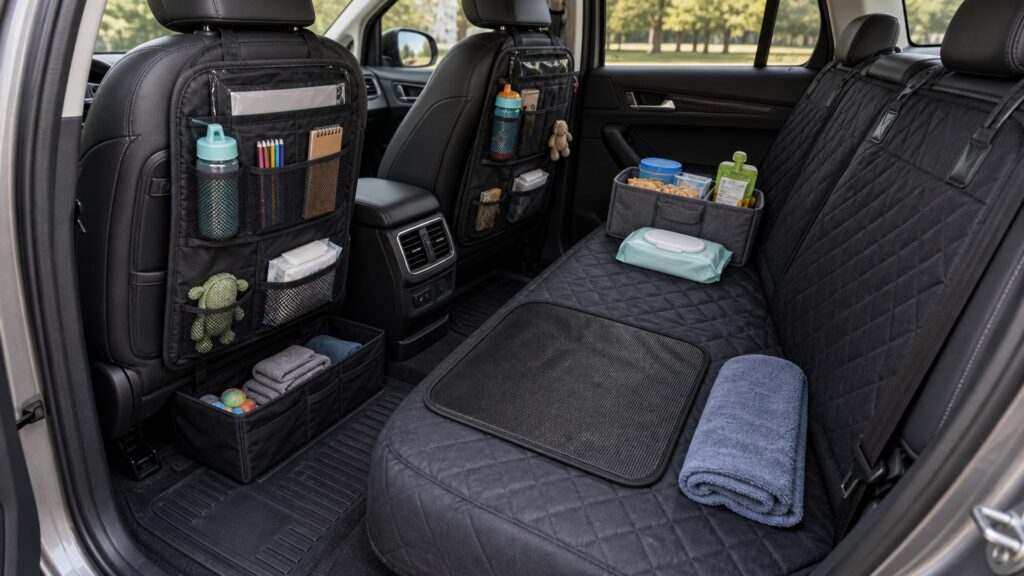
Buying framework
Set the decision order for family-seat organization
For family cleanup planning, establish child-seat footprint before pricing and secondary features. The next gates cover crumb capture, spill boundary, and seat-back pockets in the order a failed condition would end the installation.
Child-Seat Footprint: Make child-seat footprint the first measurement. Under a child restraint, use only a layer permitted by both the restraint manual guidance and the vehicle manual. A candidate that misses child-seat footprint does not advance to comfort features.
Crumb Capture: Make crumb capture the early compatibility screen. Smooth removable panels are easier to vacuum than deep quilt channels that retain cereal and sand. Remove products that cannot demonstrate crumb capture without altering original equipment.
Spill Boundary: Make spill boundary the loaded-use trial. Raised edges can contain a small spill, but liquid must not pool near seams, switches, or electrical components. Keep the trial reversible until spill boundary remains predictable under the complete load.
Seat-Back Pockets: Make seat-back pockets the final pre-purchase gate. Pockets should remain lightly loaded so they do not pull the back panel or become hard objects behind an occupant. Approve the installation only after seat-back pockets agrees with the governing manual guidance.
Who this is for
Match the design to the real routine
Family routines differ by child-restraint use, snack frequency, passenger ages, and the need to fold or clean seats quickly. Let the messiest repeated trip determine which organizational feature matters most.
Rear-Facing Child Household: Prioritize child-seat footprint for this profile, then judge the family cleanup planning finding with toy and tablet storage under the longest ordinary session. Discard options that need repeated repositioning.
School-Run Family: Make spill boundary the opening screen for this user. During the family cleanup planning mock-up, add buckle visibility and observe the complete movement, temperature, or contact range.
Road-Trip Organizer: Give this buyer a parked trial centered on seat-back pockets and its controlling manual guidance. The family cleanup planning choice advances only when lower-anchor access stays visible and directly reachable.
Mixed-Age Passenger Vehicle: Favor reversible family cleanup planning hardware for this routine. Photograph split-bench flexibility in the accepted position and schedule a laundry rotation review before the return or installation window closes.
What to pay attention to
Turn specifications into visible consequences
A useful family cleanup planning specification predicts what happens at toy and tablet storage or quick removal after installation. Translate dimensions, ratings, and materials into a visible parked finding instead of ranking numbers alone.
Vehicle interface
Judge geometry, attachment, and access against family-seat organization.
Loaded operation
During the family cleanup planning trial, include every regular occupant, device, cable, cargo item, or moving component that can alter lower-anchor access.
Toy And Tablet Storage: Storage should stay within easy parked access and must not obstruct vents, belts, or a child's restraint harness. Translate the published construction into a parked review that shows whether split-bench flexibility changes under the full load. During family cleanup planning, connect that observation to split-bench flexibility and write down the usable boundary.
Buckle Visibility: The practical limit for buckle visibility appears during adjustment and cleaning. Every regular passenger should be able to see and reach the correct buckle without lifting the cover. Note any interference with quick removal. Use the family cleanup planning finding to decide whether quick removal stays within its permitted range.
Lower-Anchor Access: Use lower-anchor access as a measured family-installation boundary. Protector slots need to line up with anchor bars without tension that distorts the seat material. Verify access again after all nearby equipment is positioned. Photograph this family cleanup planning condition after loading, with laundry rotation scheduled for a later comparison.
Split-Bench Flexibility: Material compatibility controls split-bench flexibility more than a broad durability claim. A 60/40 bench needs independent sections if the family regularly folds one side for cargo. Examine split-bench flexibility directly because a universal label cannot establish family cleanup planning compatibility. Replace a universal claim with direct family cleanup planning evidence about child-seat footprint at the contacting faces.
Quick Removal: A specification for quick removal matters only when it predicts loaded behavior. Fast release matters when a spill reaches the upholstery or the seat must change from children to adults. Record the first warning, obstruction, or loss of function. Keep the measured crumb capture outcome with the family cleanup planning notes for the final shortlist.
Avoid these traps
Shortcuts that hide incompatibility
Family organization fails when storage hides restraint hardware or cleanup layers remain wet. Test the occupied back seat, not an empty bench, while the protector can still be repositioned.
Placing convenience above child-restraint instructions: Do not put a mat beneath a car seat unless both the restraint maker and vehicle manual allow it. No organizer feature can compensate for an unauthorized installation layer.
Letting crumbs stay below the cover: A clean-looking top surface can hide sand and cereal against the upholstery. Lift panels during vacuuming so trapped particles do not abrade the seat as passengers move.
Overloading seat-back pockets: Heavy toys and bottles pull on straps, distort coverage, and become hard objects behind occupants. Keep pockets light and move substantial gear to secured vehicle storage.
Using one panel across a split bench: A continuous protector can prevent independent folding or drag across occupied seating. Choose sections that match the family's cargo pattern and keep buckles, anchors, and tethers uncovered.
Decision guidance
Let the limiting condition select the design
Let the first failed family cleanup planning boundary remove unsuitable protector families. Price, appearance, and smart features belong only in comparisons where child-seat footprint and seat-back pockets already pass.
If child-seat footprint defines the usable range: Use child-seat footprint to establish the family cleanup planning shortlist. Among compatible choices, prefer the option that keeps buckle visibility straightforward without extra pressure or unsupported hardware.
When spill boundary creates the main exposure: Reproduce the worst everyday spill boundary condition during the family cleanup planning trial. Advance only designs that also keep split-bench flexibility visible, stable, and easy to examine.
Where lower-anchor access must stay accessible: Reject an family cleanup planning arrangement that hides, tensions, or reroutes lower-anchor access. The surviving design should preserve quick removal without requiring a special user sequence.
If laundry rotation controls ownership effort: Weigh the cleaning, removal, and inspection work associated with laundry rotation. Favor the family cleanup planning candidate whose toy and tablet storage can be rechecked without dismantling unrelated equipment.
Ownership & compatibility
Keep the installation inspectable and reversible
A sound family cleanup planning installation stays open to inspection as heat, moisture, grit, and repeated handling change split-bench flexibility. Early correction protects the accessory and the vehicle.
Document the installed state: Photograph split-bench flexibility when the family cleanup planning arrangement is new. After the first week, weigh alignment, pressure, surface condition, and access before cleaning both interfaces as directed.
Clean for the actual exposure: Set the family cleanup interval from snacks, wet clothing, pets, and playground dirt. Use approved cleaners, remove hidden debris, and let the cover and upholstery dry separately before the next trip.
Repeat checks after changes: A different occupant, restraint, vehicle, EV, cable, or parking position can alter child-seat footprint. Rebuild the family cleanup planning evidence instead of transferring an earlier compatibility assumption.
FAQ
Questions about family-seat organization
These answers resolve narrow compatibility and ownership questions that should be checked before or soon after installation.
Can a seat protector go beneath a child restraint?
Which protector construction is easiest to vacuum?
How should a family protector contain drink spills?
Are seat-back storage pockets useful for children?
How can tablet storage remain safe and tidy?
How do I keep every family buckle visible?
What matters around lower anchors?
Should split-bench seats use separate protector sections?
How often should a family seat protector be removed?
Bottom line
Select the arrangement you can verify
The defensible family cleanup planning choice fits the specific vehicle, respects the controlling manual guidance, and makes laundry rotation practical after installation.
Resolve the hard limits: Approve child-seat footprint and seat-back pockets for the family cleanup planning arrangement before comparing convenience.
Load the complete system: Observe toy and tablet storage, lower-anchor access, and nearby movement while the family cleanup planning arrangement matches daily use.
Retain the evidence: Keep measurements, photographs, and manual guidance so laundry rotation can detect a meaningful change.
Reading Shortcuts
Open the unresolved family cleanup planning section: boundaries, specifications, user conditions, or focused questions.
Family-Seat Organization Checks
Complete the family cleanup planning observations while stationary with the ordinary load present.
- Child-Seat Footprint: Measure the available range.
- Crumb Capture: Follow the applicable manual guidance.
- Spill Boundary: Include the completed load.
- Seat-Back Pockets: Move nearby equipment fully.
- Toy And Tablet Storage: Record the first conflict.
- Buckle Visibility: Keep a reversible exit plan.
Glossary Snippets
Terms that describe the physical and operating limits behind family cleanup planning.
When to Use a Top 10 Review
Use an family cleanup planning ranking only after child-seat footprint and lower-anchor access have removed incompatible protector families.
- Child-Seat Footprint: The primary boundary is known.
- Crumb Capture: The permitted interface is documented.
- Spill Boundary: The loaded condition has been reproduced.
- Seat-Back Pockets: The recurring ownership demand is understood.
Already down to 2–3 options? A Comparison is usually the faster next step.
When to Use a Comparison
Judge the final two choices with identical family cleanup planning measurements, manual guidance, loads, and movement paths.
- Toy And Tablet Storage: Both candidates preserve this function.
- Buckle Visibility: Both remain stable under the everyday load.
- Lower-Anchor Access: Both permit direct inspection.
- Split-Bench Flexibility: The difference changes a real ownership outcome.
Still exploring? Start with a Top 10 to build a shortlist first.