
Seat Protection Buying Guide: How to Choose the Right One
A protector is suitable only when it covers the vulnerable upholstery without obstructing restraint hardware, airbag seams, seat controls, or functions the vehicle and child-restraint makers require to remain clear.
Before choosing hardware, document seat-mounted airbag seam in the actual vehicle and consult the relevant manuals. This guide connects belt and anchor access and heated-seat guidance to reversible checks made before installation.
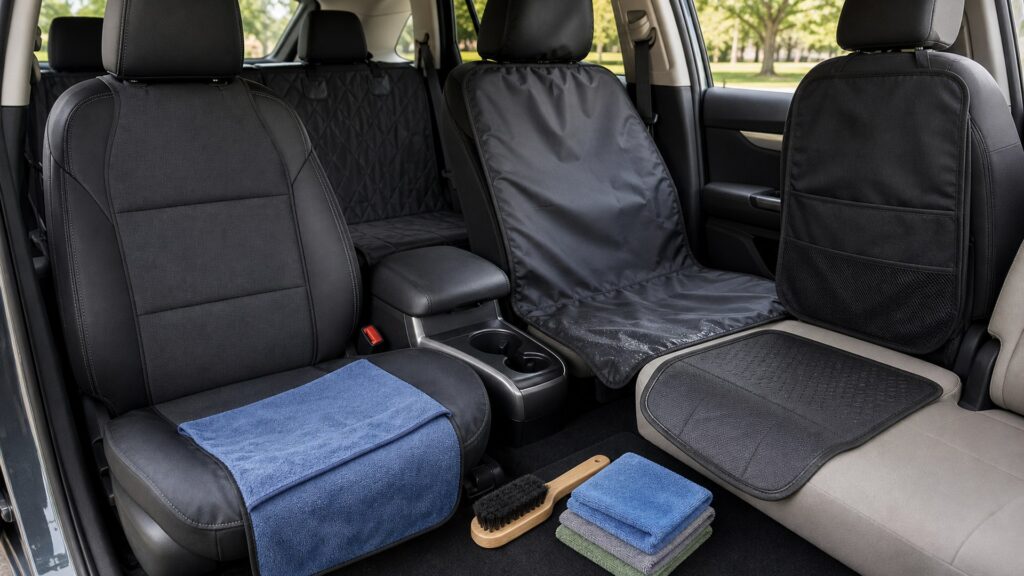
Buying framework
Build the decision around upholstery protection
Define the mess or wear being controlled, then screen for restraint and seat compatibility before comparing coverage, grip, padding, or appearance. Safety-related exclusions end the comparison immediately.
Bucket Versus Bench Contour: Map bucket versus bench contour before shopping, then reject locations that compromise waterproof barrier construction. This sets the first priority for the intended occupant routine.
Seat-Mounted Airbag Seams: Treat seat-mounted airbag seams as a physical constraint; confirm it with non-slip backing compatibility in the everyday covered seating position. The result narrows which interfaces deserve comparison.
Headrest-Post Attachment: Compare attachment styles only after documenting headrest-post attachment and the limits created by heated-seat limitations. That evidence prevents a convenience feature from masking poor contoured fit.
Seat-Belt And Lower-Anchor Access: Use a parked mock-up to judge seat-belt and lower-anchor access, paying particular attention to ventilated-seat airflow during adjustment. Keep only positions that remain workable without improvisation.
Who this is for
Match the cover construction to the actual user
Different owners expose the product to different combinations of seat-mounted airbag seam, ventilated-seat airflow, and backing compatibility. Weight the profile that best matches the recurring risk.
Family with child restraints: This owner should establish seat-mounted airbag seam first, then check whether heated-seat guidance changes the result. Reproduce the occupied cabin and regular equipment so the trial reflects upholstery coverage rather than a store display.
Pet-owning driver: For this routine, document belt and anchor access with all regular components present. Compare alternatives only after ventilated-seat airflow has been observed through its full movement or contact range.
Work and outdoor user: Give this user a separate trial centered on heated-seat guidance. The better candidate preserves waterproof barrier without additional pressure, a blocked control, or a special handling sequence.
Lease or resale-focused owner: This profile benefits from a reversible setup that makes ventilated-seat airflow easy to inspect. Recheck backing compatibility after normal adjustment and retain the option with the fewest assumptions.
What to pay attention to
Specifications that become real seating area consequences
Translate dimensions, materials, and compatibility claims into visible outcomes for upholstery coverage. Record the first point where belt and anchor access changes access, movement, surface contact, or intended function.
automobile fabric interface
Judge attachment and restraint clearance against the seating area conditions that shape upholstery protection.
occupied Use
Observe the protector with the real seat arrangement in place, not as an empty display.
seat-mounted airbag seam: Identify every marked side-airbag deployment seam and exclude covers the vehicle maker does not permit around it.
belt and anchor access: Keep buckles, belt paths, lower anchors, tether routes, and occupant sensors accessible and visually inspectable.
heated-seat guidance: Check the vehicle manual before placing any layer over a heated seat, then follow temperature and material restrictions.
ventilated-seat airflow: Perforated upholstery needs compatible coverage if ventilation is to remain useful; waterproof construction may restrict airflow.
waterproof barrier: Match water resistance to the spill zone while preventing liquid from pooling near seams, switches, or electrical components.
Avoid these traps
Shortcuts that create hidden conflicts
Most disappointments begin with an assumption made before fitted coverage. Correct the buying logic while the protector can still be returned or repositioned.
Covering a seat-mounted airbag seam: A full-seat cover may cross a marked deployment area on the seat bolster. Follow the vehicle manual exactly and use only a configuration the vehicle maker permits around integrated airbags.
Adding a layer beneath a child restraint without approval: A protector can change friction or introduce thickness under a car seat. Check both the child-restraint instructions and vehicle guidance; if either does not allow the layer, leave it out.
Blocking buckles, anchors, or sensors: Coverage should stop clear of belt buckles, lower anchors, tether routes, occupancy sensors, and controls. Hardware must remain accessible, visible, and positioned exactly as its manufacturer specifies.
Assuming waterproof means upholstery-safe: A liquid barrier can trap moisture, grit, dye, or heat against leather, vinyl, or fabric. Verify backing compatibility and cleaning directions, then lift the protector periodically to inspect and dry both surfaces.
Decision guidance
Turn constraints into a clear choice
Use the seating area's limiting condition to narrow the cover construction. The objective is to protect the vulnerable zone while keeping every safety opening and seat function unobstructed.
For child-restraint seating positions: Begin with the car-seat and vehicle manuals. Choose no added layer unless both permit it, keep belt and anchor paths clear, and confirm installation using the restraint maker's stated checks rather than relying on protector padding.
For pet claws and shedding: Favor durable, washable coverage secured without crossing airbag seams or interfering with belts. Door and side coverage should not obstruct latches, window controls, or the pet restraint arrangement used in the vehicle.
For wet outdoor gear: Match the barrier to the spill area while preserving seat controls and electrical zones. Raised edges may contain minor moisture, but the protector must be removable for prompt drying and inspection beneath it.
For lease or resale preservation: Prioritize colorfast backing, broad pressure distribution, documented upholstery compatibility, and reversible anchors. Inspect frequently so trapped debris, transferred dye, or an embossed edge is discovered before it becomes permanent.
Ownership & compatibility
Keep the fabric interface clean, stable, and reversible
Seat protection needs cleaning beneath as well as above the cover. Regular removal exposes trapped grit, moisture, dye transfer, compression marks, and shifted edges before they damage upholstery or obstruct equipment.
Lift and inspect: Remove the protector on a schedule suited to spills and use. Vacuum particles, dry moisture, and examine seams, bolsters, buckles, anchor openings, controls, and the backing contact pattern.
Follow material care limits: Use cleaners approved for the protector and the vehicle upholstery separately. Avoid saturating perforated leather, switches, heating elements, or electrical connectors, and reinstall only after both surfaces are fully dry.
Recheck after seat changes: Moving a child restraint, adjusting the seat, folding a backrest, or changing passengers can shift coverage. Restore clearance around airbags, belts, anchors, sensors, controls, and ventilation openings before travel.
FAQ
Questions about upholstery coverage
These answers address contoured fit and use details that are easiest to confirm before permanent fitted coverage.
Can a protector cover a seat-mounted airbag seam?
May I put a mat under a child car seat?
How should belt buckles and lower anchors be handled?
Can seat protectors be used with heated seats?
Will a protector reduce ventilated-seat airflow?
Which backing is safest for leather or vinyl?
How much waterproof coverage is necessary?
What fit checks matter for pet seat covers?
How do I compare two seat protectors fairly?
Bottom line
select for the seating area you actually use
A sound upholstery coverage choice passes the vehicle-specific boundaries without sacrificing a safety-related opening, control, surface, or function.
Start with the seating area: Confirm bucket bench and seat-mounted airbag before choosing features that cannot rescue a poor protected seating zone.
Test the occupied setup: Use the real seat functions and occupant or restraint arrangement to expose conflicts before permanent fitted coverage.
Prefer repeatable use: The sound choice for upholstery protection preserves the key seating area function without a fragile workaround.
Reading Shortcuts
Jump to the decision layer that matters most for upholstery protection.
Upholstery Coverage Checks
Complete these observations in the parked vehicle with the normal load present.
- Seat-Mounted Airbag Seam: Write down the available range.
- Belt And Anchor Access: Observe movement under load.
- Heated-Seat Guidance: Keep the affected path unobstructed.
- Ventilated-Seat Airflow: Repeat after a representative cycle.
- Waterproof Barrier: Include every connected component.
- Backing Compatibility: Retain a reversible exit plan.
Glossary Snippets
Terms that define the physical boundaries behind upholstery coverage.
When to Use a Top 10 Review
Use a ranked shortlist after the vehicle limits for seat-mounted airbag seam and backing compatibility are documented.
- Seat-Mounted Airbag Seam: The limiting condition is documented.
- Belt And Anchor Access: The loaded behavior has been observed.
- Heated-Seat Guidance: The relevant movement path remains usable.
- Ventilated-Seat Airflow: The recurring ownership demand is understood.
Already down to 2–3 options? A Comparison is usually the faster next step.
When to Use a Comparison
Compare finalists against the same upholstery coverage setup, manuals, movements, and contact surfaces.
- Heated-Seat Guidance: Both candidates preserve this boundary.
- Ventilated-Seat Airflow: Both survive the representative routine.
- Waterproof Barrier: Both include the complete everyday setup.
- Backing Compatibility: The remaining difference changes a real outcome.
Still exploring? Start with a Top 10 to build a shortlist first.