
Stair Climber Machines Buying Guide: How to Choose the Right One
Buying a stair climber starts with deciding what you want the equipment to do, rather than choosing a familiar name. Describe the action and pace relationship you expect before considering extras. This guide compares documented configurations so you can weigh those preferences against the electrical and care commitments you will accept.
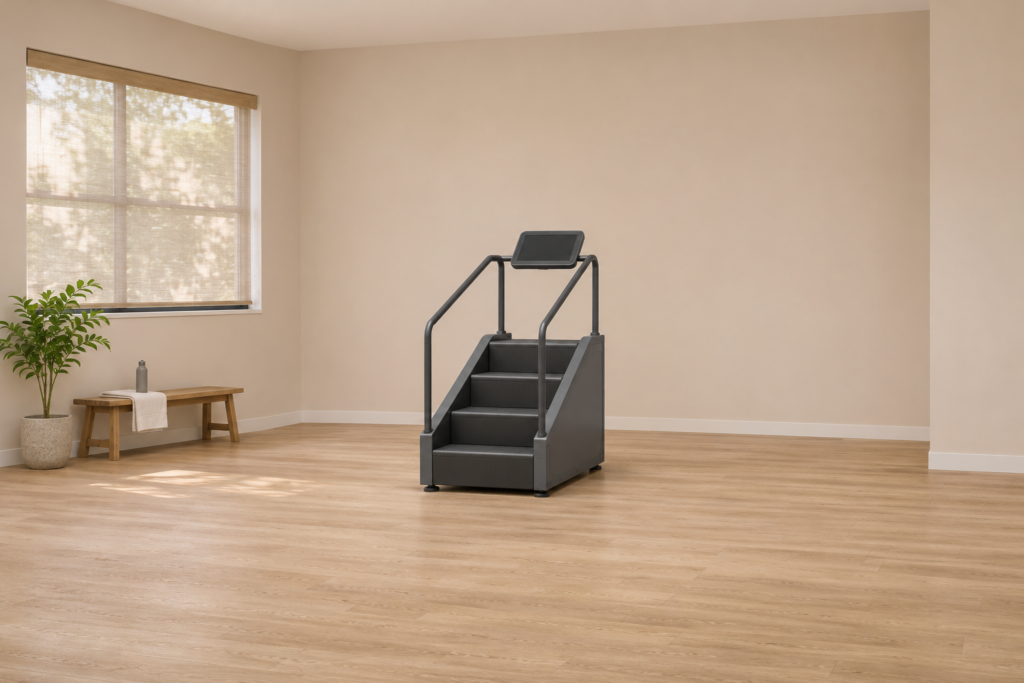
Buying framework
Set the equipment brief
Name the purchase conditions before choosing a model.
The required action: State whether actual stair treads are essential to your project. Treat that as a buying condition rather than an optional extra.
A preference and a constraint: Record the pace response you prefer, then separately mark any operating-power condition you cannot accept.
Who this is for
Two reasons for comparing climbers
A replacement project and a legacy reference create different priorities.
Replacing a familiar gym staircase: Suppose you want a replacement for a gym staircase, rather than a different equipment action. Make that continuity the first condition; secondary extras should not decide the machine type for you.
Using older documentation as a reference: When an older machine is your reference for a differently controlled replacement, identify what you intend to preserve. Familiarity with the name is a starting point for the comparison, rather than a substitute for the quoted configuration’s specification.
What to pay attention to
Three separate construction choices
Compare the equipment action, its electrical provision and its pace commands.
Required construction
Identify the equipment action that belongs in your purchase brief.
Accepted interaction
Separate the response you prefer from the conditions you must meet.
Stairs or retained platforms: The original Stairway in the February 2018 brochure is a historical rotating-staircase example, not a current-stock recommendation. Choose successive treads if that is the required action, accepting repeated foot placement. The current 8FC instead retains independent pedal platforms; its four-bar linkage keeps them level. It fits a pedal-platform preference, giving up a rotating staircase.
Operating power: Choose GTL to avoid a live operating supply during stepping; its self-powered configuration still brings recharge responsibility. The 10G’s specified 12V/5A supply suits a buyer committed to that package and willing to provide its operating feed.
Stair-speed commands: The original Stairway uses waist-belt tension: climbing higher makes the stairs faster. It suits position-paced stepping, accepting the belt and that response. The GTL manual instead assigns actual stair speed to console UP/DOWN arrows, suiting explicit selection while accepting button commands.
Avoid these traps
One care assumption to leave behind
A purchasing obligation can differ from a familiar maintenance habit.
Chain care: Accept GTL’s chain-care rule: its manual advises against oiling or greasing the chains.
Decision guidance
Apply two conditions to one configuration
Keep both requirements visible when evaluating a partial match.
Self-power and selected stair speed: GTL satisfies self-power plus console-selected speed; accept its adapter when battery recharging is needed. The original Stairway also meets self-power, but its position-paced stairs fail the console-command condition.
Ownership & compatibility
Keep the prescribed surfaces clean
This continuing duty is distinct from the purchasing mistake above.
Rail contamination: Keep GTL’s stainless frame rails beneath the step-to-chain attachment clean and free of grease, oil and polish.
FAQ
Three additional details
These facts concern console operation and later identification.
Does STOP do the same as RESET?
Which wireless receiver compatibility is named?
Where is the serial number?
Readiness check
Let the remaining preference decide
Use the purchase brief to give secondary extras their proper place.
Research note: Selective manufacturer desk research uses current product sheets, a historical brochure and paragraph text from a manufacturer-authored manual mirror. No hands-on or accuracy comparison was performed. The original Stairway illustrates the 2018 configuration only.
Prioritize the relationship: After firm geometry and operating-power constraints are settled, give the preferred pace relationship priority over secondary extras.
Reading shortcuts
Go to the part of the purchase decision you need.
Decision reminders
Keep the purpose of the purchase alongside the shortlist.
- Preserve the priority: Write down the feature you set out to retain or change.
- Separate optional extras: Identify which additions are welcome without letting them redefine the project.
Glossary
A construction term from the comparison.
Lists
Explore candidates before naming finalists.
- Broaden the search: Use a list to identify equipment worth investigating for your stated purpose.
Have named finalists? A comparison can resolve the differences that remain.