
Stair Machines Buying Guide for Home Workouts
A residential stair machine has to fit vertically as well as horizontally. The standing user rises above the cabinet, rotating steps need safe entry and exit, and commercial-style units can be difficult to deliver, power, service, and remove. Measure the person, specified standing position, ceiling, door route, floor, outlet, and emergency path as one system.
Current products span compact pedal steppers and vertical climbers through residential revolving staircases costing several thousand dollars. STEPR lists an 82-inch-tall residential design and a limited home-use warranty, but buyers still need user headroom and model-specific installation clearance. Compare the delivered machine, electrical work, mat, assembly, maintenance, subscription, and eventual removal before financing.
Buying framework
Design the home climbing station from ceiling to floor
Room readiness, fast startup, noise tolerance, and cleanup determine whether a home stair machine remains available.
1. Define the home climbing session: Write down session length, step-rate range, household schedule, nearby sleepers or workers, and the shortest workout worth starting. A compact stepper and a powered revolving staircase create very different home routines.
2. Measure from floor to ceiling: Use the manufacturer’s ceiling-height requirement for the exact model and tallest intended user. Confirm the specified standing position, mounting motion, overhead fixtures and service clearance; do not add the full cabinet height to the user’s height. Keep the entry side, emergency exit, and power cable unobstructed.
3. Walk the delivery route: Compare package size and weight with doors, hallway turns, stairs, elevator, railings, ceiling changes, and final assembly area. Confirm in-room placement, packaging removal, return pickup, and eventual removal in writing.
4. Test slow entry and stopping: Use normal shoes, reach the rails, mount at the minimum speed, climb steadily, stop, and dismount. The household user should not need a jump, hurried step, or body-weight hang from the handrails.
5. Price the installed home system: Include freight, assembly, electrical work, floor protection, fan, subscription, preventive maintenance, drive parts, labor, technician travel, and removal. Confirm that the warranty covers the exact residential installation.
Who this is for
Home stair formats create different movement and space demands
The same stair machine can be convenient in a dedicated room and disruptive in a bedroom, office, or shared living area.
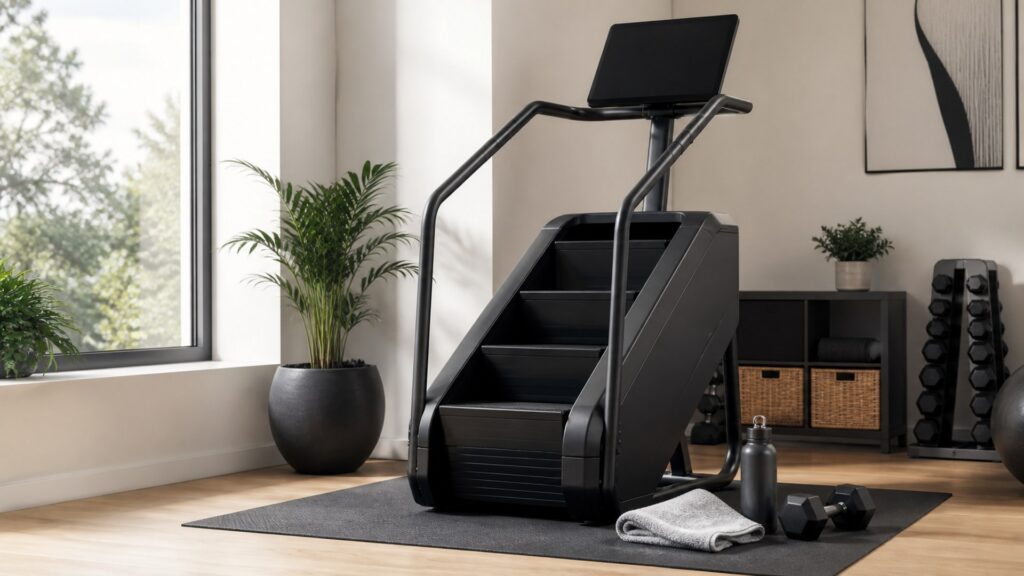
Residential revolving staircase: This format delivers continuous moving treads in a shorter cabinet than many commercial units, but it remains tall, heavy, powered equipment. Verify headroom, tread depth, slow speed, sensors, delivery, and home warranty.
Compact pedal stepper: Two pedals reduce height and floor demand, making this the simplest home option. Compare pedal size, minimum force, side-to-side consistency, handle support, resistance range, frame stability, and whether both pedals stop predictably.
Vertical climber: Linked hand-and-foot motion uses little floor length but requires coordination and substantial overhead clearance. Check stride adjustment, handle reach, mounting, frame movement, ceiling fans, and control during fast climbing.
Incline trainer: A steep moving belt offers climbing without discrete treads and may support slower walking. It needs more floor length plus belt alignment, incline motor, deck care, outlet planning, and safe entry at elevation.
Used commercial staircase: A secondhand club machine may appear durable, yet freight, ceiling, model-specific electrical requirements, worn steps, obsolete electronics, unavailable parts, and residential service can make the apparent bargain expensive.
What to pay attention to
Residential specifications that affect every climb
Judge dimensions, power, sound, controls, and cleanup as parts of one household installation.
Tread fit: Use the household's largest normal training shoe and compare usable depth, width, rise, edge visibility, and grip. Repeated heel overhang or uncertain placement becomes more important than the number of programmed levels.
Slowest controllable pace: Home users need a calm starting rate for mounting, warm-up, and fatigue. Test acceleration from the minimum speed and deceleration back to it; a high maximum does not compensate for a rushed entry.
Installed headroom: Use the model-specific user-height and ceiling guidance. Account for the actual standing position, natural movement, mounting and overhead fixtures at every proposed location.
Landing and emergency controls: Inspect fixed landings, first-step height, rail position, stop buttons, presence sensors, and what happens when the user slows unexpectedly. Practice stopping and stepping off without turning into a wall or furniture.
Rail position: The front handrail and side grips should steady the climber without raised shoulders, forward collapse, or backward leaning. At the intended step rate, the feet should carry the workload rather than the arms.
Home electrical and floor plan: Verify voltage, amperage, plug, grounding, dedicated-circuit language, product mass, user limit, floor structure, leveling feet, and mat compatibility. Route power away from the mounting side and emergency exit.
Home service coverage: Compare drive, steps, sensors, monitor, wear parts, labor, technician travel, and freight separately. Confirm who services the installed machine locally and how a tall unit is removed if on-site repair fails.
Avoid these traps
Home exercise-stair machine plans that fail after delivery
Home stair-machine mistakes usually begin with missing headroom, an uncontrollable minimum speed, insecure treads, difficult delivery, inadequate power, or no practical service route.
Measuring the cabinet only: A home stair machine can clear the walls while the standing user hits an overhead fixture or lacks room to mount. Tape the tread, body, handrail, entry, exit, and service envelope.
Planning to roll it away daily: Transport wheels help only on suitable level floors. Tall mass, carpet, thresholds, tight turns, power cables, and ceiling changes can make frequent relocation unsafe or unrealistic.
Choosing the fastest model: Maximum step rate matters less than a smooth, controllable minimum, secure treads, reachable stop controls, and predictable deceleration. Beginners and tired users need a genuinely manageable starting pace.
Assuming headphones solve household noise: Headphones reduce class audio for the user but do not change step impacts, drive sound, cooling fans, frame movement, or vibration reaching another room or the floor below.
Ignoring cancellation and offline use: A connected console may lose classes, profiles, or history when a membership ends. Confirm that manual step-rate control, time, and safe stopping remain useful without internet access.
Decision guidance
Perform a three-day home simulation
A taped zone and timed routine reveal conflicts before a heavy stair machine enters the room.
Build the vertical mock-up: Tape the stair-machine footprint and mark the user’s headroom using the manufacturer’s specified standing position. Include handrail reach, mounting landing, door swings, ceiling fixtures, outlet, and the household walkway.
Time two start-ups: Time a connected class start and a five-minute manual stair climb. Include shoes, water, sign-in, profile selection, minimum step rate, cooling fan, emergency stop check, and return to neutral speed.
Listen through the home: Warm the drive, climb at easy and brisk rates, and have another person listen beside the machine, in the next room, and below. Separate step impact, motor, fan, speaker, and floor vibration.
Practice delivery and service access: Walk the carton route and verify where assembly occurs. Leave technicians room to reach steps, drive covers, sensors, leveling feet, power inlet, serial number, and the parts required for removal.
Rehearse the complete reset: Stop the steps, dismount, clean the rails and treads, remove personal devices, dry towels, restore neutral speed, and leave the entry and emergency path clear for the next session.
Ownership & compatibility
Keep a home stair machine ready without crowding the room
Readiness depends on sweat control, stable flooring, organized accessories, account discipline, and early mechanical attention.
Clean after each climb: Use approved products on treads, landings, rails, controls, and sweat paths, then let towels and shoes dry away from sensors, drive openings, electrical parts, and household fabrics.
Recheck placement: Inspect leveling feet, mat edges, power-cable routing, overhead clearance, and frame migration after early sessions or any move. Restore the measured envelope if the machine shifts toward furniture or a doorway.
Inspect step and stop systems: Check tread surfaces, pedal links, rails, fasteners, guards, sensors, and emergency controls at the manual's interval. Stop use for irregular movement, damaged steps, unreliable stopping, heat, odor, or grinding.
Manage accounts and updates: Use separate profiles, protect credentials, schedule software changes deliberately, and document cancellation terms. Delete personal data before service or resale and preserve a manual climbing mode for outages.
Keep service evidence: Save the receipt, serial number, assembly record, electrical work, warranty, maintenance log, and technician contacts. Record step rate, temperature, and timing when reporting an intermittent noise or control fault.
FAQ
Home Stair Machine FAQ
Direct answers about format, ceiling, entry, rails, power, maintenance, calorie estimates, and warranty.
Which stair-machine type works best at home?
How do I calculate home ceiling clearance?
Can a beginner use a home stair machine?
How much should I hold the rails?
Are home stair-machine calorie numbers reliable?
Can a stair machine be installed upstairs?
What maintenance will a home stair machine need?
Does a home stair machine need a dedicated circuit?
Which home warranty terms matter?
Bottom line
Buy for an ordinary day at home
A successful home stair machine starts quickly, fits the room, respects other occupants, and returns cleanly to a ready state.
Room: The complete operating zone survives normal household traffic.
Routine: Both short and full sessions start without avoidable delay.
Sound: Actual listeners accept warmed-machine and floor noise.
Reset: Sweat, accessories, profiles, and settings are handled after every climbing session.
Home Stair Machine Route
Use these checkpoints before comparing home stair machine products.
Home Stair Machine Boundaries
A home stair machine must coexist with the room before its entertainment features matter.
- Frame is not use space: Add user movement.
- Wheels have limits: Rehearse relocation.
- Home headroom includes the standing user: Check the actual climbing position.
- Apps can change: Preserve manual use.
Home Stair Machine Terms
Terms used in this home stair machine guide.
When a Home Stair Machine Ranking Helps
Home-stair machine rankings help only after the room and routine are defined.
- Best suited for: Prefer installed dimensions, sound protocol, startup steps, offline behavior, fit testing, delivery scope, and local service evidence.
- Known drawback: Lists can overvalue screens while ignoring floor transmission, accessory clutter, subscription dependence, and the effort required to move a heavy stair machine.
Evidence note: Product dimensions, delivery options and home-use warranty are described in STEPR documentation. No Review Streets hands-on test is claimed. Source reviewed September 23, 2026; confirm the exact model’s installation and electrical requirements in its manual.
Compare Home Stair Machine Finalists
Compare stair machines in the household sequence from startup through cleanup.
- Evidence check: Build a floor-to-ceiling mock-up, rehearse minimum-speed mounting and stopping, listen through the home, verify the outlet, and walk the complete delivery and removal route.
- Ownership check: Include residential freight, in-room assembly, electrician work, floor mat, software membership, step and drive care, technician travel, labor, and eventual removal.
Approve the home stair machine only when headroom, tread fit, slow entry, household noise, electrical supply, residential warranty, and local service are confirmed for that room.