
Stair Machines Buying Guide for Low-Impact Training
For low-impact training, choose a stair machine by how comfortably you can step, balance and stop—not by the low-impact label alone. A pedal stepper keeps the feet on moving platforms, while a revolving staircase requires repeated foot placement onto treads. Those experiences can feel very different even at a modest pace.
Start with a manageable step height, smooth movement, stable support and a genuinely easy starting effort. If joint pain, recent surgery or a balance problem is driving the purchase, ask your clinician or physical therapist whether stepping is appropriate before committing to a machine.
Buying framework
Separate lower impact from lower demand
Understand the movement: Low impact does not mean no joint loading. Stepping still involves supporting and moving your body through a repeated range of motion; a machine can avoid jumping yet feel demanding.
Define what comfort means: Note whether your concern is the first step onto the machine, knee bend, foot pressure, balance or keeping up with moving treads. Different problems require different equipment features.
Choose control before intensity: A gentle starting effort and predictable motion are more useful than a high maximum. You should be able to finish a short trial without being forced into hurried steps or heavy leaning.
Who this is for
Choose the stepping motion you can control
Pedal stepper: The feet remain on the platforms, reducing the need to locate a new tread each time. Check pedal size, travel and minimum force; small hydraulic units are not automatically easy to press.
Stepper with integrated rails: A stable handhold may help with mounting and balance. Check whether it is reachable while you stand comfortably rather than pulling yourself into an awkward position.
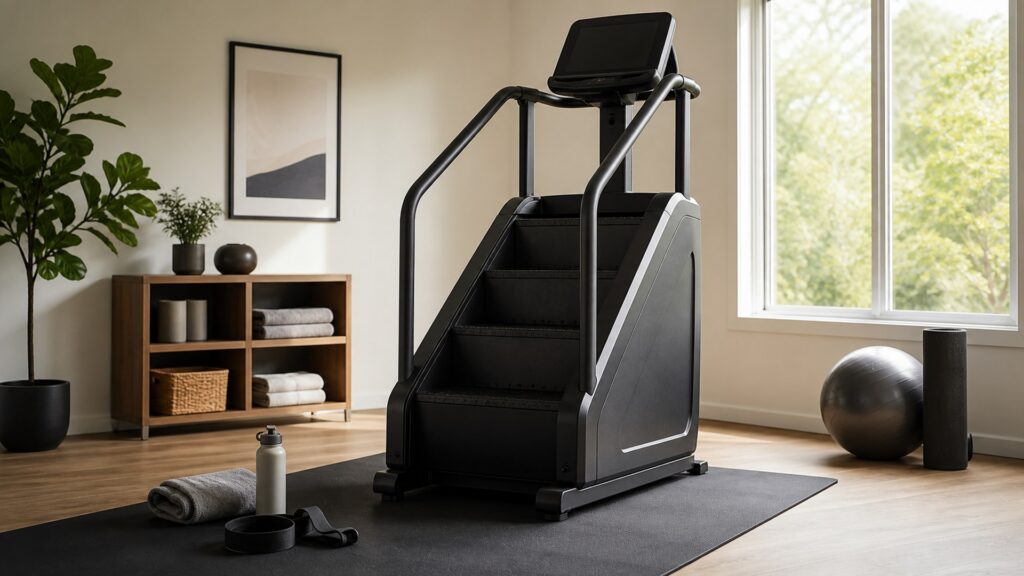
Revolving staircase: Continuous stairs suit buyers who tolerate repeated step-ups and can place their feet reliably. Confirm the minimum speed, entry height and stop procedure before considering harder sessions.
Another cardio format: If comfortable stepping is not possible, compare a suitable walking, cycling or elliptical option with your care professional. Buying a stair machine is not the only route to lower-impact activity.
What to pay attention to
Inspect the contact points and easy settings
Step height and travel: Try the actual motion in normal workout shoes. Shorter travel can feel different, but there is no single height that suits every person; judge the complete movement rather than a number in isolation.
Pedal or tread area: Check secure foot placement, grip and edge visibility. An oversized shoe should not force an unstable position or interfere with the opposing pedal.
Minimum effort: Test the lowest usable setting and smooth return. Resistance, step depth and speed controls may do different jobs, so ask what each adjustment actually changes.
Support and stopping: Reach the rails and stop control without twisting or overreaching. Ask the seller to explain normal stopping, emergency stopping and safe dismounting for that model.
Avoid these traps
Avoid promises the machine cannot make
Low impact is not pain-free: A marketing phrase does not establish suitability for arthritis, recovery or a particular injury. The Arthritis Foundation recommends choosing exercise with individual needs and professional advice in mind.
A smaller base is not always easier: A mini stepper can demand more balance than a larger model with rails. Judge support and control alongside storage convenience.
Rails do not correct an unsuitable pace: If ordinary stepping requires hanging heavily from the handles, reduce the demand and reassess the fit. Do not buy extra speed in place of a usable easy setting.
Therapy claims need evidence: Do not assume a consumer stepper is rehabilitation equipment. For example, the Sunny SF-S021055 manual explicitly states that it is not suitable for therapeutic use.
Decision guidance
Use a comfortable demonstration to decide
Start with access: Have the seller demonstrate entry and exit before you try the machine. A comfortable workout is not enough if mounting is the difficult part.
Check a short easy session: Use the lowest comfortable effort and observe foot placement, support and rhythm. This is a fit check, not a test of how much discomfort you can tolerate.
Notice what changes: Compare whether movement remains smooth and controllable as you continue. Stop for pain or instability; a symptom-provoking demonstration is not a reason to buy and hope.
Keep a return option: Check the assembled-trial policy. When health limitations are involved, use your clinician’s advice to judge the choice rather than relying on a salesperson’s assurance.
Ownership & compatibility
Maintain predictable movement
Inspect before use: Follow the manual for checking pedals, rails, fasteners and moving connections. Loose support or uneven pedal action can undermine an otherwise comfortable fit.
Respect usage limits: Some hydraulic steppers need cooling between uses. Read the actual operating instructions rather than borrowing a session limit from another model.
Service changes promptly: Stop for damaged parts, unusual grinding or uncontrolled movement. Follow the manufacturer’s maintenance procedure; do not experiment with lubricant on every joint.
FAQ
Low-impact stair machine FAQ
Are stair machines automatically easy on the knees?
Is a pedal stepper easier than a revolving staircase?
Should I choose the lowest step height?
Can I use a consumer stepper for rehabilitation?
What if the trial causes pain?
Bottom line
Buy for comfortable repeatable movement
Put these first: Manageable access, stable support, smooth motion and an easy setting you can use confidently.
Spend more when it helps: Better rails, clearer controls and reliable servicing may matter more than a larger screen.
Choose another option when necessary: If stepping remains uncomfortable or poorly controlled, a different activity is a better choice than forcing the purchase.
Reading Shortcuts
Use the sections below to check fit, practical constraints and ownership before choosing.
Decision Reminders
Keep these checks in view when comparing finalists.
- Low impact does not guarantee comfort.
- Check mounting and stopping as well as stepping.
- Choose support that suits the individual.
Glossary Snippets
Terms that help compare the actual machines.
When to Use a Top 10 Review
Use rankings to find candidates after defining your space, fit and session requirements.
- Look for: Exact-model dimensions, control details and ownership support.
- Then verify: The manufacturer’s manual and a suitable demonstration.
Evidence: Arthritis Foundation exercise guidance supports individualized activity selection. Sunny SF-S021055 manual, p. 1 identifies that consumer model as unsuitable for therapeutic use. Sources reviewed September 23, 2026. No hands-on product test is claimed.
When to Use a Comparison
Use a direct comparison after two or three models meet the basic requirements.
- Fit check: Low impact does not guarantee comfort.
- Cost check: Include delivery, setup, wear parts, service and any subscription.
Keep the exact model and warranty terms alongside the quote so similar names do not hide different specifications.