
Stair Machines Buying Guide: How to Choose the Right One
The term stair machine can describe four different movements: a revolving staircase, a pair of pedals, a linked vertical climber, or a steep incline belt. They differ in foot placement, coordination, entry, ceiling demand, power, service, and how intensity changes. Choose the movement before comparing screens or estimated calories.
Large commercial staircases may cost well into five figures, while compact home units and vertical climbers occupy lower price tiers with different compromises. StairMaster publishes large commercial 8G and 10G systems; STEPR markets shorter residential machines around an 82-inch cabinet height. These are reference points, not interchangeable recommendations. Fit the user, room, delivery route, electrical supply, maintenance plan, and warranty first.
Buying framework
Choose the climbing movement before the console
A useful stair machine comparison begins with body position, access, resistance behavior, and the room where stepping will happen.
1. Choose the climbing motion: Decide among a revolving staircase, independent-pedal stepper, vertical climber, incline trainer, or compact residential stair unit. Each changes foot placement, coordination, ceiling demand, controls, power, and maintenance.
2. Measure the full vertical envelope: Use the manufacturer’s ceiling requirement for the exact model and tallest user. Check the specified standing position, mounting motion, overhead fixtures and service clearances; do not add the full cabinet height to the user’s height. Cabinet height alone cannot prove that a room is suitable.
3. Test entry at the slowest rate: Practice reaching the rails, stepping onto the landing or pedals, starting, stopping, and dismounting. The minimum controllable speed matters more for beginners than a headline maximum step rate.
4. Evaluate foot placement and posture: Use normal training shoes and inspect usable tread depth, heel support, knee path, hip control, rail reach, and whether the user can stay upright without hanging body weight from the handrails.
5. Price installation and service: Include freight, doorway or elevator constraints, assembly, electrical work, floor protection, preventive maintenance, wear parts, technician travel, subscriptions, downtime, and eventual removal. Match the warranty to residential or commercial use.
Who this is for
Compare five distinct climbing formats
Compare each format by user position and resistance behavior instead of treating every stationary stair machine as interchangeable.
Revolving staircase: A continuous loop of steps most closely resembles climbing stairs and permits sustained work without a tall building. It demands substantial height, careful mounting, unobstructed egress, and disciplined use of side rails rather than body-weight support.
Independent-pedal stepper: Two linked or independent pedals create a compact stepping path without exposed rotating stairs. Compare minimum step force, pedal depth, side-to-side consistency, range, joint path, and whether the user can stop both pedals predictably.
Vertical climber: Hands and feet move through a tall linked pattern, increasing upper-body involvement while reducing floor length. Check coordination, stride adjustment, overhead clearance, mounting, handle reach, and whether the machine remains stable at vigorous rates.
Incline trainer: A steep treadmill-style deck provides climbing work with a walking belt instead of discrete stairs. It occupies more floor length and adds belt alignment, deck care, incline motor, speed control, and footwear considerations.
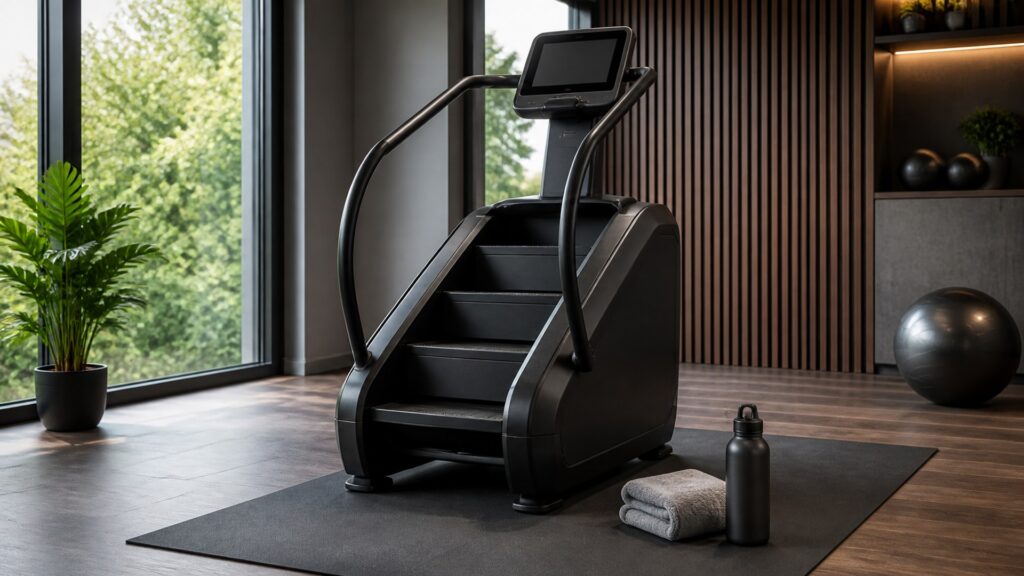
Compact home staircase: Newer residential stair units shorten the commercial footprint but remain tall, heavy, powered machines. Verify ceiling clearance over the standing user, delivery turns, step dimensions, safety sensors, electrical circuit, service access, and approved home warranty.
What to pay attention to
Translate stair specifications into movement and room demands
Numbers matter when they explain user geometry, step contact, resistance response, room demand, or service exposure.
Usable step geometry: Compare tread depth, width, rise, edge visibility, surface texture, and exposed-step count together. The intended shoe should land securely without repeated heel overhang, and the staircase must provide enough recovery space for controlled placement.
Step-rate range: Compare the slowest stable rate before the headline maximum. Beginners, warm-ups, and cautious users need a genuinely manageable start; trained users need smooth acceleration and controls reachable without changing posture.
Ceiling envelope: Machine height is not the required ceiling. Use the model-specific ceiling and user-height guidance, including the specified standing position, mounting motion, overhead fixtures and required clearances.
Mounting and stopping: Inspect fixed landings, first-step height, rail reach, emergency stop, presence sensors, side clearance, and deceleration. Practice entry and exit at the slowest speed, following the manufacturer’s demonstration procedure for stopping.
Handrails and posture: Rails should support balance without forcing a shrug, forward hang, or backward lean. Test front and side grips while keeping most body weight through the feet; constant arm support changes the intended stepping demand.
Power and floor: Confirm voltage, amperage, plug, dedicated-circuit guidance, cord route, product weight, user limit, floor capacity, levelers, and mat compatibility. Do not run a cord through the mounting or emergency-exit path.
Console, parts, and support: Check step rate, time, elevation assumptions, heart-rate support, guest mode, offline operation, updates, parts diagrams, labor, and technician travel. Confirm that the warranty explicitly covers the buyer's residence or facility installation.
Avoid these traps
Exercise-stair machine shortcuts that produce poor matches
Most bad stair machine purchases confuse one impressive number with complete user fit or long-term ownership.
Choosing by calorie display: A calorie estimate cannot prove secure foot placement, controllable speed, useful posture, or individual energy expenditure. Compare movement, access, room, power, and service before treating console output as a benefit.
Measuring cabinet height only: The user stands on a tread or pedal, not on top of the cabinet. Check the manufacturer’s required ceiling height for the model and user, including mounting space and overhead fixtures.
Using maximum capacity as fit proof: A structural user limit does not show that the tread supports the shoe, the slowest rate is manageable, the rails fit the user, or entry and exit are controlled.
Leaning heavily on the rails: Handrails support balance and safe entry, but carrying body weight through the arms changes posture and workload. Reduce speed when upright control requires constant pulling, hanging, or a forward collapse.
Ignoring removal and repair access: A tall, heavy stair machine can be difficult to service or remove. Confirm cover access, technician space, replaceable steps and drive parts, doorway height, elevator limits, and who pays for disassembly.
Decision guidance
Run a complete stair machine fit and control trial
A structured exercise-stair machine moving trial provides more useful evidence than comparing program counts from product pages.
Walk the delivery route: Compare packaged and assembled dimensions with doors, hallway turns, stairs, elevator, ceiling, railings, and final position. Confirm where assembly occurs and how the machine leaves for return or disposal.
Mount at minimum speed: Use normal shoes, reach the rails, step onto the fixed landing or first moving tread, start at the lowest rate, and stop. The user should not need a jump or hurried transfer.
Climb through three rates: Try a slow warm-up, sustainable working pace, and brief harder rate. Observe foot placement, knee path, posture, rail use, frame motion, step consistency, control reach, and emergency-stop access.
Test the actual console: Find step rate, time, pause, stop, and any target metric without a phone or account. Then verify heart-rate devices, profiles, guest mode, class access, and behavior after subscription cancellation.
Rehearse an interruption: Learn normal and emergency stopping under the manufacturer’s procedure and the demonstrator’s supervision. Confirm when the steps stop and how to dismount; do not stage a surprise stop.
Ownership & compatibility
Maintain the stair machine where force and sweat collect
steps, drive components, step deck hardware, adjustment posts, resistance components, and electronics deserve a written inspection routine.
Clean treads and contact points: Use approved products on steps, rails, controls, landings, and sweat paths. Keep liquid away from bearings, drive openings, sensors, electrical joints, belts, chains, and console vents.
Inspect the climbing path: Check tread surfaces, step edges, pedal links, rails, fasteners, leveling feet, guards, and stop sensors at the specified interval. Lock out the machine for damaged or irregular movement.
Follow drive maintenance exactly: Use only the specified tension, lubrication, cleaning, and preventive-service procedures. Record changes in step timing, belt or chain sound, heat, vibration, and deceleration rather than improvising adjustments.
Protect electrical and account systems: Keep the power cable outside entry and exit routes, review software updates, protect administrator credentials, and verify guest reset and personal-data deletion before service or resale.
Preserve service records: Save the receipt, serial number, installation sign-off, electrical work, warranty, maintenance log, parts diagrams, and technician contacts. Report the step rate and operating conditions that reproduce an intermittent fault.
FAQ
Stair Machine Buying FAQ
Direct answers about format, ceiling, entry, rails, power, maintenance, calorie estimates, and warranty.
What type of stair machine should I buy?
How much ceiling height does a stair machine need?
Is a stair machine suitable for beginners?
How should I use the handrails?
Can I trust stair-machine calorie estimates?
Can a stair machine go upstairs?
What maintenance does a stair machine require?
When is a dedicated circuit required?
Which warranty terms should I compare?
Bottom line
Approve the user-machine relationship
The best stair machine fits the user, responds predictably, and remains usable after the initial feature excitement fades.
Format proof: The stepping position suits the intended sessions and mounting needs.
Fit proof: Knees, hips, feet, hands, and step deck contact remain comfortable under motion.
Control proof: Useful resistance changes and core metrics work without fragile dependencies.
Ownership proof: Space, accessories, cleaning, warranty, service, and total cost are acceptable.
Stair Machine Route
Use these checkpoints before comparing stair machine products.
Stair Machine Boundaries
An exercise-stair machine specification matters only when it changes fit, control, access, or ownership.
- Capacity is not fit: Test body geometry.
- Minimum speed matters: Test a controlled start and stop.
- Connected is not permanent: Check cancellation.
- Home warranty has limits: Match the use setting.
Stair Machine Terms
Terms used in this stair machine guide.
When a Stair Machine Ranking Helps
Use rankings after selecting stair machine format and proving user fit.
- Best suited for: Look for measured adjustment, step details, moving trials, resistance behavior, offline controls, warranty, and installed cost.
- Known drawback: Lists organized around screens or maximum speed can hide poor geometry, incompatible shoes, app dependence, and short labor coverage.
Evidence note: step geometry, entry, speed range, headroom, power, and support were checked against current StairMaster 10G documentation. No Review Streets hands-on test is claimed. Checked September 21, 2026.
Compare Stair Machine Finalists
Compare finalists with one user, shoe, setup protocol, step rate, and resistance sequence.
- Evidence check: Compare the movement families through a shoe-on-tread trial, slow-speed entry, emergency-stop rehearsal, full vertical measurement, power review, and model-specific service check.
- Ownership check: Total freight, rigging, assembly, electrical preparation, floor protection, preventive visits, drive and tread parts, labor, technician travel, downtime, and removal.
Select the stair format only after movement control, shoe placement, headroom, power, warranty eligibility, and a realistic technician route have all been documented.