Standing Desks vs Traditional Desks: Key Differences Explained

Standing desks and traditional desks both can support productive work, but they create different ergonomic and purchasing tradeoffs. This comparison weighs adjustability, posture variety, cost, stability, cable management, floor planning, employee adoption, and the practical risk of sitting or standing too long.

By: Harley Hansen
Updated: June 24, 2026
Approx. 10-12 min read
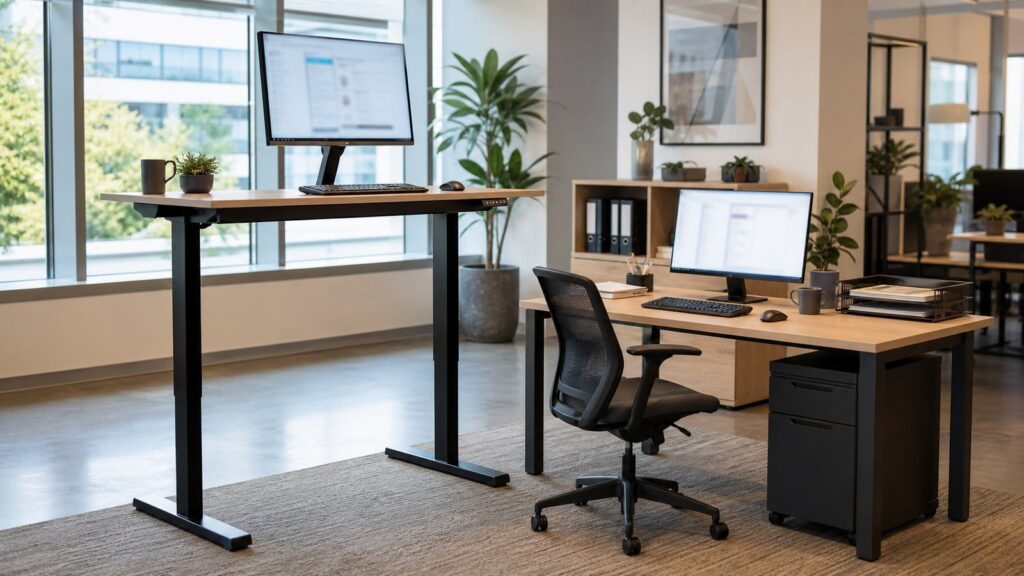
Standing Desks vs Traditional Desks business comparison image

Head-to-head

Standing Desks vs Traditional Desks: Key Differences Explained

A practical A/B look at standing desks and traditional desks, focused on ergonomics, adjustability, cost, stability, adoption, workspace planning, and comfort.

Standing Desks comparison image

Standing Desks

Standing desks are stronger when the business wants adjustable workstations that let employees alternate posture and tune desk height to the user.

Score 8.7 Best for posture flexibility Model Adjustable Why buy Flexibility
  • Allows sitting and standing rotation
  • Better fit for varied users
  • Can improve workstation height matching
VS
Traditional Desks comparison image

Traditional Desks

Traditional desks are stronger when low cost, simplicity, fixed layouts, maximum stability, and minimal training or electrical complexity matter most.

Score 8.2 Best for simple fixed work Model Fixed Why buy Simplicity
  • Lower cost and simpler purchasing
  • Stable fixed work surface
  • Good when users rarely need adjustment
Metric
Standing
Traditional
Winner
Posture variety
Stronger
Limited
Standing
Cost
Higher
Stronger
Traditional
User fit
Stronger
Fixed
Standing
Simplicity
Moderate
Stronger
Traditional
Training need
Higher
Lower
Traditional
Best use
Adjustable work
Fixed tasks
Standing
Real-world context
Standing desks win for adjustability and posture variety; traditional desks win when fixed simplicity, lower cost, and maximum stability are the priorities.

Standing - Why people choose it

  • Supports alternating sitting and standing
  • Better height fit across users
  • Useful for ergonomic workstation programs

Traditional - Why people choose it

  • Lower purchase and setup complexity
  • Stable fixed work surface
  • Simple for offices with predictable seating
Winner: Standing Desks Standing desks are the stronger default for ergonomic flexibility, while traditional desks are better when the office needs low-cost fixed workstations with minimal operational complexity.
Read FAQs

Deep dive

What actually matters in this matchup

The standing-versus-traditional desk decision is really about adjustability and behavior. We weighted ergonomic fit, posture variety, cost, user training, stability, cable management, power access, floor planning, employee adoption, and whether the desk will actually be used in both sitting and standing positions.

Ergonomic flexibility: Standing desks are valuable because they let users alternate between sitting and standing and tune the work surface to their body. That does not mean standing all day is the goal. The practical advantage is movement and fit, not replacing one static posture with another.

Traditional simplicity: Traditional desks remain useful when the job is stable, the user group is consistent, and budget or facility simplicity matters. Fixed desks are easier to buy, install, cable, and maintain, and they avoid electrical controls or motorized components. Practically speaking.

Adoption reality: A standing desk only helps if employees know how to set chair height, monitor height, keyboard position, standing intervals, and accessory placement. Without training, users may stand too long, hunch over, or leave the desk at one height permanently. Today.

Cost and rollout: Standing desks usually cost more and can complicate power, cable routing, monitor arms, privacy panels, and floor plans. Traditional desks can stretch a budget further, especially for temporary workstations, touchdown spaces, classrooms, and fixed task areas. That keeps planning practical.

Health and comfort: Ergonomic guidance generally favors avoiding awkward postures and avoiding sitting or standing too long. A well-designed office should help workers change position, take breaks, and stay comfortable rather than treating any single desk type as a health shortcut. Practically speaking.

Final choice: Standing desks earn the default edge because adjustability makes them better for varied users and modern workstation programs. Traditional desks remain the better choice when cost, simplicity, fixed layout, or task stability matters more than sit-stand flexibility. That matters practically.

Methodology

How we evaluated the matchup

This comparison uses current category research and buyer-decision analysis rather than hands-on lab testing.

Scope: This comparison uses official product information, vendor documentation, and buyer workflow analysis. We did not claim hands-on lab testing of Standing Desks and Traditional Desks; the goal is to map practical fit, adoption risk, and purchase criteria. Practically speaking.

What we compared: We compared ergonomic fit, posture variety, workstation adjustability, cost, user training, stability, cable management, power access, floor planning, and employee adoption, operating control, implementation effort, scalability, cost shape, reporting needs, integration burden, data governance, support expectations, and how quickly a business can get reliable outcomes after setup.

How results are interpreted: The winner is the stronger default for the buyer described here, not a universal answer. Standing Desks and Traditional Desks can both be correct when company size, workflow maturity, budget, staffing, and change-management tolerance point different directions.

What buyers should verify: Before deciding, verify current pricing, feature availability, contract terms, migration support, security requirements, data ownership, integration limits, reporting depth, exit options, and the internal owner who will keep the workflow working. That keeps rollout planning practical.

FAQ

Standing Desks vs Traditional Desks: common questions

Are Standing Desks and Traditional Desks direct substitutes?
Sometimes, but not perfectly. Standing Desks and Traditional Desks can solve overlapping business problems, yet they usually differ in ownership model, workflow depth, implementation effort, reporting style, and long-term flexibility. Start with the process you need to improve, then compare fit. Practically speaking.
Which option is better for most businesses?
Standing Desks is the stronger default for the buyer described in this comparison because it better matches the central workflow tradeoff. Still, Traditional Desks can be smarter when team size, budget, integration needs, compliance requirements, or internal ownership point another direction. Practically speaking.
When should a team choose Standing Desks?
Choose Standing Desks when its strengths match the workflow you repeat often and the team can own adoption after launch. Verify integrations, reporting depth, user permissions, migration effort, support needs, and renewal terms before assuming it will stay practical after kickoff. Practically speaking.
When should a team choose Traditional Desks?
Choose Traditional Desks when its strengths match the buyer's constraints better than Standing Desks. Before committing, check implementation scope, data portability, user limits, support coverage, compliance fit, and how much training the team will need to use the option consistently. That matters practically.
Should price decide the comparison?
Price should be a gate, not the whole decision. A cheaper option can cost more if adoption fails, integrations break, reporting is weak, or migration takes longer than planned. Compare total ownership cost, setup effort, support needs, and switching friction. That matters practically.
Can a company use both options together?
Yes. Some teams combine Standing Desks and Traditional Desks when each solves a different part of the workflow. Define which system owns records, reporting, approvals, and ongoing changes so the combination does not create duplicated work or unclear accountability. That keeps planning practical.
What should buyers verify before deciding?
Verify the current feature set, pricing page, contract length, security posture, data export options, implementation timeline, integration needs, support coverage, and internal owner. A small pilot or structured demo is safer than buying from a feature checklist alone. That keeps rollout planning practical.
Is this based on hands-on testing?
No. This comparison synthesizes official documentation, category definitions, implementation patterns, and buyer decision criteria. It does not claim instrumented testing of every platform or configuration. Buyers should verify current terms, demos, references, and security details for the exact option considered. That matters practically.

Key Takeaways

  • Standing desks win for adjustability.
  • Traditional desks win for cost and simplicity.
  • Standing all day is not the goal.
  • Training affects ergonomic value.
  • Cable planning matters for sit-stand use.
  • Match desk type to work behavior.

Verdict

The Better Default for Adjustable Workstations

This desk-type matchup favors standing desks when ergonomic flexibility and posture variety matter most.

#1 Winner

Standing Desks

Standing desks are the better default for businesses that want adjustable workstations and a practical way for users to vary posture during the day.

  • Better posture variety
  • Stronger user fit
  • More ergonomic flexibility

Runner-up

Jump to the Head-to-Head

Tip: Do not buy standing desks as a magic health fix. Buy them when the office will train users and support sitting, standing, and movement well.

Where to Buy

Use demos, trials, discovery calls, and contract review before committing budget.

Vendor terms, demos, pricing, and feature availability change regularly. Some links may earn a commission and never affect rankings.

Accessories You’ll Want

  • Requirements checklist (keeps must-have workflows, data needs, and approvals visible before demos start)
  • Decision matrix (scores each option against cost, control, speed, risk, and long-term ownership)
  • Data inventory (shows which records, integrations, and permissions must move or be protected)
  • Stakeholder map (names the teams that will use, approve, support, or fund the choice)
  • Implementation calendar (turns the decision into milestones, owners, training dates, and review points)

Tip: Document responsibilities before kickoff so the winning option has an owner, timeline, data plan, and review point.