
Strength Training Equipment Buying Guide for Home Gyms
A home gym fails at its boundaries: a bar cannot be loaded beside a wall, the bench strikes an upright, a cable reaches the ceiling, plates wake another household, or freight never clears the stairs. Equipment selection therefore begins with a scale room plan and a limited exercise program, not a catalog of everything a commercial gym owns.
Prioritize the build this way: choose recurring exercises; record present loads and useful increments; measure delivery and working paths; set floor, noise, and anchoring limits; choose one primary resistance family; verify rated capacities and safeties; check rack, bench, bar, plate, dumbbell, and cable interfaces; price freight and assembly; reserve storage; then document inspection, service, parts, and expansion. Dated examples are not recommendations.
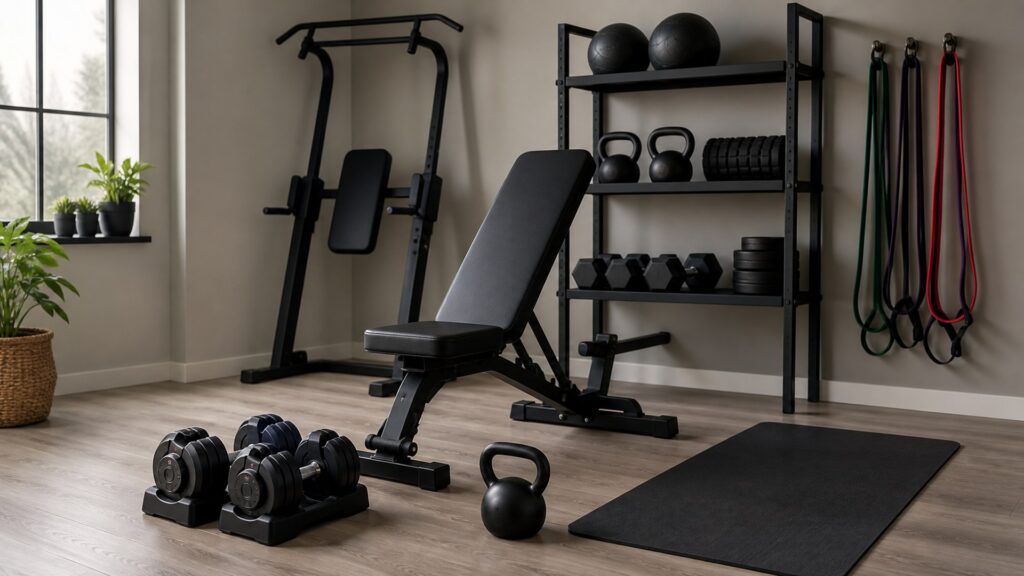
Buying framework
Design the room before buying equipment
The home plan must include delivery, assembly, use, storage, neighbors, and future service—not only a product's catalog footprint.
1. Draw fixed room constraints: Measure wall-to-wall dimensions, ceiling height at the lowest obstruction, doors, turns, stairs, outlets, windows, vents, lighting, floor slope, and anchorable surfaces. Verify load and alteration rules with the owner, building, or qualified professional as appropriate.
2. Overlay the moving envelope: Add barbell sleeves, plate loading stance, bench roll-out, rack safeties, cable extension, attachment swing, pull-up headroom, user limb travel, spotter position, and manufacturer clearances. Preserve doors, egress, electrical access, and household circulation.
3. Define the household progression: List users, exercises, minimum loads, useful increments, and plausible maximums. A selector that starts too heavy, a plate set with large jumps, or a cable ratio that changes effective increments can exclude part of the household.
4. Set noise and floor boundaries: Identify permitted lifting style, drop restrictions, quiet hours, shared walls, subfloor, moisture, and storage pressure. Plate material and diameter, bench feet, rack anchoring, mats, and platforms affect vibration differently; follow equipment and building instructions.
5. Plan delivery through retirement: Confirm carton sizes, weights, curbside or room delivery, lift-gate, assembly, packaging disposal, damaged-freight process, warranty, service access, replaceable cables and pads, proprietary components, disassembly, resale, and the path back out of the room.
Who this is for
Compare home-gym architectures
Each setup is best suited to a different household; decisive criteria and the main drawback clarify what the room is accepting.
Adjustable-dumbbell corner — best suited for minimal footprint: Key buying criteria are usable load range, increments, max load, handle length, selector speed, cradle clearance, and drop restrictions. Typical drawback: proprietary mechanisms can be long, delicate, or expensive to expand and replace.
Bench and dumbbells — best suited for broad compact training: Key buying criteria include bench geometry, adjustment angles, pad grip, stability, wheel path, and dumbbell clearance. Typical drawback: floor exercises and heavy dumbbell starts still need open working area and controlled handling.
Wall rack — best suited for reclaiming floor area: Key buying criteria are wall and floor requirements, folded and operating depth, rack width, hole spacing, safeties, bench fit, and accessory ecosystem. Typical drawback: installation is structure-dependent and folded hardware does not eliminate bar or plate storage.
Full rack and barbell — best suited for dedicated rooms: Key buying criteria are rated capacity, inside dimensions, safeties, anchoring, pull-up height, bench path, bar sleeves, and plate storage. Typical drawback: the complete working envelope and delivered cost are much larger than the rack frame.
Functional trainer — best suited for quiet directional variety: Key buying criteria are cable ratio, starting resistance, stack increments, pulley positions, handle travel, ceiling height, and service access. Typical drawback: high cost, complex assembly, fixed footprint, and exercise limits when cable travel is short.
What to pay attention to
Convert home-gym specs into room consequences
Every listed number should map to a user, exercise, safety control, household boundary, or service task.
Rated and usable load: Check bench, rack, safety, attachment, bar, dumbbell, and storage ratings with their conditions. Separately calculate minimum load, each increment, and maximum useful load for every user. A large capacity does not guarantee accessible progression.
Rack dimensions and ecosystem: Record outer and inner width, height, depth, upright size, hole diameter, hole spacing, base, crossmembers, and pull-up bar. Confirm compatible safeties, spotter arms, storage, and attachments for the exact generation, plus anchoring instructions and substrate.
Bench fit and adjustment: Compare flat height, pad length and width, gap, grip, back and seat angle combinations, adjustment ladder or pin, feet, rated capacity, wheels, and handle. Rehearse alignment, incline clearance, and removal without striking plates or walls.
Bars and plates in a quiet room: Verify shaft diameter, knurl, sleeve diameter and length, collars, plate holes, thickness, diameter, material, noise, and allowed drops. Iron can be compact but loud; bumpers can reduce some impact noise yet consume sleeve length and still transmit vibration.
Adjustable dumbbell operation: List every increment, minimum and maximum, handle length, change time, selector confirmation, cradle tolerance, expansion, and drop restrictions. Provide enough side and vertical clearance to return a tired set without pinching fingers or damaging mechanisms.
Cable mechanics and ceiling: Confirm 1:1, 2:1, or other stated ratio; effective steps; cable travel; lowest and highest pulley points; stack guard; attachment storage; and full overhead reach. Include guide-rod, pulley, and cable inspection or replacement access.
Dated complete-cost examples: Official Rogue US listings checked September 14, 2026 included adjustable dumbbells from $219 to $845, flat bench $195, adjustable benches $595–$950, wall rack $605, RML racks about $1,015–$2,072, and bars at $315 or $365. Examples are not recommendations; configurations, freight, shipping, sales, and availability change.
Avoid these traps
Avoid home-gym layout traps
A product can be well made and still be wrong for the room, household, delivery route, or maintenance capacity.
Using catalog footprint as floor plan: The frame rectangle omits user positions, bar loading, plate storage, bench movement, cable extension, spotter access, and egress. Draw each priority exercise at its maximum working orientation before ordering.
Assuming mats solve structure and noise: Mats can protect surfaces and alter contact, but they do not verify floor loading, eliminate vibration, correct slope, or authorize dropping. Follow building requirements, manufacturer directions, and suitable professional advice where needed.
Buying a rack without complete safeties: J-cups hold the starting bar; they are not the full failed-repetition plan. Price and position compatible pins, straps, or arms, confirm their rated use, and practice setting them for each movement.
Forgetting carton and service access: Assembled dimensions do not show whether boxes clear stairs or whether a technician can reach panels and cables. Review shipping weights, team-lift needs, tool access, wall gaps, and disassembly requirements.
Expanding before the core loop works: Attachments can consume money, storage, and setup time while priority exercises remain awkward. Complete several weeks with the base system, then add only the accessory that solves a repeated limitation.
Decision guidance
Conduct a room-scale dry run
Use tape, cardboard, measurements, and manuals to rehearse the complete system before freight enters the home.
Tape the operating zones: Mark rack, bench, dumbbell cradles, plate trees, cable station, bar sleeves, storage, and user paths. Open every door and test likely household traffic while the maximum exercise envelope is occupied.
Simulate loading and spotting: Walk the route for plates and dumbbells, set imaginary safeties, roll the bench, and take the bar-loading stance. Check hand, head, foot, and wall clearance at the lowest and highest planned positions.
Verify the substrate plan: Follow written anchoring and floor instructions for the exact model. Identify studs, concrete requirements, fasteners, torque, and permitted mat thickness using appropriate expertise; never improvise anchoring based on appearance alone.
Price a delivered first phase: Include required safety hardware, initial load set, collars, floor protection, storage, freight, lift-gate, installation, taxes, tools, and disposal. Keep optional attachments in a separate future budget tied to specific exercises.
Write the acceptance checklist: Inspect packaging, compare serial and model, inventory fasteners, document damage, assemble in sequence, torque as instructed, test empty movement, verify safeties and anchors, and stop for instability, binding, cable damage, or missing parts.
Ownership & compatibility
Keep the home setup quiet, clear, and serviceable
Household equipment needs repeatable reset locations, structural checks, clean contact points, and parts records.
Reset loads after every session: Return dumbbells to cradles, unload bars when instructed, seat selectors, store plates and collars, retract cables appropriately, and clear egress. A defined location prevents floor hazards and reveals missing or damaged components.
Inspect anchors and fasteners: Use manufacturer intervals and methods for anchors, bolts, safeties, J-cups, bench adjustments, wheels, selectors, bar sleeves, storage pegs, cables, pulleys, and guide rods. Remove questionable equipment from use pending proper resolution.
Control contact, corrosion, and grit: Clean knurl, handles, bench pads, frames, guide rods, and floors with approved products. Manage humidity and sweat without putting lubricant on grip surfaces or cables unless instructions specify it.
Monitor household effects: Listen for new vibration, rocking, floor movement, wall contact, or cable slap. Recheck mat creep, rack level, clearance, storage reach, and quiet-hour practice after rearrangement or meaningful load increases.
Preserve service information: Keep receipts, manuals, warranty terms, model revisions, serials, parts diagrams, anchor records, and support correspondence. Know the source and lead time for upholstery, cables, pulleys, feet, pins, selectors, and compatible hardware.
FAQ
Home-gym strength equipment FAQ
These answers address limited space, household impact, safety infrastructure, delivery, and expansion.
What equipment is best for a small home gym?
How much room does a power rack need?
Does a home rack need anchoring?
Are bumper plates quiet enough for apartments?
Which bench dimensions matter at home?
Are adjustable dumbbells suitable for home gyms?
What should be checked before equipment delivery?
How should a home gym be expanded?
What maintenance does home strength equipment need?
Bottom line
Make the room earn every component
A durable home gym covers priority exercises inside verified space, safety, noise, delivery, and service limits.
Room proof: Draw delivery, storage, full movement, loading, spotting, ceiling, and egress before purchase.
Progression proof: Confirm every household user's minimum, increments, useful maximum, and exercise coverage.
Safety proof: Follow capacities, safeties, anchoring, floor, clearance, assembly, and inspection instructions.
Ownership proof: Price freight, cleanup, noise control, maintenance, service, parts, and eventual disassembly.
Home-Gym Room Plan
Design the room in this order.
Household Setup Reminders
Four home-gym reminders.
- Stored is not operating: Working bodies, bars, benches, and cables expand every footprint.
- Quiet is structural: Mats alone do not eliminate vibration or verify floor suitability.
- Safety costs belong upfront: Safeties, anchors, collars, and clearance are core components.
- Exit matters: Know how equipment will be serviced, broken down, transferred, or removed.
Home-Gym Planning Terms
Home-gym terms decoded.
When a Home-Gym Ranking Helps
Use home-gym rankings after the scale drawing.
- Best suited for: Filter architectures by room, household loads, noise, and progression.
- Key buying criteria: Compare operating geometry, safety, delivery, service, and complete cost.
Research basis: official manufacturer listings and editorial interpretation; no hands-on testing or endorsement is claimed. Current examples can be checked at Rogue benches.
How to Compare Installed Systems
Compare complete installed systems.
- Typical drawback: Name the accepted cost in space, noise, setup, proprietary parts, or expansion.
- Official listings: Check current <a href="https://www.roguefitness.com/conditioning/strength-equipment/dumbbells/adjustable-dumbbells">adjustable dumbbells</a> and <a href="https://www.roguefitness.com/powerlifting">powerlifting equipment</a> for listed dimensions and configurations.
The official US home-equipment snapshot was recorded 2026-09-14. Confirm today's model configuration, delivered total, freight terms, promotions, and stock.