
Swimming Gear Buying Guide for Lap Swimming
Lap swimming repeats the same goggle seal, suit edges, cap pressure, turns, wall approaches, and deck routine for many lengths. Small fit problems compound, while oversized aids or slow retrieval can disrupt a shared lane. Choose the wearable core first, then add only training tools permitted by the pool and used by the actual workout.
Use this checklist: 1. confirm lane and aid rules; 2. note indoor or outdoor lighting; 3. fit the goggle seal, bridge, strap, and lens; 4. select a chlorine-resistant training suit with reliable turn coverage; 5. check cap edge and hair fit; 6. add only scheduled aids; 7. map circle-swimming and deck access; 8. size the locker bag; 9. rehearse rinsing and drying.
Buying framework
Design around repeated lengths and shared lanes
Fit, visibility, wall turns, lane traffic, and between-session care determine the useful lap kit.
1. Read the lane rules: Ask about circle swimming, speed sorting, passing, entry, rest positions, equipment queues, fins, snorkels, paddles, buoys, boards, watches, bottles, and deck bags. Match purchases to the facility's current practice instead of assuming another pool's policy.
2. Choose goggle optics and seal: Map indoor lighting, outdoor glare, early or evening use, prescription needs, peripheral awareness, and clock visibility. Screen eyecup shape and bridge placement before tightening the strap; pressure is not a reliable fix for leakage.
3. Fit a repeat-use training suit: Evaluate fabric blend, lining, seams, straps or waistband, coverage, stretch, and position through streamlines, turns, push-offs, and deck movement. Use only trials allowed by the seller and preserve return eligibility until fit is understood.
4. Keep aids compatible with traffic: A fin blade, board, snorkel, or buoy must suit the drill and leave predictable space near other swimmers. Confirm coach direction, lane width, entry and exit handling, and where the aid waits when not in use.
5. Close the deck-to-drying loop: Assign locations for goggles, cap, towel, permitted bottle, aids, locker key, wet suit, and dry clothing. The home reset must protect lenses, rinse contacted materials as directed, ventilate the bag, and finish before the next session.
Who this is for
Compare lap-swimming gear families
Repeated use changes the importance of seal, material durability, predictable retention, and easy deck handling.
Low-profile training goggles — best suited for steady pool lengths: Key criteria are socket fit, gasket softness, bridge options, split strap, buckle location, lens clarity, and spare availability. The drawback is smaller visual range or uncomfortable orbital pressure when the frame shape does not match the swimmer.
Chlorine-resistant training suit — best suited for frequent pool exposure: Compare fiber blend, lining, cut, seams, strap or waistband security, coverage, and care language. A durable fabric claim cannot correct poor fit; elastic, lining, and color can still change over time.
Silicone or latex cap — best suited for hair control and permitted streamlining: Inspect circumference, long-hair volume, thickness, edge feel, stretch, grip, and material-care needs. Caps can pull hair, feel hot, create pressure, tear, or slip, and some swimmers or facilities may not require one.
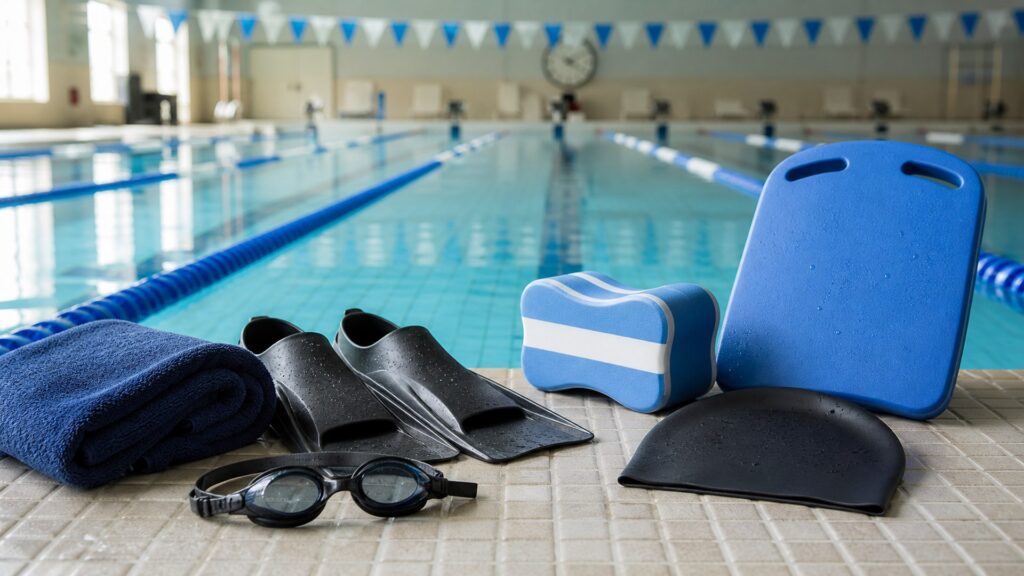
Short fins and center snorkel — best suited for scheduled technique sets: Check pocket geometry, blade stiffness, ankle comfort, tube and bracket position, mouthpiece, purge, and pool permission. They add cleaning, lane length, and handling complexity, while poor fit can interrupt rather than support the set.
Pull buoy or compact board — best suited for assigned isolation work: Evaluate body-size match, density, grip, edge comfort, lane footprint, deck storage, and whether the pool supplies them. The drawback is bulky carriage for an item that may appear in only a small part of the workout.
What to pay attention to
Translate lap specifications into repeat-use consequences
A useful detail explains visibility, retention, material behavior, lane fit, or reset work.
Eyecup and gasket geometry: Compare inner and outer dimensions, gasket depth and softness, frame flex, and where the seal contacts the face. Use gentle dry screening allowed by the seller; facial movement and repeated starts may reveal a mismatch later.
Lens tint and anti-fog care: Choose goggle tint for the actual light, wall contrast, pace clock, and peripheral needs rather than appearance. Read coating instructions because touching, wiping, soaps, or sprays may damage a factory treatment or void care guidance.
Bridge and strap adjustment: Fixed bridges rely on available sizes; interchangeable or adjustable bridges require correct assembly. Check strap split, buckle reach, hair interaction, cap layering, tail length, and whether replacement straps or bridges are sold.
Suit fibers, lining, and retention: Review polyester, PBT, nylon, elastane, or other stated blends without assuming a fiber guarantees life. Check wet-use care, lining, seam placement, neckline, leg opening, straps, waistband, and coverage through turns.
Cap fit under repetition: Compare silicone, latex, and textile construction for stretch, grip, edge pressure, hair volume, warmth, and drying. Inspect how goggle straps and cap edges overlap; neither should need constant adjustment at the wall.
Aid length and lane footprint: Measure fin blade beyond the toes, board width, buoy size, snorkel projection, and the location of each item during rest. Verify that the swimmer can enter, turn, stop, and exit under the lane protocol.
Dated pool-kit prices: Speedo US pages checked September 15, 2026 listed Vanquisher 3.0 goggles at $25, mirrored examples at $32, Bullet Head Snorkel at $40, and Team Pull Buoy at $16. These are not recommendations; prices, colors, sizes, and availability change.
Avoid these traps
Avoid repeat-lap equipment failures
Pressure, unstable fabric, lane conflict, and delayed drying become more important as sessions accumulate.
Cranking the goggle strap: A tighter strap may increase face marks or discomfort while a mismatched gasket still leaks. Revisit eyecup shape, bridge, hair under the seal, strap position, and fitting instructions rather than treating tension as the only variable.
Using race-only criteria for a training suit: Compression, limited-use expectations, or premium construction may not serve repeated chlorine exposure and ordinary practice care. Prioritize stable fit, appropriate coverage, material description, comfort, and replacement budget for training.
Dropping aids at the wall: Boards, fins, bottles, and snorkels can obstruct turns or other swimmers when left in a crowded rest area. Learn the pool's placement and passing norms before bringing personal equipment onto the deck.
Packing every possible workout tool: An oversized kit slows locker changes and creates wet maintenance. Carry aids listed for that session or reliably used by the program, especially when the pool already supplies boards or buoys.
Letting chlorine dry into materials: Delayed rinsing and sealed storage can increase residue, odor, or material stress. Follow each maker's care directions, protect anti-fog surfaces, and ventilate the suit, cap, towel, aids, and bag promptly.
Decision guidance
Rehearse one complete lane session
The test runs from locker entry through repeated turns to the final drying rack.
Create the lane card: Write pool length, light conditions, expected crowding, circle direction, passing convention, workout, permitted aids, rest location, deck storage, locker size, and travel. Mark questions to ask staff before purchase.
Screen the goggle setup: Try allowed bridge and strap configurations with clean, dry skin and hair arranged as it will be for swimming. Check seal, pressure, lens view, buckle reach, cap overlap, and the seller's water-exposure return boundary.
Move through suit positions: Within an allowed fitting, trace streamline reach, squat, hinge, step, and torso rotation to expose strap, waistband, neckline, lining, coverage, or seam issues. Fit does not require invented claims about drag or speed.
Stage wall transitions: Place fins, snorkel, buoy, or board where the facility directs, then rehearse putting on, removing, and clearing each aid without entering another swimmer's turn path. Reduce the kit if handling remains cumbersome.
Time the post-swim reset: From the final length, record shower, change, wet-item separation, travel, rinsing, goggle care, drying, bag ventilation, and repacking. A routine that repeatedly leaves moisture sealed needs simplification or better storage.
Ownership & compatibility
Keep the lap kit ready for repetition
Inspection and drying should be simple enough to finish after ordinary sessions.
Inspect the goggle assembly: Review lenses, coating, gasket, frame, bridge, buckle, strap, and attachment slots without stretching parts beyond instructions. Keep a replacement or backup only when it has been fitted and stored to protect the seal.
Track training-suit changes: Notice loosened edges, thinning fabric, lining separation, seam wear, stretched straps or waistband, reduced coverage, and persistent residue. Follow the label, rotate only when useful, and replace before fit becomes unreliable.
Maintain cap and aid surfaces: Check cap tears, tackiness, stretching, fin pocket splits, blade damage, snorkel bracket and mouthpiece, purge components, buoy edges, and board surfaces. Clean and dry each material by its own instructions.
Organize deck retrieval: Use distinct bag locations for goggles, cap, locker key, towel, bottle, and scheduled aids. Keep wet gear from phone, papers, dry clothing, and food; name-label items where facility policy permits.
Reconfirm facility permission: Rules can change with lane program, age group, crowding, staffing, or equipment condition. Ask again before bringing fins, snorkels, paddles, watches, boards, large bags, or personal electronics to a different session.
FAQ
Lap-swimming gear FAQ
Nine answers cover repeated pool wear, shared lanes, and permitted training aids.
What goggles work best for lap swimming?
How tight should lap-swimming goggles be?
Which swimsuit fabric is best for daily laps?
Does a swim cap keep hair dry?
Are fins allowed during public lap swim?
Should lap swimmers use a center snorkel?
Is a pull buoy or kickboard more useful?
How large should a lap-swimming bag be?
How should goggles and suits be dried?
Bottom line
Choose gear that survives the whole lap routine
The purchase must work at the wall, in traffic, in the locker, and on the drying rack.
Seal proof: Fit eyecups, bridge, strap, and lens tint to the venue.
Retention proof: Check suit and cap through streamlines, turns, and deck movement.
Lane proof: Confirm aid permission, wall placement, passing, and shared-space handling.
Reset proof: Finish rinsing, lens protection, ventilation, inspection, and repacking.
Lap-Session Gear Route
Move through the lap swimming decision from conditions to drying.
Shared-Lane Boundaries
Four practical boundaries for lap swimming gear.
- Seal precedes tension: Choose goggle shape before tightening.
- Training fabric has a job: Read chlorine and care statements.
- Lane traffic sets limits: Stage aids away from turn paths.
- The reset must finish: Dry everything before closing the bag.
Lap Fit and Traffic Terms
Terms used to compare lap swimming equipment.
When a Lap-Gear Ranking Helps
Open rankings only after the lap swimming fit and rule checks are written.
- Best suited for: Filter each family by the swimmer, venue, session, and lap swimming job.
- Typical drawback: For lap swimming, keep seal, drag, fatigue, storage, cleaning, replacement, and rule limitations visible beside attractive features.
Research note: facility rules and maker documentation guide the checks; no hands-on test is claimed. CDC healthy swimming information remains separate from product fit.
Compare Repeat-Use Pool Kits
Compare the full lap swimming kit, including backups and wet-item handling.
- Fit evidence: When evaluating lap swimming, use permitted dry or water trials and the seller's return conditions; do not invent performance evidence.
- Ownership evidence: For lap swimming ownership, check policy, material care, drying access, replacement availability, and dated delivered price.
Official dated examples include Vanquisher 3.0 goggles and Bullet Head Snorkel and Team Pull Buoy; verify current price and stock.