
Tires & Wheels Buying Guide for Off-Road Terrain Needs
Off-road is not one surface. Rock concentrates force at sidewalls and wheel lips, gravel cuts and chips tread, mud fills voids, and sand rewards flotation while punishing heat and unnecessary mass. Every trail tire also reaches the terrain by road, trailer, or both.
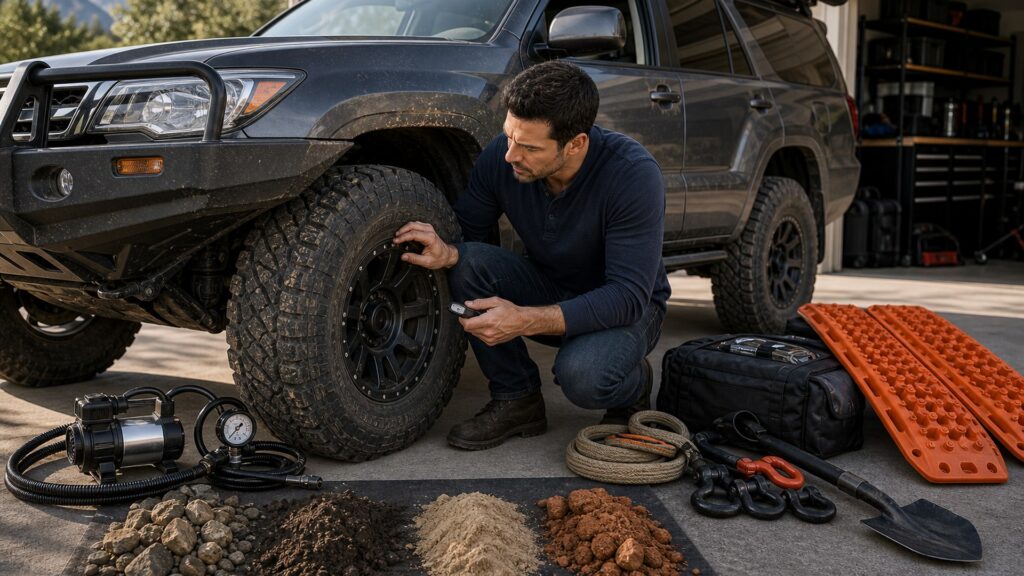
Choose for the dominant damage and traction mechanisms, then build a compromise. Weigh the vehicle, verify tire capacity at approved pressure and wheel rating, and account for rotational mass. Define aired-down use from guidance, load, speed, heat, bead support, and field reinflation. Protect the wheel and brake without destroying steering or clearance. Carry a compatible spare, jack and base, gauge, compressor, and repair capability within trained limits. Technique and route choice remain part of the tire system.
Buying framework
Map terrain failures before choosing tread aggressiveness
The right package addresses the route’s most consequential cut, pinch, sinking, clearing, heat, or road-control problem.
Rank the surfaces: Estimate pavement, gravel, rock, mud, sand, snow, ice, water, speed, load, distance, and frequency rather than naming only the hardest obstacle.
List likely damage modes: Include sidewall cuts, tread punctures, pinch damage, chunking, heat, bead loss, wheel impact, stone retention, rubbing, and unavailable replacements.
Define road and terrain pressure states: Use approved data and procedures for load, speed, temperature, wheel and bead, then plan accurate reinflation before road travel.
Close the mobility loop: Match spare, jack, base, wheel tool, lock key, inflation, gauge, repair training, recovery, and replacement sources to the final package.
Who this is for
Match specialization to how the vehicle reaches the trail
Daily-driven 4x4s, overland travelers, mud users, rock crawlers, and sand vehicles accept different road and terrain penalties.
Daily-driven trail vehicles: Favor balanced wet braking, noise, wear, winter plan, common sizes, moderate mass, and enough casing for actual weekend damage.
Remote mixed-surface travelers: Prioritize load, heat, puncture resistance, repairability, spare compatibility, inflation reliability, and replacement access over maximum terrain specialization.
Mud-focused users: Need suitable void and clearing, rut and water awareness, cooling inspection, recovery, and road compromises without assuming wheelspin solves traction.
Rock and sand specialists: Rock favors casing and controlled deformation; sand favors flotation and low resistance. Their ideal widths, tread, mass, and techniques can conflict.
What to pay attention to
Off-road specifications tied to load, speed, and pressure
Sidewall slogans and tread depth omit casing response, heat, road grip, bead behavior, wheel support, and exact terrain damage.
Terrain Contact
Casing, sidewall, tread, compound, footprint, pressure, bead, wheel lip, puncture, clearing, flotation, and grip.
Travel Support
Load, speed, heat, wet road, noise, wear, balance, TPMS, spare, repair, inflation, jack, and replacement.
Casing and sidewall behavior: Compare exact construction, load and pressure data, approved rim, flex, heat, pinch and cut resistance, weight, repair limits, and road response.
Tread architecture: Evaluate void, block support, siping, biting edges, shoulder, stone ejection, mud release, chip and chunk resistance, snow marking, wet grip, and noise.
Wheel width and protection: Match rim range, load rating, width, offset, hub, fasteners, brake clearance, lip exposure, impact strength, mass, valve protection, and serviceability.
Low-pressure envelope: No universal number applies; define load, speed, temperature, terrain, tire, wheel, bead, sidewall deflection, steering, and reinflation criteria.
Diameter and clearance: Model axle and body clearance, gearing, brakes, steering, suspension travel, rubbing, chains, spare packaging, jack height, and recovery-point access.
Avoid these traps
Off-road packages selected from obstacle photos
Visual aggression can hide road penalties, wrong pressure, poor load support, inaccessible spares, and terrain mechanisms the tread does not address.
Choosing mud tread for every loose surface: Large void may clear mud yet increase noise, warm-up, wear, wet or ice limitations, and digging in soft sand.
Assuming more sidewall plies prevent all damage: Construction details, pressure, load, speed, heat, obstacle shape, wheel, line choice, and impact energy still determine cuts and pinches.
Airing down without reinflation capacity: A trail pressure plan is incomplete without accurate measurement, temperature awareness, bead support, a working compressor, time, and road-pressure restoration.
Mounting a spare that cannot serve every position: Brake clearance, diameter, load, wheel, fasteners, TPMS, pressure, and damaged-component access must match the intended axle use.
Decision guidance
Choose the least specialized package that controls the route’s worst failure
Add casing, void, sidewall, and wheel protection only where their benefit exceeds mass, road grip, heat, noise, and service penalties.
If sharp rock causes repeated cuts or pinches: Prioritize casing, sidewall and rim support, controlled pressure, line choice, wheel protection, speed, and a capable spare before deeper tread.
If mud packing is the limit: Choose suitable clearing and spacing, maintain momentum within control, protect cooling surfaces, and carry recovery rather than depending on wheelspin.
If sand sinking is the limit: Reduce unnecessary mass, use appropriate approved pressure and footprint, control heat and wheelspin, and avoid a narrow aggressive digging strategy.
If most mileage remains paved: Favor a balanced all-terrain or similar supported compromise and use technique, recovery, and route judgment for occasional extremes.
Ownership & compatibility
Inspect off-road tires after every damaging exposure
Cuts, pinches, bead contamination, wheel bends, valve damage, heat, rubbing, and repairs may be hidden after pressure is restored.
Inspect before reinflation and speed: Check tread, sidewalls, beads, valves, wheels, pressure loss, heat, trapped stones, rubbing, cuts, bulges, and exposed material.
Service the trail-support system: Test compressor duty and fittings, gauge accuracy, repair materials and dates, jack and base, tools, spare pressure, TPMS, and recovery access.
Log terrain and damage: Record pressure, load, speed, temperature, surface, impacts, repairs, rotations, wheel work, tread, and spare use to refine the next selection.
FAQ
Off-road tire and wheel questions
These answers cover terrain, all-terrain versus mud-terrain, sidewalls, pressure, wheels, beadlocks, spares, diameter, and road use.
Are all-terrain or mud-terrain tires better off road?
What tire features help on sharp rock?
How low should tire pressure be off road?
Are steel wheels better than alloy wheels for trails?
Do I need beadlock wheels for aired-down driving?
How should an off-road spare be chosen?
How do larger tires change off-road capability?
Can an off-road tire still be good in rain and snow?
What should be checked after a hard trail day?
Bottom line
Terrain capability is a tire, wheel, pressure, and support system
Choose from failure modes, preserve road control, define low-speed pressure states, and carry the equipment and judgment needed to restore mobility.
Map the mechanism: Rock, gravel, mud, sand, snow, ice, and pavement damage tires in different ways.
Control the compromise: Balance casing, tread, mass, wheel, pressure, road grip, clearance, gearing, and heat.
Support the outcome: Maintain spare, inflation, gauge, jack, tools, inspection, recovery, and replacement access.
Reading Shortcuts
Move from the measured problem to a documented terrain-failure setup that can be installed and verified.
Decision Reminders
Keep the complete terrain-failure setup in view while comparing tires and wheels.
- Terrain: Rank surfaces and failure modes.
- Casing: Load, flex, heat, cuts, pinches.
- Tread: Clearing, edges, wet, snow, noise.
- Pressure: Defined states and reinflation.
- Wheel: Rating, geometry, lip, bead.
- Support: Spare, jack, repair, compressor.
Glossary Snippets
Terms that separate useful performance from apparent compatibility.
When to Use a Top 10 Review
Use a product roundup only after the required performance and terrain-failure setup limits are known.
- Problem defined: The visibility or mobility failure is specific.
- Vehicle mapped: Interfaces and limits are documented.
- Format chosen: The correct product family is settled.
- Evidence available: Finalists can be compared on relevant tests.
Have finalists already? Open a Comparison for a closer tradeoff.
When to Use a Comparison
Compare finalists that solve the same defined terrain-failure setup need on the same vehicle.
- Application: Both match the exact vehicle and function.
- Performance: Evidence addresses the operating problem.
- Integration: Mounting and system effects are understood.
- Ownership: Inspection and service demands are acceptable.
Need a broader field? Use a Top 10 to form a shortlist.