
Tires & Wheels Buying Guide for Road Noise and Ride Comfort
Road noise is not one specification. Tread blocks can create airborne sound, the tire cavity can reinforce a narrow tone, and force variation can travel through the wheel, hub, suspension, and body. A worn bearing or cupped tread may sound like the wrong tire category entirely.
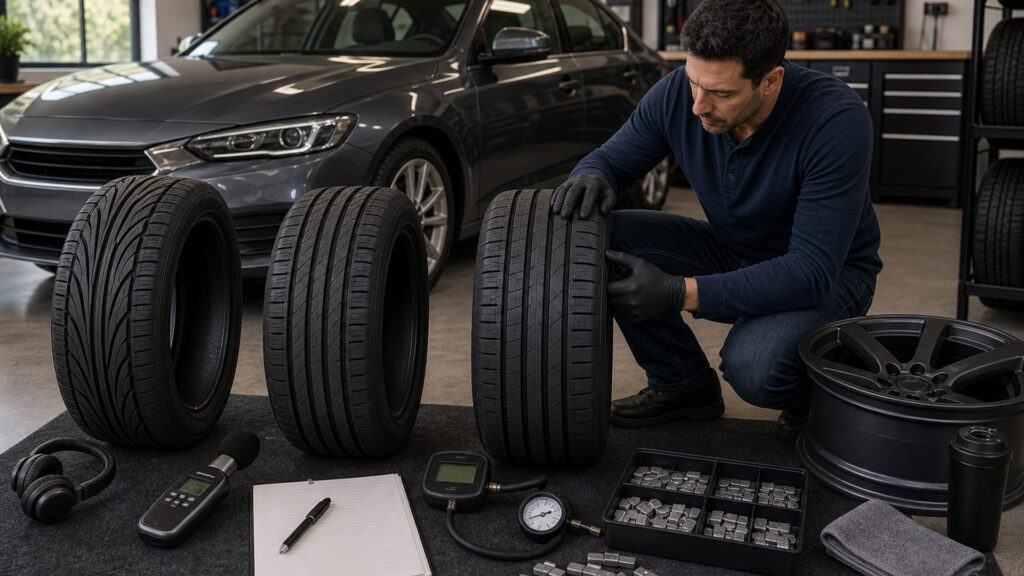
Record the symptom before shopping: road surface, speed, temperature, load, steering input, acceleration or coasting, frequency, and where the sound or vibration is felt. Verify cold pressure, tread wear, alignment, balance, runout, bearings, and suspension condition. Then compare approved tires on tread, casing, sidewall volume, documented noise treatment, wet grip, load, and season. Smaller wheels with more sidewall can reduce some impacts, but only when brakes, geometry, ratings, TPMS, and full clearance remain correct.
Buying framework
Diagnose the sound and force path before changing tires
Surface, speed, frequency, steering, load, and temperature reveal whether the source is tread, tire structure, wheel, hub, suspension, or body.
Describe the symptom: Record hum, roar, slap, thump, shake, sharp impact, or narrow tone with speed, surface, weather, load, steering, and acceleration state.
Inspect the current assembly: Check cold pressure, tread map, cupping, feathering, damage, repairs, balance, runout, wheel condition, fasteners, and TPMS.
Rule out vehicle sources: Evaluate bearings, hubs, brakes, alignment, dampers, bushings, mounts, body seals, cargo, and loose trim before blaming tire design.
Set a matched acceptance route: Use the same surfaces, speeds, load, pressure, temperature range, and measurement position before and after the change.
Who this is for
Comfort priorities differ by road and driver
Urban impacts, coarse highways, EV cabins, winter tread, and handling goals produce different noise and compliance compromises.
Coarse-highway commuters: Prioritize tread pitch and block stability, casing isolation, even wear, alignment, and a package that avoids narrow-frequency cabin boom.
Pothole and urban drivers: Value sidewall volume, compliant construction, wheel impact resistance, correct pressure, and manageable unsprung mass within approved geometry.
EV and quiet-cabin owners: Low powertrain noise can expose tire tones; compare exact fit, load, efficiency, acoustic treatment, replacement availability, and foam repair implications.
Performance-oriented comfort buyers: Seek stable steering and wet grip with controlled harshness, rather than selecting the softest casing or lowest pressure as a comfort shortcut.
What to pay attention to
Comfort specifications tied to a diagnosed frequency
Decibel claims alone omit road surface, vehicle cabin, frequency spectrum, wear, pressure, load, and structure-borne transmission.
Sound Generation
Tread pitch, void, compound, surface, cavity, airflow, wear, speed, and acoustic treatment.
Force Transmission
Sidewall, pressure, load, wheel diameter and mass, runout, balance, hub, suspension, body isolation, and impact.
Tread pattern and wear: Compare pitch sequencing, block size, void, lateral grooves, siping, directional orientation, rotation options, and how irregular wear changes noise.
Casing and sidewall: Assess approved size, load, speed, sidewall height, construction, compound, deflection, heat, steering response, and impact compliance.
Wheel contribution: Verify diameter, width, offset, mass, stiffness, runout, balance-weight placement, tire volume, brake clearance, and impact vulnerability.
Pressure and load state: Use vehicle-approved cold pressure for measured load; excess or insufficient pressure can change harshness, heat, footprint, wear, and noise.
Assembly uniformity: Professional mounting, bead seating, balance, road-force diagnosis where useful, hub cleanliness, centering, fasteners, and runout affect residual vibration.
Avoid these traps
Comfort fixes that mask the diagnostic clue
Pressure changes, soft tires, and sound treatment can reduce a symptom while allowing wear, damage, or mechanical faults to continue.
Lowering pressure below approved guidance: Softer initial feel can increase heat, deformation, shoulder wear, response delay, damage risk, and load-capacity problems.
Buying from a universal noise score: Results depend on size, vehicle, road, load, pressure, temperature, wear, and frequency; one label cannot predict every cabin.
Replacing tires without correcting cupping: Worn dampers, alignment, balance, pressure, load, or looseness can reproduce the same noise on the new set.
Assuming larger wheels are always harsher: Sidewall and mass often matter, but exact tire construction, pressure, wheel design, suspension, surface, and approved size determine the outcome.
Decision guidance
Choose the change that interrupts the identified path
Correct defects first, then select tire construction and wheel geometry that reduce the dominant source without sacrificing safety performance.
If noise varies strongly by pavement: Prioritize tread-road interaction, pitch, void, compound, and even wear while preserving wet and seasonal capability.
If a narrow hum tracks road speed: Inspect tread pattern and wear, cavity behavior, balance, runout, bearings, and body resonance before purchasing acoustic foam.
If sharp impacts dominate: Use an approved package with more sidewall or lower mass where feasible, then verify pressure, wheel strength, brakes, TPMS, and full travel.
If vibration remains after balancing: Diagnose tire uniformity, runout, bead seating, wheel or hub damage, centering, bearings, and suspension rather than adding repeated weights.
Ownership & compatibility
Preserve comfort by preventing irregular wear
The quietest new set becomes noisy when pressure, rotation, alignment, balance, suspension, or damage creates repeating force and tread patterns.
Trend pressure and tread: Record monthly cold pressure, inner-center-outer tread, position, rotations, load, and new sound or vibration on familiar roads.
Respond to early symptoms: Investigate pull, feathering, cupping, leakage, vibration, impact, wheel damage, or bearing noise before wear becomes permanent.
Keep the comparison baseline: Document model, size, wheel, pressure, alignment, balance, mileage, road, temperature, and subjective or measured cabin result for the next purchase.
FAQ
Road noise and ride comfort questions
These answers cover tread noise, sidewall, wheel diameter, pressure, foam, balance, wear, EVs, and acceptance testing.
What makes one tire quieter than another?
Will smaller wheels improve ride comfort?
Can I lower tire pressure for a smoother ride?
Do acoustic-foam tires eliminate road noise?
Why did my tires become louder as they wore?
What is road-force balancing?
Why does tire noise seem more obvious in an EV?
How should a quieter tire be compared before purchase?
What should I test after installing comfort-focused tires?
Bottom line
Quiet and comfort begin with identifying what reaches the cabin
Correct pressure, wear, runout, balance, alignment, and vehicle faults, then choose a supported tire and wheel package for the dominant sound or impact path.
Name the symptom: Separate airborne roar, narrow tones, impact harshness, and rotating vibration by condition.
Fix the source: Correct wear drivers and mechanical defects before asking a new tire to mask them.
Retest consistently: Use matched road, speed, load, pressure, temperature, and vehicle condition to judge the result.
Reading Shortcuts
Move from the measured problem to a documented noise-path diagnosis that can be installed and verified.
Decision Reminders
Keep the complete noise-path diagnosis in view while comparing tires and wheels.
- Source: Airborne, structural, impact, rotation.
- Condition: Surface, speed, load, temperature.
- Assembly: Pressure, wear, runout, balance.
- Vehicle: Alignment, bearings, suspension.
- Package: Tread, casing, sidewall, wheel.
- Test: Use a matched acceptance route.
Glossary Snippets
Terms that separate useful performance from apparent compatibility.
When to Use a Top 10 Review
Use a product roundup only after the required performance and noise-path diagnosis limits are known.
- Problem defined: The visibility or mobility failure is specific.
- Vehicle mapped: Interfaces and limits are documented.
- Format chosen: The correct product family is settled.
- Evidence available: Finalists can be compared on relevant tests.
Have finalists already? Open a Comparison for a closer tradeoff.
When to Use a Comparison
Compare finalists that solve the same defined noise-path diagnosis need on the same vehicle.
- Application: Both match the exact vehicle and function.
- Performance: Evidence addresses the operating problem.
- Integration: Mounting and system effects are understood.
- Ownership: Inspection and service demands are acceptable.
Need a broader field? Use a Top 10 to form a shortlist.