
Tires & Wheels Buying Guide for Truck and SUV Setups
Truck and SUV tires face broad expectations. One vehicle may commute, tow, cross winter passes, drive gravel, and crawl over sharp terrain. No tread or load range is best at every job, and added mass creates costs before the vehicle leaves pavement.
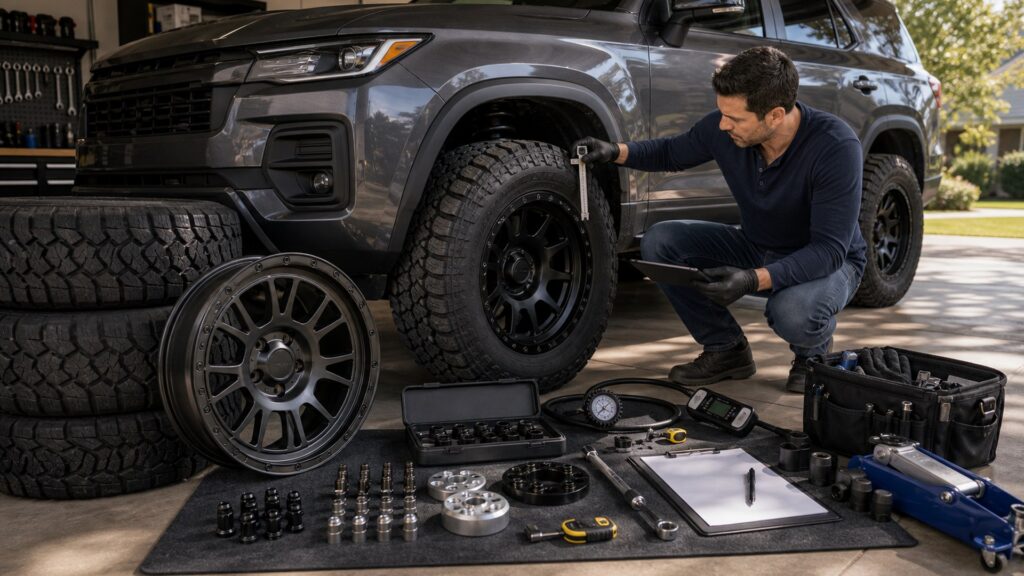
Weight the mission honestly, then weigh the vehicle in travel and towing configurations. Choose capacity from exact tire load and pressure data, wheel rating, axle demand, and vehicle guidance. Compare casing and tread after that foundation is secure. Model diameter and mass effects on gearing, brakes, steering, bearings, and fuel use; model width and offset through full travel and chains. Include a compatible spare, inflation, gauge, jack, wheel tools, and realistic replacement supply wherever the truck operates.
Buying framework
Weight the mission before adding tire and wheel mass
Highway behavior, load, towing, winter, and terrain must be prioritized because the same construction choices cannot maximize every outcome.
Score the use mix: Assign real percentages and consequence to pavement, speed, rain, snow, towing, payload, gravel, rock, mud, sand, noise, ride, and economy.
Weigh operating configurations: Measure normal, travel, and towing axle loads with passengers, accessories, cargo, water, hitch, tongue load, camper, and spare.
Define tire and wheel capacity: Use exact load-at-pressure data, approved rim, wheel rating, GAWR, speed, heat, and application guidance before choosing tread.
Model system effects: Calculate diameter, mass, offset, clearance, gearing, braking, steering, bearings, TPMS, spare fit, chains, and service access.
Who this is for
Match construction to the dominant truck duty
A highway tow rig, mixed-surface overlander, trail-focused 4x4, and winter family SUV reward different casing and tread choices.
Highway and towing users: Prioritize load and pressure stability, wet braking, heat, noise, ride, rolling resistance, trailer response, common replacements, and verified spare capacity.
Mixed-surface travelers: Choose moderate casing and tread durability with predictable pavement behavior, gravel resistance, winter strategy, repair access, and manageable mass.
Trail-focused trucks: Prioritize route-specific sidewall, tread, pressure and wheel needs while budgeting brakes, gearing, bearings, steering, noise, wet grip, and trailer transport.
Family SUVs in winter: Favor compatible matched seasonal grip, placard capacity, braking, stability, TPMS, chain clearance, quiet ride, and replacement access over off-road appearance.
What to pay attention to
Truck tire specifications tied to measured duty
Load range, ply language, sidewall style, and tread depth are incomplete without pressure, casing, mass, wheel, heat, and application data.
Load and Road
Axle demand, pressure, heat, wet and winter grip, braking, steering, ride, noise, tread life, and towing.
Terrain and Support
Casing, sidewall, tread, puncture, air-down, bead, wheel, clearance, spare, repair, inflation, and replacement.
Construction and load data: Compare exact size, P-metric or LT application, load index or range, pressure table, rim range, speed, casing, mass, and service description.
Tread and compound: Evaluate void, block stability, siping, stone retention, mud clearing, wet braking, snow marking, ice limitations, noise, heat, wear, and chunk resistance.
Wheel capacity and geometry: Verify wheel load, diameter, width, offset, hub, bolt pattern, fastener seat and engagement, brake and tie-rod clearance, and terrain impact exposure.
Diameter and mass consequences: Model effective gearing, acceleration, shift logic, braking energy, unsprung and rotational mass, steering, bearing load, ride, speed display, and fuel use.
Pressure operating plan: Set road pressure from approved load guidance, monitor cold and hot trends, define any low-speed terrain range with manufacturer input, and restore pressure before speed.
Avoid these traps
Truck tire upgrades that spend capability twice
Buyers often count a higher sidewall rating as new payload and a larger diameter as free clearance without accounting for vehicle ratings and system costs.
Treating load range as ride quality or toughness: Load range relates to defined capacity and pressure, not a universal ranking of puncture resistance, comfort, handling, or suitability.
Adding diameter without gearing analysis: Larger rolling radius reduces effective torque, changes shifts and speed, adds brake demand, and may worsen crawl control despite more axle clearance.
Pushing wheels outward for stance: Offset can increase bearing and steering leverage, debris throw, fender contact, scrub radius, and sidewall exposure while reducing chain legality.
Carrying no matched spare: An uncommon large tire without a compatible spare, jack capacity, wheel tool, inflation, and replacement source creates an avoidable mobility failure.
Decision guidance
Choose the lightest supported system that survives the mission
Add casing, tread, diameter, and wheel strength only where measured load and terrain consequence justify their road and service penalties.
If the truck tows mostly on pavement: Prioritize verified load, wet and heat performance, stable steering, braking, common replacements, and pressure discipline before aggressive tread.
If sharp terrain causes repeated damage: Increase casing and sidewall capability with appropriate wheel and pressure strategy, while reassessing mass, heat, highway behavior, and repair limitations.
If soft sand dominates: Favor load distribution, appropriate approved pressure strategy, manageable vehicle mass, temperature control, and recovery rather than narrow mud-focused assumptions.
If the desired size disrupts several systems: Choose a smaller supported package unless gearing, brakes, clearance, steering, TPMS, spare, and legal effects can all be resolved and validated.
Ownership & compatibility
Operate the setup across road and terrain pressure states
Truck tires fail when load, heat, damage, low-pressure use, wheel impacts, towing, and spare readiness are not tracked together.
Keep a configuration and load record: Store scale tickets, pressures, tire and wheel data, positions, alignment, rotations, towing loads, terrain use, repairs, spare, and installed-system mass.
Inspect after terrain and towing: Check cuts, bulges, punctures, beads, wheels, valves, tread, heat symptoms, pressure loss, irregular wear, rubbing, fasteners, brakes, bearings, and spare.
Service the full mobility system: Maintain compressor or inflation source, gauge, repair equipment within trained limits, jack and base, lock key, wheel tools, TPMS, and replacement contacts.
FAQ
Truck and SUV tire setup questions
These answers cover LT and P-metric tires, load range, towing, larger sizes, offset, air-down use, spares, mud tires, and pressure.
Do trucks always need LT tires?
What does tire load range mean?
Can higher-capacity tires increase truck payload?
How do larger tires affect towing?
What wheel offset is best for a truck?
How low can truck tires safely be aired down?
Do I need a full-size matching spare?
Are mud-terrain tires safer off road?
Should tire pressure rise when towing?
Bottom line
Truck capability starts with measured load and honest mission weighting
Choose enough casing, tread, wheel, and pressure support for the real job while minimizing mass, geometry, braking, and service penalties.
Weight the mission: Separate highway, towing, winter, gravel, rock, mud, sand, noise, ride, and replacement needs.
Verify capacity and fit: Use scale tickets, load-at-pressure data, wheel rating, full travel, brakes, gearing, TPMS, and spare.
Maintain mobility: Inspect after load and terrain, restore road pressure, service inflation and tools, and track repairs and age.
Reading Shortcuts
Move from the operating need to a documented mission-weighted truck setup that can be installed and verified.
Decision Reminders
Keep the complete mission-weighted truck setup in view while comparing tires and wheels.
- Mission: Weight road, load, winter, terrain.
- Scale: Measure every operating configuration.
- Construction: Choose casing after capacity.
- System: Mass, gearing, brakes, offset.
- Pressure: Road and terrain states differ.
- Spare: Match mobility and service plan.
Glossary Snippets
Terms that separate useful performance from apparent compatibility.
When to Use a Top 10 Review
Use a product roundup only after the required performance and mission-weighted truck setup limits are known.
- Problem defined: The visibility or mobility failure is specific.
- Vehicle mapped: Interfaces and limits are documented.
- Format chosen: The correct product family is settled.
- Evidence available: Finalists can be compared on relevant tests.
Have finalists already? Open a Comparison for a closer tradeoff.
When to Use a Comparison
Compare finalists that solve the same defined mission-weighted truck setup need on the same vehicle.
- Application: Both match the exact vehicle and function.
- Performance: Evidence addresses the operating problem.
- Integration: Mounting and system effects are understood.
- Ownership: Inspection and service demands are acceptable.
Need a broader field? Use a Top 10 to form a shortlist.