
Tools & Garage Equipment Buying Guide for Lift and Safety Requirements
A vehicle lift is more than a machine with enough advertised capacity. It is a load path beginning at exact vehicle contact points and continuing through pads, adapters, arms or runways, locks, columns or stands, anchors, concrete, and soil. A mismatch anywhere can defeat the rating on the largest component.
Identify the heaviest and most unusual vehicles, approved lifting procedures, weight distribution, wheelbase, track, clearance, suspension, and planned component removal. Verify facility drawings, slab and anchor requirements, overhead clearance, power, approach, and emergency lowering. Prefer documented installations, trained positioning, visible lock engagement, routine pre-use checks, qualified periodic inspection, and a strict rule against working beneath a vehicle held only by hydraulic pressure.
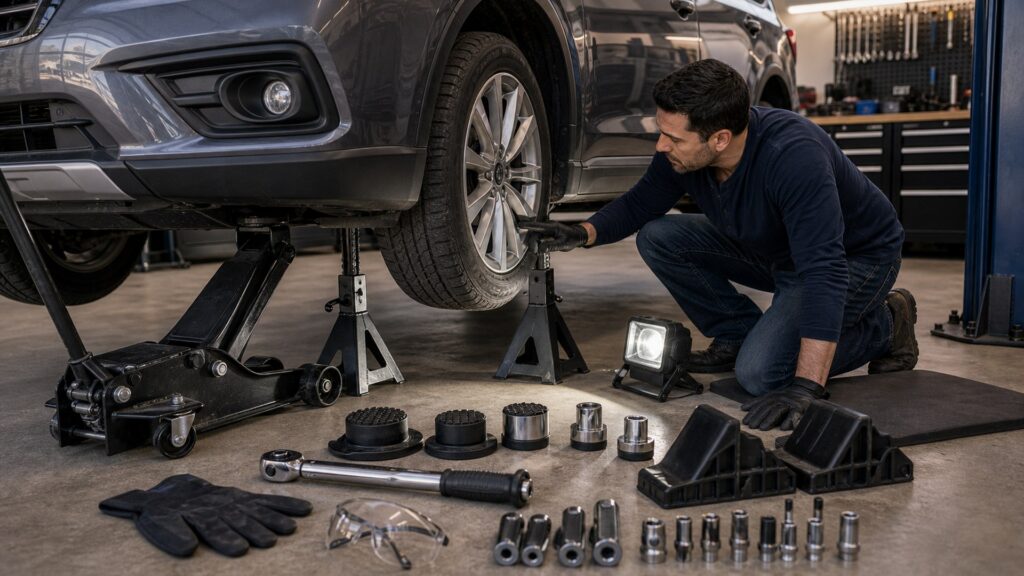
Buying framework
Prove the load path before choosing a lift type
Vehicle points, equipment geometry, restraint, locks, structure, and operator procedure must form one documented support system.
Define the lifting population: Record actual curb and working weights, distribution, wheelbase, track, clearance, lift points, tires, modifications, cargo, and component-removal tasks.
Trace every structural interface: Follow force from vehicle through pads, adapters, arms, runways, locks, frames, columns, anchors, slab, and supporting ground.
Model changing balance: Account for engine, transmission, axle, body, bed, battery, or cargo removal; pushing and torquing can also move an elevated vehicle.
Commission the full installation: Use qualified installation where required, verify anchors and utilities, test controls and locks, document training, and establish inspection and emergency procedures.
Who this is for
Different work access calls for different support geometry
Wheel service, underbody repair, storage, low-clearance vehicles, and heavy asymmetric work favor distinct lifting arrangements.
Occasional maintenance users: A compatible jack and stands or approved ramps may suit limited tasks when the floor, points, height, wheel restraint, and underneath access are correct.
Low-clearance performance owners: Need verified approach angle, pad reach, pinch-weld or frame adapters, undertray access, tire clearance, hydraulic unit position, and safe support after raising.
Frequent underbody technicians: May justify a certified installed lift with repeatable positioning, ergonomic height, suitable adapters, reliable locks, inspection support, and adequate facility structure.
Storage and alignment users: Four-post runways can support wheels and parking, but need chocks, bridge-jack integration, runway capacity and spacing, approach clearance, locks, and fall awareness.
What to pay attention to
Lift specifications read as a system
Capacity must be interpreted with distribution, reach, contact, lock, structural, environmental, and task restrictions.
Vehicle Support
Weight, balance, points, adapters, arm or runway geometry, tire restraint, travel, and changing component state.
Facility and Control
Slab, anchors, ceiling, doors, utilities, power, locks, guarding, training, inspection, maintenance, and rescue.
Capacity and distribution: Check total rating plus front-rear, side-to-side, arm, runway, axle, jack, stand, and adapter limits under the exact configuration.
Contact geometry: Compare pad type, adapter height, arm reach and angle, runway spacing, tire width, approach, pinch weld or frame design, and obstruction clearance.
Locks and restraints: Verify mechanical lock positions, arm restraints, wheel chocks, runway stops, safety latches, synchronization, lowering controls, and behavior after power or pressure loss.
Slab and anchorage: Follow exact concrete strength, thickness, age, reinforcement, joints, cracks, edge distance, anchor type, hole preparation, torque, cure, inspection, and local structural requirements.
Installation envelope: Measure raised vehicle height, doors, opener, roof, antennas, ceiling, beams, lights, heaters, sprinklers, cords, hoses, panels, egress, approach, and service circulation.
Avoid these traps
Lift decisions reduced to capacity and price
Most dangerous mismatches involve contact, balance, structure, locks, installation, or procedure rather than the headline tonnage.
Assuming floor appearance proves strength: An uncracked surface does not reveal slab thickness, concrete quality, reinforcement, joints, voids, anchors, edge distance, or soil support.
Stacking unapproved adapters: Height increases leverage and instability; blocks, sockets, lumber, and mixed pads can slip or overload contact areas outside the rated configuration.
Lifting before identifying every point: Covers, batteries, fuel tanks, exhaust, corroded structure, and model-specific reinforcements can make a visually convenient contact unsafe.
Removing heavy parts without reassessment: Center of gravity can move beyond the support polygon after drivetrain, axle, body, bed, cargo, or battery removal, even if the initial lift was stable.
Decision guidance
Choose the simplest verified method that preserves required access
Do not buy more height or capacity than the facility and procedures can control; reject any method with an unresolved load-path link.
If wheels must remain loaded: Use compatible ramps or runways with correct width, approach, surface, stops, and chocks; add only approved wheel-free lifting equipment when required.
If work requires wheels hanging: Choose stands, portable frames, bridge jacks, or arm lifts that contact approved points while maintaining balance and the necessary suspension clearance.
If the slab cannot be verified: Use a lifting method supported by the known floor condition or obtain qualified structural evaluation and remediation before installing anchored equipment.
If vehicle balance will change: Follow the manufacturer’s stabilization procedure with approved supplementary support or select another service method; do not rely on friction or added dead weight.
Ownership & compatibility
Inspect lifting equipment as life-safety equipment
Wear, leaks, corrosion, impact, anchor movement, damaged pads, altered vehicles, and operator drift can invalidate the original setup.
Perform pre-use checks: Inspect contact points, pads, adapters, arms, restraints, runways, chocks, locks, cables or chains, hydraulics, controls, anchors, floor, labels, and clear zones.
Maintain qualified records: Keep installation and structural documents, manuals, training, inspections, repairs, lubrication, anchor checks, incidents, adapter inventory, and vehicle lifting notes.
Stop after abnormal events: Remove equipment from service after overload, movement, impact, unexpected lowering, damaged locks, anchor or slab change, hydraulic failure, or unclear vehicle contact until qualified evaluation.
FAQ
Vehicle lift and support questions
These answers cover capacity, jacks, stands, lift points, adapters, two-post and four-post lifts, slabs, locks, inspection, and balance.
Is a two-ton jack safe for a two-ton vehicle?
Can I work under a vehicle supported by a hydraulic jack?
How do I find the correct lifting points?
Are jack-stand ratings stated per stand or per pair?
Is a two-post lift safer than a four-post lift?
Can lift adapters be stacked for taller vehicles?
What concrete slab does an automotive lift require?
Why should a lift rest on mechanical locks?
How often should vehicle lifts be inspected?
Bottom line
Every safe lift is a complete load path
Match the exact vehicle, preserve balance, verify contact and locks, support the structure, train the operator, and inspect the system throughout its life.
Start at the vehicle: Use approved points, correct adapters, actual weight and distribution, and a plan for balance changes.
Finish at the ground: Equipment, anchors, slab, utilities, clearances, and installation must meet documented requirements.
Operate with evidence: Position carefully, engage locks, control zones, inspect before use, maintain records, and stop after abnormal movement.
Reading Shortcuts
Move from the real constraint to a documented verified lift load path that can be used and inspected safely.
Decision Reminders
Keep the complete verified lift load path in view while comparing equipment.
- Vehicle: Points, weight, balance, changes.
- Contact: Pads and adapters must be approved.
- Locks: Use physical holding systems correctly.
- Structure: Verify anchors, slab, and ground.
- Envelope: Measure overhead and approach.
- Inspect: Train, document, stop on defects.
Glossary Snippets
Terms that separate useful performance from apparent compatibility.
When to Use a Top 10 Review
Use a product roundup only after the required verified lift load path limits are known.
- Problem defined: The visibility or mobility failure is specific.
- Vehicle mapped: Interfaces and limits are documented.
- Format chosen: The correct product family is settled.
- Evidence available: Finalists can be compared on relevant tests.
Have finalists already? Open a Comparison for a closer tradeoff.
When to Use a Comparison
Compare finalists that solve the same defined verified lift load path need.
- Application: Both match the exact vehicle and function.
- Performance: Evidence addresses the operating problem.
- Integration: Mounting and system effects are understood.
- Ownership: Inspection and service demands are acceptable.
Need a broader field? Use a Top 10 to form a shortlist.