
Tools & Garage Equipment Buying Guide for Space-Saving Garage Setups
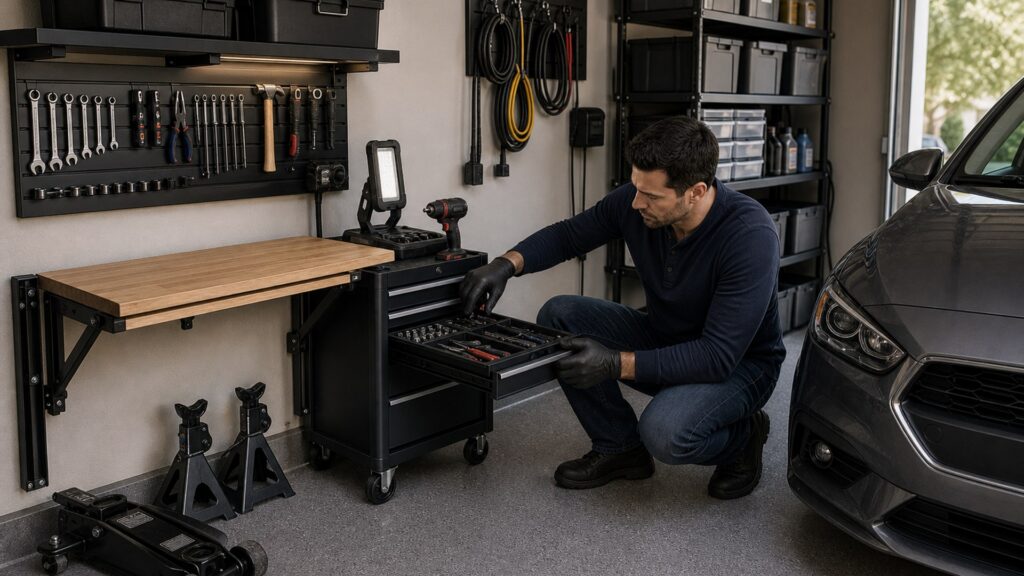
Space-saving equipment should be judged while being retrieved and used, not only while folded. A rolling cabinet needs room for its handle, caster sweep, open drawers, and technician. A wall bench needs a clear drop zone and stable support. An overhead rack creates a lifting and falling-object problem whenever a heavy case moves.
Inventory tools by frequency, mass, hazard, task location, and sensitivity. Measure five states: stored, retrieval, deployment, active use, and reset. Keep dense items low, daily tools within reach, precision instruments protected, and emergency equipment accessible. Verify wall, ceiling, shelf, anchor, and caster ratings against structures and loads. Mark home positions so the vehicle, exits, panels, doors, and utilities return to a known clear arrangement after each job.
Buying framework
Recover volume without hiding operating space
Compact design succeeds only when equipment can be found, retrieved, deployed, used, inspected, and returned without creating a new hazard.
Inventory by use and consequence: Record frequency, task location, packed mass, dimensions, contamination, security, climate sensitivity, inspection need, and harm if dropped or delayed.
Measure all five states: Capture stored footprint, approach and retrieval, unfolding or rolling, full working envelope, and the path back to the marked home position.
Assign volume by hierarchy: Keep frequent and safety-critical items visible and reachable; move rare lightweight items upward or deeper while removing unjustified duplicates.
Protect permanent clearances: Reserve vehicle openings, parking line, electrical panels, doors, windows, vents, appliances, lift paths, extinguishers, and emergency egress.
Who this is for
Compact layouts respond to different space conflicts
A single parking bay, rental wall restrictions, multi-use family storage, and dense enthusiast inventory need different kinds of reversibility.
Single-car garages: Favor shallow wall storage, folding surfaces, narrow mobile modules, vertical but low-risk volume, and strict home positions that restore the vehicle envelope.
Renters: Use freestanding or permitted low-impact systems, verify lease and wall construction, control tipping, protect surfaces, and avoid assuming removable means structurally adequate.
Shared household spaces: Secure chemicals, batteries, sharp tools, and heavy drawers; preserve daily routes and put clear labels and reset rules ahead of maximum density.
High-tool-count enthusiasts: Reduce duplicates, organize task modules, maintain a searchable inventory, protect precision equipment, and give every heavy case a safe retrieval method rather than stacking indefinitely.
What to pay attention to
Compact-storage specifications beyond cubic capacity
Useful density depends on structure, reach, opening geometry, mobility, environment, and how quickly an incomplete module becomes visible.
Space Use
Stored depth, opening, swing, deployment, working reach, nesting, module size, home position, and vehicle clearance.
Risk and Retrieval
Wall and shelf loads, anchorage, tip resistance, casters, lifting height, dropped objects, security, contamination, and inspection.
Wall and rail systems: Verify substrate and framing, anchor type, bracket spacing, rail and hook ratings, dynamic loads, pullout, sharp edges, positive retention, and visible overload.
Cabinet proportions: Compare shallow depth, drawer extension, load, interlocks, door swing, shelf deflection, handle projection, lock, corrosion protection, and wall or floor restraint.
Folding equipment: Measure hinge and leg rating, latching, pinch points, leveling, bracing, work load, vise leverage, deployment clearance, and stability before placing parts.
Mobile modules: Check total and per-drawer load, caster capacity and diameter, brakes, tip control, thresholds, slope, pull handle, latch, case retention, and parked footprint.
Overhead storage: Limit use to structure-supported, retained, inspectable loads with safe lifting access, ceiling and door clearance, seismic needs, and exclusion from people or vehicle damage zones.
Avoid these traps
Compactness that shifts risk into retrieval
Dense storage fails when users climb, overreach, unload stacks, open multiple heavy drawers, or block the vehicle simply to reach routine equipment.
Counting only folded dimensions: Doors, drawers, legs, handles, cords, hoses, tools, operator stance, and part staging can consume several times the marketed stored footprint.
Placing dense tools overhead: Sockets, pullers, batteries, and power tools increase shelf and retrieval forces; a small case can still be too heavy for safe elevated handling.
Stacking unlabeled modules: The needed case sits under several similar boxes, encouraging unstable unloading and incomplete kits; identity and access order should be visible.
Using every wall surface: Maximum coverage can obstruct panels, outlets, shutoffs, windows, ventilation, doors, vehicle openings, fire equipment, and the clearances needed to inspect anchors.
Decision guidance
Save the space that does not protect work or safety
Remove duplication and empty air first; preserve retrieval, structure, egress, inspection, and task surfaces even when they reduce nominal density.
If a tool is used every session: Place it at comfortable point-of-use reach with an obvious home, not inside a high shelf, deep case, or stack optimized for rare access.
If wall structure is unknown: Use properly stabilized freestanding storage or obtain qualified attachment guidance rather than multiplying anchors into drywall or unverified masonry.
If mobile storage tips or rolls: Reduce height and drawer load, improve rated casters and brakes, add approved restraint or select a stable unit; floor marks do not correct poor mechanics.
If the vehicle cannot park after work: Reduce deployed inventory, use nested task modules, change home positions, or remove low-value equipment until the full reset envelope is dependable.
Ownership & compatibility
Compact storage needs visible load and reset discipline
Small changes in stacking, drawer contents, anchors, wheels, labels, and parked positions can erase the original safety margin.
Post load and location rules: Mark shelf, drawer, rail, hook, case, and cart limits; identify heavy-lift assistance, ladder restrictions, home positions, and items prohibited overhead.
Inspect structural and moving parts: Check anchors, rails, brackets, shelves, hinges, latches, interlocks, casters, brakes, handles, floor transitions, cases, straps, corrosion, and signs of movement.
Run a periodic space audit: Remove duplicates and expired supplies, repair modules, update labels, test retrieval, clear floors and egress, verify vehicle openings, and return emergency gear to immediate reach.
FAQ
Space-saving garage questions
These answers cover vertical storage, walls, overhead racks, cabinets, folding benches, carts, modular cases, tires, access, and reset.
Is vertical tool storage always the best use of space?
How deep should garage cabinets be?
Are overhead garage racks safe for automotive tools?
What should go on a pegboard or wall panel?
Are folding workbenches stable enough for repair work?
How can a rolling cart save space safely?
Are stackable modular tool cases worth using?
How should tires and wheels be stored compactly?
How do I know whether a compact layout actually works?
Bottom line
True space efficiency preserves safe access
Measure every operating state, place equipment by frequency and mass, verify structures, keep heavy items low, and reset the garage to marked clearances.
Count the whole envelope: Stored size is only one of retrieval, deployment, active-work, and reset requirements.
Use structure honestly: Match real walls, ceilings, shelves, anchors, casters, and loads; compactness never increases their capacity.
Make order visible: Label modules and home positions, inspect supports, remove duplication, and preserve vehicle, utility, and emergency access.
Reading Shortcuts
Move from the real constraint to a documented five-state compact layout that can be used and inspected safely.
Decision Reminders
Keep the complete five-state compact layout in view while comparing equipment.
- Five states: Stored through final reset.
- Structure: Verify every support and anchor.
- Frequency: Put daily tools near the work.
- Mass: Keep dense items low.
- Mobility: Control casters, drawers, and tipping.
- Reset: Restore parking and emergency access.
Glossary Snippets
Terms that separate useful performance from apparent compatibility.
When to Use a Top 10 Review
Use a product roundup only after the required five-state compact layout limits are known.
- Problem defined: The visibility or mobility failure is specific.
- Vehicle mapped: Interfaces and limits are documented.
- Format chosen: The correct product family is settled.
- Evidence available: Finalists can be compared on relevant tests.
Have finalists already? Open a Comparison for a closer tradeoff.
When to Use a Comparison
Compare finalists that solve the same defined five-state compact layout need.
- Application: Both match the exact vehicle and function.
- Performance: Evidence addresses the operating problem.
- Integration: Mounting and system effects are understood.
- Ownership: Inspection and service demands are acceptable.
Need a broader field? Use a Top 10 to form a shortlist.