
Tools & Garage Equipment Buying Guide: How to Choose the Right One
A useful garage is not measured by drawer count. It is measured by whether a defined job can move from correct service information through diagnosis, safe access, disassembly, measurement, installation, and verification without improvising a dangerous substitute. One missing socket profile, support point, range, or fluid specification can stop the entire chain.
List the services you will actually perform, then walk through their procedures step by step. Separate frequently used core tools from rentable or job-specific equipment. Match every interface and rating, provide stable lifting and energy isolation, and budget for lighting, ventilation, containment, storage, calibration, and consumables. A smaller documented system that completes its jobs safely is more capable than a larger assortment assembled from promotions.
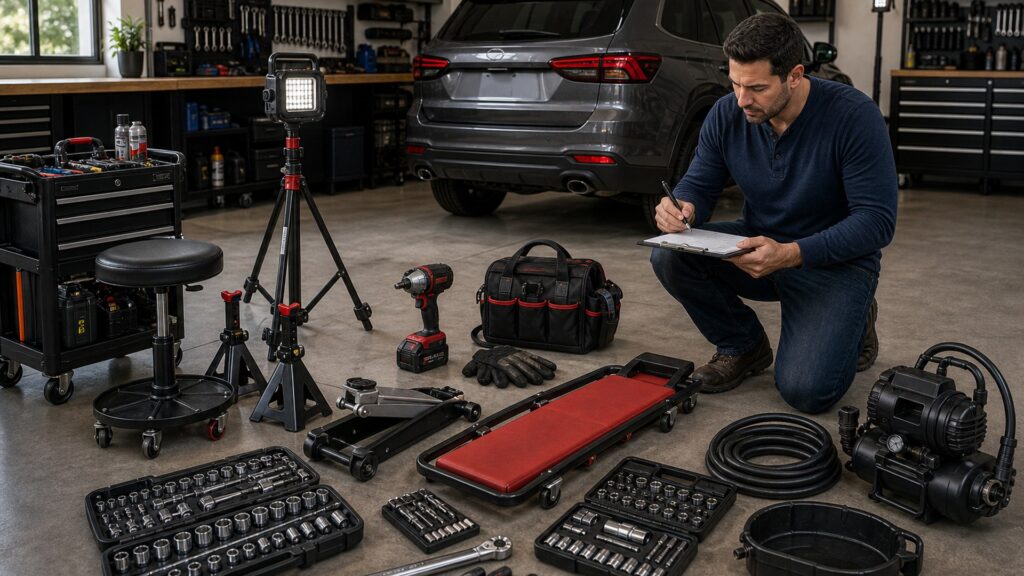
Buying framework
Design the garage around complete jobs
Start with procedures and failure consequences, then supply every link from information to return-to-service checks.
Write the task list: Name exact vehicles and services, frequency, conditions, acceptable downtime, skill, and the work that will always go to a professional.
Trace each procedure: Mark diagnosis, access, lifting, energy control, fastener interfaces, measurement, fluids, replacement, calibration, verification, and waste steps.
Find shared capability: Buy durable core items where several jobs use the same range and interface; rent or borrow rare specialized equipment when support is credible.
Set stop conditions: No verified procedure, wrong rating, unstable support, unclear energy state, missing measurement, or damaged tool means pause rather than improvise.
Who this is for
Match equipment depth to service ambition
Routine maintenance, diagnostic work, restoration, and fabrication demand different information, space, measurement, and hazard controls.
Basic maintenance owners: Need exact manuals, lighting, hand tools, pressure and torque control, fluid capture, tire service basics, safe lifting, storage, and inspection.
Diagnostic troubleshooters: Add a capable meter or scan path, back-probing methods, power support, schematics, pressure or vacuum tools, logging, and disciplined baselines.
Restoration builders: Require parts tracking, corrosion and fastener strategy, long-term support, precision measurement, cleaning, labeling, preservation, and project-safe vehicle storage.
Fabrication-focused users: Need material-specific cutting, forming, welding, extraction, fire control, fixturing, metrology, and training separated from ordinary mechanical work.
What to pay attention to
Specifications that determine usable capability
A headline torque, tool count, or motor power matters only when the complete interface and operating envelope fit the procedure.
Execution
Information, access, interface, reach, force, measurement, power, air, consumables, and verification.
Risk Control
Capacity, stability, isolation, guarding, ventilation, PPE, fire prevention, inspection, storage, and waste.
Hand-tool interface: Confirm fastener type, exact size, drive, wall thickness, depth, reach, swing, articulation, material, finish, and replacement availability.
Measurement system: Compare required range and tolerance with accuracy, resolution, repeatability, calibration evidence, leads or adapters, environment, and reading method.
Lifting and support: Use the lowest relevant rating across jack, lift, stands, adapters, anchors, floor, vehicle points, load distribution, height, reach, and procedure.
Power and air infrastructure: Calculate circuit, grounding, charging, battery compatibility, compressor flow at pressure, duty cycle, storage, hose loss, moisture control, noise, and ventilation.
Ownership package: Include cases, labels, inspection records, calibration, lubricants, wear parts, batteries, software access, warranty, repair pathway, and responsible disposal.
Avoid these traps
Buying habits that leave the capability chain open
Tool volume and advertised output conceal incompatibility, missing safety controls, and measurements that cannot support a service decision.
Starting with a giant set: Duplicates and unused sizes consume budget while special profiles, torque ranges, access tools, test leads, and support equipment remain absent.
Treating adapters as harmless: Stacked reducers, universals, extensions, crowfeet, and improvised fixtures alter access, load, torque, strength, and error; each needs an approved use.
Selecting by maximum rating: Minimum usable range, control, accuracy, balance, access, and duty cycle often matter more than an impressive maximum.
Forgetting the last ten percent: Refill quantity, bleed or relearn, leak check, fastener marking, road test, data review, cleanup, and waste disposal are part of the job.
Decision guidance
Fund the weakest necessary link first
The next purchase should remove a documented constraint without creating a larger safety, infrastructure, or maintenance burden.
If the procedure is unclear: Obtain correct service information and training before hardware; a tool cannot define an unknown support point, torque method, or disabling sequence.
If one rare tool blocks a job: Compare rental, professional service, shared access, and purchase using frequency, condition verification, calibration, training, storage, and failure consequence.
If infrastructure is marginal: Choose lower-demand equipment or upgrade circuits, floor, ventilation, lighting, air, and fire protection before adding a high-energy machine.
If verification is missing: Buy or arrange the correct measurement and commissioning capability before undertaking the service, even when disassembly tools are already available.
Ownership & compatibility
Keep tools trustworthy and the garage ready
Condition, calibration, consumables, software, storage, and facility controls determine whether yesterday’s capability still exists.
Inspect by consequence: Check support equipment, torque and measuring tools, guards, cords, hoses, batteries, sockets, adapters, PPE, extinguishers, and extraction at suitable intervals.
Control identity and condition: Label precision and safety equipment, record calibration or checks, segregate damaged items, replenish consumables, and prevent clean tools from hiding contamination.
Review after each project: Record missing access, unsafe reach, delayed parts, measurement uncertainty, waste problems, and unused purchases before changing the system.
FAQ
Garage tool selection questions
These answers cover set size, quality, ratings, torque, measurement, lifting, power, rentals, storage, and professional boundaries.
Should I buy a complete mechanic’s tool set?
Which tools deserve the highest quality?
How many torque wrenches does a garage need?
Are cordless tools better than pneumatic tools?
What accuracy should a measuring tool have?
Can jack and stand ratings simply be added together?
When does renting a specialty tool make sense?
How should tools be organized in a small garage?
Which automotive jobs should remain professional?
Bottom line
Capability matters more than collection size
Choose tools from complete procedures, provide safe infrastructure, verify the result, and maintain the equipment that makes each decision trustworthy.
Map the job: Information, access, interfaces, support, measurement, installation, and commissioning form one chain.
Control the hazards: Ratings, stability, isolation, ventilation, guarding, PPE, fire, and waste are equipment requirements.
Preserve trust: Inspect, calibrate, document, quarantine damage, renew consumables, and revise the system from real project evidence.
Reading Shortcuts
Move from the service need to a documented capability-chain plan that can be used and verified safely.
Decision Reminders
Keep the complete capability-chain plan in view while comparing equipment.
- Tasks: Buy for named procedures.
- Interfaces: Match size, profile, reach.
- Measure: Range and uncertainty matter.
- Support: Rated components plus stability.
- Infrastructure: Power, air, light, ventilation.
- Verify: Commission before normal use.
Glossary Snippets
Terms that separate useful performance from apparent compatibility.
When to Use a Top 10 Review
Use a product roundup only after the required capability-chain plan limits are known.
- Problem defined: The visibility or mobility failure is specific.
- Vehicle mapped: Interfaces and limits are documented.
- Format chosen: The correct product family is settled.
- Evidence available: Finalists can be compared on relevant tests.
Have finalists already? Open a Comparison for a closer tradeoff.
When to Use a Comparison
Compare finalists that solve the same defined capability-chain plan need.
- Application: Both match the exact vehicle and function.
- Performance: Evidence addresses the operating problem.
- Integration: Mounting and system effects are understood.
- Ownership: Inspection and service demands are acceptable.
Need a broader field? Use a Top 10 to form a shortlist.