
Towing, Trailers & Hauling Buying Guide for Tow Rating Compatibility
Tow-rating compatibility is not proven by finding a trailer below an advertised maximum. The vehicle's exact configuration sets several boundaries, and occupants, cargo, accessories, hitch hardware, plus tongue or pin load consume capacity before the combination enters the road.
Build one worksheet that places every loaded pound against the rating it affects. Check vehicle and trailer gross limits, individual axles, tires, combined weight, and each hitch component, then verify the travel configuration with appropriate scale readings. The first limit reached is the one that controls.
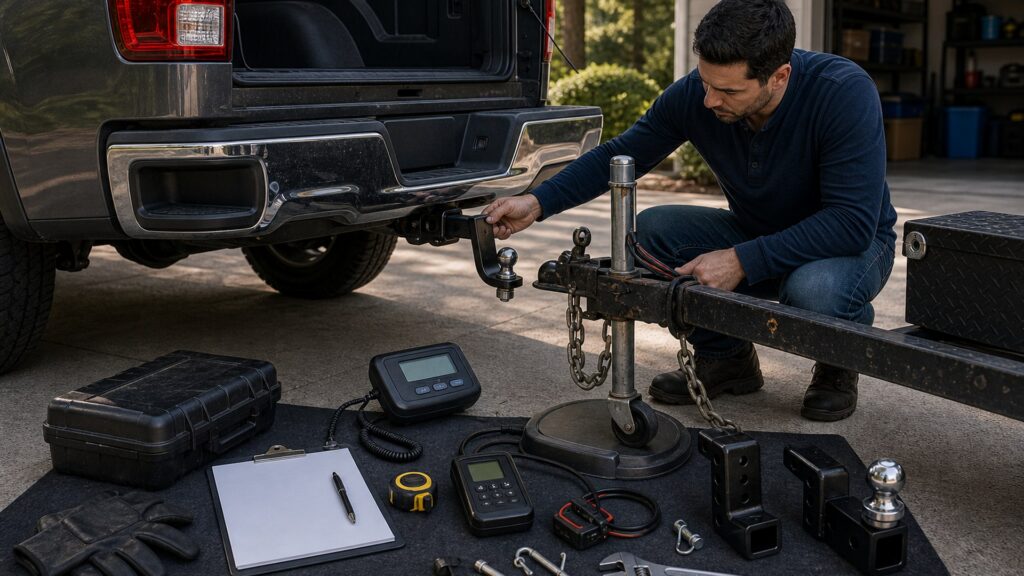
Buying framework
Build a rating worksheet for the exact combination
Tow compatibility is a chain of limits, not one advertised maximum. Start with vehicle-specific labels and manuals, then replace brochure assumptions with loaded measurements.
Identify the exact tow vehicle: Record model year, engine, transmission, drivetrain, axle ratio, cab, wheelbase, installed towing package, wheels, tires, factory options, and relevant aftermarket equipment. A rating published for the model line may belong to a different configuration.
Account for vehicle payload first: Occupants, pets, bed or cargo-area load, accessories, racks, toolboxes, receiver or fifth-wheel hardware, and trailer tongue or pin load all ride on the tow vehicle. Compare their combined effect with payload, GVWR, and individual axle limits.
Use the trailer's loaded condition: Begin with actual scale weight when possible. Otherwise add cargo, water, fuel, propane, batteries, tools, options, spare equipment, and aftermarket additions to a documented base. Keep the result within trailer GVWR, axles, tires, and structural limits.
Connect gross, axle, and hitch limits: Check GCWR against the loaded combination, vehicle GVWR against the loaded vehicle, each GAWR against its scale reading, and every hitch component against the applicable tongue or pin load. Passing one calculation does not excuse another.
Verify at a scale and revise: Weigh the combination in the travel configuration with people, cargo, and fluids represented. Obtain axle-group readings that support the vehicle and hitch manufacturer's method. Reposition or remove load only within all instructions; change equipment if the ratings cannot be satisfied.
Who this is for
Find the rating most likely to become your bottleneck
Vehicle class alone does not predict the controlling limit. Passenger load, accessories, trailer type, and hitch geometry can move the constraint from tow rating to payload or an axle.
Crossover and light-SUV owners: Small advertised trailer limits are often accompanied by modest payload, receiver, frontal-area, brake, or cooling requirements. Verify the exact vehicle manual and do not assume a physically fitting hitch makes every trailer of the stated weight compatible.
Half-ton pickup buyers: Configuration variation is large, and family passengers, bed cargo, caps, steps, toolboxes, and conventional tongue load can consume payload before the trailer reaches a headline maximum. Door labels and configuration-specific guides matter more than model reputation.
Heavy-duty truck users: Higher ratings do not remove the need to check rear axle, tires, payload, receiver, fifth-wheel or gooseneck components, and pin weight. Service bodies, auxiliary tanks, generators, and work tools may materially reduce the remaining capacity.
Travelers with variable cargo: Water, food, bicycles, generators, batteries, coolers, luggage, and seasonal gear change both trailer weight and vehicle payload. Use a repeatable loading inventory and scale process instead of relying on one empty or dealer-delivery measurement.
Fifth-wheel and gooseneck users: Pin load transfers into the truck bed and can make payload or rear GAWR controlling. Confirm hitch placement, bed and cab clearance, truck ratings, trailer GVWR, tire capacities, and the manufacturer's allowed combination for the exact configuration.
What to pay attention to
The ratings that must agree at the same time
Each number answers a different question. Compatibility exists only when the loaded combination stays within all applicable vehicle, trailer, tire, axle, and hitch boundaries.
Vehicle Rating Envelope
Configuration-specific payload, GVWR, front and rear GAWR, GCWR, tires, equipment, and manufacturer trailer limits.
Loaded Trailer & Hitch Transfer
Actual trailer mass, tongue or pin load, hitch components, axle distribution, and scale verification.
Payload and GVWR: The payload label estimates carrying allowance for a vehicle configuration, while GVWR caps the loaded vehicle itself. Verify the as-equipped condition and subtract occupants, cargo, accessories, hitch hardware, and tongue or pin load without double-counting.
Front and rear GAWR: Scale axle groups separately because a vehicle can remain under GVWR while overloading one axle. Hitch load, bed position, cargo, and weight-distribution setup can change front and rear readings; follow the vehicle and hitch instructions for evaluation.
GCWR and trailer weight rating: GCWR limits the loaded combination, and manufacturer trailer ratings depend on configuration and required equipment. Subtract actual loaded vehicle weight according to the maker's method rather than assuming the published maximum survives every passenger and cargo choice.
Loaded trailer and trailer GVWR: Trailer GVWR is not a target and dry weight is not a trip weight. Use the actual loaded mass, include options and fluids, and also verify trailer axle, tire, wheel, coupler, frame, and cargo-distribution limits.
Tongue or pin load: The downward hitch load affects tow-vehicle payload and axle distribution. Use the trailer and vehicle manufacturers' target or required range rather than a universal percentage, and measure the actual loaded configuration after cargo placement.
Receiver and hitch-component limits: Receiver, drawbar, ball, coupler, safety equipment, weight-distribution hardware, fifth-wheel, gooseneck, and attachment structure may have separate ratings and modes. The lowest limit in the installed system governs that load path.
Tires, wheels, and pressure: Vehicle and trailer tire capacities, pressure instructions, wheel ratings, speed limits, and condition remain part of compatibility. A suspension aid or higher-rated replacement component does not automatically increase certified vehicle, axle, or trailer ratings.
Avoid these traps
Tow-rating math errors that create false capacity
Most compatibility mistakes come from selecting the most favorable number and ignoring where other weight lands.
Using the model's headline maximum: A maximum often assumes a specific powertrain, axle, cab, wheelbase, towing package, and limited occupant or cargo allowance. Match the VIN configuration and labels to the appropriate guide instead of borrowing another trim's result.
Treating dry weight as travel weight: Dry or shipping figures can omit dealer options, water, fuel, batteries, propane, cargo, and accessories. A trailer far below advertised tow capacity can still overload payload, rear axle, hitch, or its own cargo capacity once prepared for use.
Forgetting tongue load in payload: Conventional tongue or fifth-wheel pin load is carried by the tow vehicle. It joins people, cargo, upfits, and hitch hardware in the payload and axle calculations; it is not already harmless because the trailer remains attached.
Letting the hitch override the vehicle: Installing a stronger receiver, ball mount, weight-distribution hitch, fifth-wheel, or gooseneck does not raise the manufacturer's vehicle GVWR, GAWR, GCWR, payload, or trailer rating. The new component can only operate within every lower limit.
Calling suspension aids a rating increase: Air springs, helper springs, shocks, or leveling devices may change ride height or behavior when properly selected, but they do not rewrite certified weight ratings. Solve an overloaded combination by reducing load or changing rated equipment.
Decision guidance
Act on the first failed limit
A compatibility worksheet should lead to a concrete response. Do not average limits or offset one overload with unused capacity elsewhere.
If payload fails first: Remove occupants or cargo, reduce hitch hardware where an approved lighter solution exists, choose a trailer with lower measured tongue or pin load under manufacturer guidance, or use a tow vehicle with suitable carrying capacity. Do not shift cargo merely to chase a low number and create instability.
If rear GAWR or tire capacity fails: Revisit cargo location, hitch setup, and measured tongue or pin load within approved procedures. If compliant distribution cannot bring the axle group below every limit, reduce the load or choose equipment with compatible ratings.
If GCWR or trailer rating fails: Lower the actual loaded trailer or vehicle weight, make fewer or separate trips, or select a tow vehicle rated for the combination. A higher-rated hitch, brake controller, or cooling add-on cannot by itself fix a combined-rating failure.
If trailer payload fails: Remove cargo, select a trailer with adequate GVWR and running gear, or reduce installed options. Never assume unused tow-vehicle capacity can be transferred to a trailer axle, tire, deck, or frame that is already at its limit.
If all ratings pass but data is uncertain: Delay the trip until configuration documents and loaded scale readings are reliable. Verify the hitch, brakes, tires, and load placement, then repeat measurements after material changes. A narrow calculation based on estimates deserves more verification, not optimism.
Ownership & compatibility
Keep the worksheet synchronized with the equipment
Compatibility can change after purchase. Accessories, passengers, new batteries, water, cargo, tires, or hitch hardware alter the loaded picture.
Save the controlling records: Keep door labels, towing guides, owner manuals, trailer certification labels, hitch ratings, tire data, scale tickets, and the loading worksheet together. Record which options and people were represented by each measurement.
Reweigh after meaningful changes: Repeat axle and combined measurements after adding a cap, rack, toolbox, auxiliary tank, larger battery bank, generator, interior build, different hitch, or substantial cargo. Treat a new tow vehicle or trailer as a new calculation.
Inspect the rated components: Follow manufacturer schedules for receivers, hitch hardware, couplers, frame attachments, tires, wheels, suspension, brakes, and trailer running gear. Damage, corrosion, modification, or missing labels can make an old worksheet irrelevant.
Plan for trip variation: Create defined loading locations and maximum cargo allowances for common travel modes. If passengers, water, fuel, or gear vary, measure or conservatively account for those changes before departure and keep every rating satisfied.
FAQ
Tow-rating compatibility FAQ
Clear answers to the weight, payload, hitch, and scale questions that cause the most confusion.
Is maximum towing capacity the same as trailer GVWR?
Why can payload run out before towing capacity?
Should I use trailer dry weight for compatibility?
How do I find my vehicle's exact ratings?
Does tongue weight count against payload?
Can a weight-distribution hitch increase towing capacity?
What scale readings should I obtain?
Do upgraded tires increase my truck's payload rating?
How often should I recalculate tow compatibility?
Bottom line
Compatibility is defined by the lowest limit
A safe rating worksheet makes every weight visible at the place it acts. One generous maximum cannot compensate for an overloaded vehicle, axle, tire, hitch, or trailer.
Use exact configuration data: Match labels and guides to the vehicle and installed towing equipment.
Count every carried pound: People, accessories, hitch hardware, cargo, fluids, tongue load, and pin load all belong somewhere.
Check gross and axle limits: GVWR, GAWR, GCWR, trailer weight, hitch components, and tires must pass together.
Verify with loaded measurements: Scale the travel configuration and repeat the process after meaningful changes.
Reading Shortcuts
Connect every loaded pound to a rating.
Decision Reminders
Checks to complete before the combination moves.
- Use the exact vehicle: Trim and equipment change ratings.
- Count passengers: Occupants consume payload.
- Load the trailer honestly: Dry weight omits trip equipment.
- Include hitch load: Tongue or pin weight rides on the vehicle.
- Check axle groups: GVWR alone can hide an overload.
- Use scale data: Measurements replace optimistic estimates.
Glossary Snippets
Terms used in this towing decision.
When to Use a Top 10 Review
Use rankings only after the required vehicle and trailer rating envelope is known.
- The configuration is verified: Compare advice for the correct powertrain and chassis.
- The loaded trailer is known: Reject candidates built around dry figures.
- Payload is calculated: Screen tongue and pin demands realistically.
- Hitch mode is defined: Compare conventional, fifth-wheel, or gooseneck systems.
Already down to 2–3 options? A Comparison is usually the faster next step.
When to Use a Comparison
Compare finalists with the same loaded worksheet rather than different marketing maxima.
- Compare payload use: Include hardware and transferred hitch load.
- Compare axle margin: Use measured front and rear groups.
- Compare component limits: Review receiver, mount, ball, coupler, and tires.
- Compare verification tools: Consider scales, labels, and onboard measurements where supported.
Still building a shortlist? Start with a Top 10.