
Towing, Trailers & Hauling Buying Guide for Work Truck Hauling Needs
A work truck begins the day partly loaded. Service bodies, racks, boxes, fuel systems, hitches, compressors, generators, tools, and crew consume payload before a pallet, machine, or trailer is added. The finished truck—not the brochure configuration—sets the useful capacity.
Choose hauling equipment around the work sequence as well as the ratings. Material must load, stay restrained, leave room for daily tools, and unload at the site without unnecessary handling. Fleet parts, inspection access, and recovery from breakdowns also shape long-term value.
Buying framework
Design the truck around a full workday
A work truck carries permanent equipment before it carries today's material. Map people, upfits, tools, loads, access, and downtime together instead of treating payload as empty bed space.
Weigh the truck as equipped: Account for service body, cap, rack, toolbox, auxiliary fuel, generator, compressor, hitch, driver, crew, and recurring inventory. Compare the resulting vehicle and axle weights with the certification labels before assigning capacity to jobsite cargo.
Separate bed load from trailer load: Bed cargo consumes payload directly; a trailer adds hitch hardware and tongue or pin load while placing its remaining mass on trailer axles. Build both calculations for mixed days rather than assuming unused trailer capacity offsets an overloaded truck.
Map the loading workflow: Record forklift approach, side and rear access, bed height, ramp or crane use, compartment doors, tool retrieval, unload order, and where the vehicle can park. Productivity depends on reaching tools without unloading material or standing in traffic.
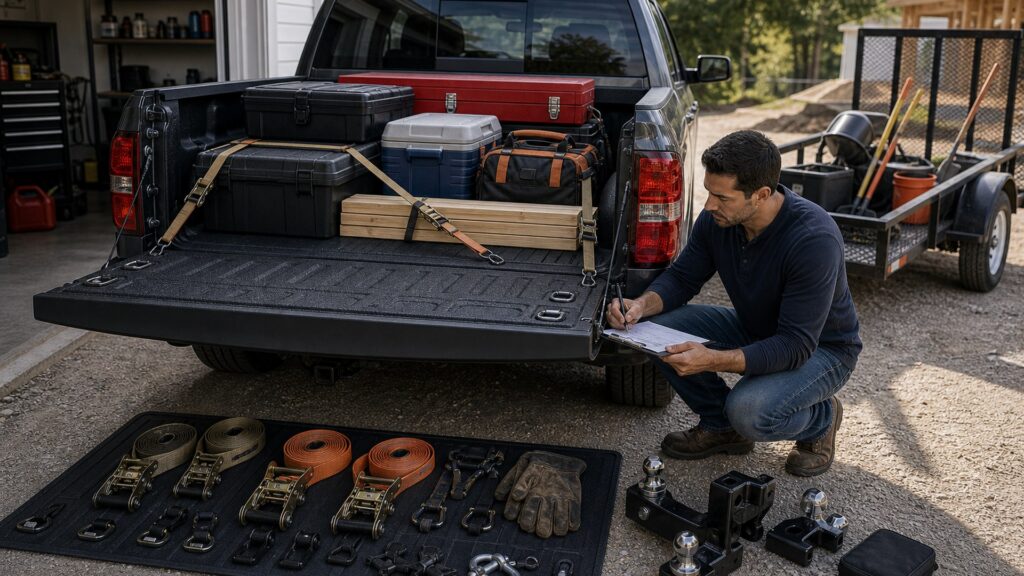
Create a rated restraint path: Match racks, bulkheads, bed anchors, track, stake pockets, chains, straps, edge protection, and blocking to the carried material. Confirm mounting and ratings after an upfit; a convenient attachment point is not automatically a securement anchor.
Plan for failure and reassignment: Identify tires, hitch parts, connectors, brake components, latches, straps, keys, hydraulic pieces, and batteries that can stop work. Standardize high-wear items across trucks where possible and define what happens when a vehicle or trailer leaves service.
Who this is for
Match the body and trailer to the trade
Materials, tools, weather, theft exposure, and unload method create distinct work-truck systems.
Service and repair trades: Plumbers, electricians, HVAC technicians, and mobile mechanics benefit from compartment access, parts bins, interior lighting, protected small inventory, and a payload calculation that includes shelving and tools. An enclosed service body or trailer trades rear visibility and empty weight for organization.
Construction-material haulers: Lumber, pipe, sheet goods, masonry, and mixed supplies need rack geometry, bulkheads, load stops, bed length, trailer deck, forklift access, rated anchors, and edge protection. Dense material can reach axle or payload limits before the bed appears full.
Landscape and debris crews: Open beds, utility trailers, and dump trailers simplify dirty loads and unloading. Compare material density, side height, tarp system, ramp storage, tailgate modes, hydraulics, cleanup, and jobsite ground clearance rather than choosing from volume alone.
Equipment-moving contractors: Skid steers, compact excavators, lifts, and attachments require actual machine weights, trailer payload, axle placement, deck clearance, rated ramps, brakes, hitch system, and machine-specific restraint. Attachments and fuel belong in the manifest.
Fleet managers: Repeatability can matter more than one operator's preferred layout. Standard connector pinouts, coupler sizes, keys, tie-down kits, inspection forms, spare tires, brake parts, and load diagrams reduce training errors and make trucks easier to reassign.
What to pay attention to
Work-truck specifications that protect payload and uptime
Read the as-equipped truck, not the model brochure. Upfits and daily inventory change axle loads, access, and repairability.
Payload & Chassis Integration
Actual truck weight, GVWR, axle and tire limits, service bodies, racks, hitches, bed geometry, and transferred trailer load.
Jobsite Workflow & Fleet Uptime
Loading access, organization, securement, shared parts, inspection, weather and theft protection, serviceability, and downtime.
Payload label, GVWR, and curb reality: The door label and configuration records establish boundaries, but the completed upfit should be weighed. Account for the crew, fixed equipment, tools, carried material, coupling assembly, and downward trailer transfer, then compare the resulting vehicle mass with GVWR.
Rear GAWR, tires, and load position: Service bodies, toolboxes, material stacks, and trailer hitch load often concentrate weight behind the cab. Obtain axle readings and verify tire capacities and pressures under manufacturer guidance; level stance does not prove acceptable rear-axle load.
Bed, body, and compartment geometry: Compare clear bed length and width, wheel wells, side reach, door sweep, shelf depth, weather seals, floor rating, payload of the installed body, and clearance around fuel fills, lights, cameras, and hitch components.
Rack and long-material support: Check vehicle-specific mounting, crossbar and system limits, load stops, front protection, overhang, tie-down paths, and clearance for ladders, pipe, doors, and trailers. The lowest rail, mount, roof, bed, or cargo attachment rating governs.
Receiver, gooseneck, or fifth-wheel integration: Confirm frame fit, hitch rating, bed location, pin or tongue load, wiring, brakes, safety equipment, turning and cab clearance, service-body interference, spare-tire access, and whether the upfitter permits the installation.
Trailer loading and unload equipment: Deck height, ramps, dump hydraulics, winch, crane, forklift pocket, tailgate, stabilizers, and ground clearance must suit actual sites. Include the weight of every powered or structural option in trailer payload.
Fleet service and diagnostics: Favor accessible grease points, replaceable lighting and connectors, common hubs or tires where appropriate, diagnostic information, parts channels, and inspection visibility. Telematics may help scheduling, but it does not replace physical inspections or scale data.
Avoid these traps
Work-truck choices that consume capacity or time
A setup can look capable while its upfits have already used the payload and its layout forces repeated unloading.
Using advertised payload after upfitting: Model-level payload figures do not subtract a specific service body, rack, cap, toolbox, auxiliary tank, hitch, crew, or inventory. Weigh the finished truck and calculate from its own labels and axle readings.
Treating suspension aids as new capacity: Air springs, helper springs, and other devices may change ride height or behavior when correctly selected, but they do not increase manufacturer GVWR, GAWR, tire capacity, or certified payload. Reduce load when a rating is exceeded.
Buying trailer volume instead of workflow: A large enclosed or dump trailer can add parking, wind, weight, licensing, and maintenance without improving the unload sequence. Define cargo density, access, and site constraints before paying for cubic space.
Blocking tools behind material: A layout that requires unloading sheet goods or equipment to reach daily tools wastes time and encourages unsafe roadside access. Separate first-use tools, PPE, securement, and emergency equipment from cargo that remains until the destination.
Assuming locked means restrained: A toolbox lock addresses access, not internal movement. Heavy tools, cylinders, batteries, and parts still need trays, dividers, mounts, or securement appropriate to their mass and shape, especially on rough sites.
Decision guidance
Choose where the load belongs
Use the bed for immediate access, a rack for supported long material, and a trailer when volume, dirty cargo, equipment, or unloading method justify the extra system.
Choose bed-only hauling if: The as-equipped truck retains enough payload and axle capacity, the cargo fits within legal dimensions, and bed anchors provide a proper restraint path. Preserve access to tools, spare tire, cameras, lamps, and emergency gear.
Add a rack if: Long material is frequent, its weight and overhang can be supported within rack and vehicle ratings, and loading does not block doors or raise instability unacceptably. Use load stops and tiedown paths designed for the actual product.
Use an open or dump trailer if: Dirty, bulky, dense, or machine-loaded cargo would overwhelm bed access or cleanup. Select payload, axle placement, brakes, ramp or hydraulic unloading, anchor geometry, and jobsite maneuverability from repeat loads rather than maximum box size.
Use an enclosed trailer or service body if: Weather, inventory control, mobile workspace, and theft deterrence justify the weight and access tradeoff. Calculate shelving and stock as permanent payload, secure heavy contents internally, and plan ventilation, lighting, and door clearance.
Move to heavier-rated equipment if: The real crew, upfit, inventory, cargo, tongue or pin load, axles, or combined weight cannot stay within ratings. Do not normalize overload because the truck sits level or the route is short; reduce the mission or use a suitably rated system.
Ownership & compatibility
Make the work system inspectable and replaceable
Frequent users need repeatable checks across truck, body, hitch, trailer, and securement equipment.
Track configuration weight: Keep upfit invoices, installed weights, scale tickets, axle readings, payload worksheet, and repeat-load diagrams. Update them when racks, boxes, tanks, generators, compressors, hitch hardware, inventory, or staffing changes.
Inspect mounting and restraint systems: Check body mounts, racks, bulkheads, anchors, hitches, couplers, straps, chains, binders, doors, locks, ramps, and hydraulic components. Remove damaged securement gear and correct loosened or corroded mounts under manufacturer and upfitter procedures.
Standardize the fleet essentials: Use clearly labeled couplers, plugs, brake-controller profiles, keys, spares, tie-down kits, inspection forms, and emergency equipment. Standardization should reduce error without encouraging a driver to use one load plan for a different trailer.
Protect uptime with scheduled service: Coordinate truck maintenance with trailer tires, hubs, brakes, wiring, dump batteries, hydraulics, lights, cameras, and body hardware. Maintain required commercial records and put unsafe equipment out of service rather than carrying a defect into the next shift.
FAQ
Work-truck hauling FAQ
Answers about payload, upfits, racks, trailers, and fleet operation.
How do I calculate payload after adding a service body?
Do air springs increase my work truck's payload?
When is a trailer better than carrying material in the bed?
What should I check before installing a ladder rack?
How does trailer tongue weight affect a work truck?
Are service-body compartments enough to secure tools?
What trailer type suits compact equipment?
How can a fleet reduce hauling setup errors?
What records should a work-truck hauling system keep?
Bottom line
Protect payload and the workday
A useful work truck carries the crew, upfit, tools, materials, and hitch load within every limit while keeping equipment accessible and the fleet serviceable.
Weigh the finished truck: Permanent equipment counts before today's material arrives.
Protect axle capacity: Rear load concentration can become the controlling constraint.
Design access and restraint: The layout should support the unload sequence and secure each item.
Standardize without assuming: Shared parts and procedures help uptime, but each combination still needs verification.
Reading Shortcuts
Connect payload, access, and securement to each job.
Decision Reminders
Checks to complete before the combination moves.
- Weigh the upfit: Permanent equipment consumes payload.
- Check rear axle: Work loads often concentrate behind the cab.
- Keep tools accessible: Do not bury daily equipment behind cargo.
- Rate every anchor: Convenient holes are not automatic tie-downs.
- Plan downtime: Identify parts that can stop the shift.
- Update the worksheet: Inventory and staffing changes affect capacity.
Glossary Snippets
Terms used in this towing decision.
When to Use a Top 10 Review
Use rankings after the work mission and as-equipped capacity are documented.
- The trade workflow is mapped: Compare layouts serving the same tasks.
- Permanent payload is known: Reject options that consume critical capacity.
- Loading access is measured: Screen doors, racks, ramps, and compartments.
- Uptime requirements are set: Rank parts and service channels realistically.
Already down to 2–3 options? A Comparison is usually the faster next step.
When to Use a Comparison
Compare finalists with the same crew, inventory, material, and trailer load.
- Compare usable payload: Include body, rack, boxes, and hitch.
- Compare access: Evaluate side reach, unload order, and forklift path.
- Compare securement: Review anchors, racks, track, and blocking.
- Compare fleet support: Check common parts, inspection, and downtime.
Still building a shortlist? Start with a Top 10.