
Training Equipment Buying Guide for Functional Fitness
Functional fitness equipment should make varied movement practice easier to organize, not simply make the room look busy. Start with the families the program actually uses: squats, hinges, pushes, pulls, carries, rotation work, bracing, steps, and transitions. Then choose tools that create usable load steps and clear movement lanes.
Use this checklist: 1. map lower-body, upper-body, loaded-carry, rotation, and conditioning tasks; 2. identify users and scaling needs; 3. measure stations and transitions; 4. match implements to surfaces; 5. choose storage that keeps paths open; 6. include cleaning and inspection; 7. avoid duplicate tools unless they solve different jobs.
Buying framework
Cover movement families without crowding transitions
The kit should support varied work while leaving room to change stations deliberately.
1. Map the movement menu: List knee-dominant work, hip hinges, lunges, presses, rows, carries, rotation, bracing, crawling, jumping, and conditioning tasks. Do not buy equipment for movements that never appear in the program.
2. Assign station space: Place each implement where it will be used, changed, and returned. Functional fitness fails when boxes, bells, mats, and bands compete for the same walking path.
3. Build scaling options: Record beginner, intermediate, and stronger user loads or heights for each movement family. Useful equipment offers practical progressions without requiring a warehouse of duplicates.
4. Match surfaces and impacts: Check flooring, ceiling, wall, anchor, and noise rules before throws, jumps, swings, or dragged loads. Follow manufacturer directions rather than assuming rubber solves every contact problem.
5. Rehearse transitions: Walk through a circuit slowly, changing loads, moving implements, wiping handles, and returning items. If the room jams during rehearsal, buying more equipment will not fix it.
Who this is for
Compare functional fitness equipment families
Each family should cover a movement job and admit its limitation.
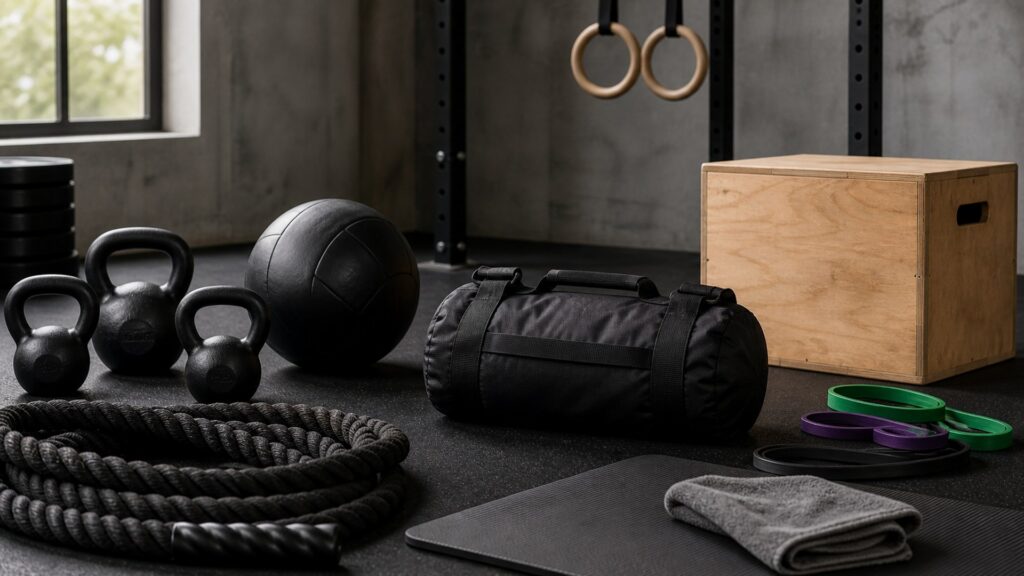
Kettlebells and dumbbells - best suited for hinge, squat, press, and carry work: Compare handle feel, increments, paired inventory, coating, floor behavior, and rack access. Drawbacks include storage cost, awkward jumps, and impact restrictions for adjustable models.
Bands and suspension tools - best suited for pulling, assistance, and portable scaling: Inspect resistance range, length, anchors, handles, stitching, and replacement guidance. They can degrade, irritate skin, or create poor angles when attached casually.
Boxes and mats - best suited for height, landing, floor, and position tasks: Check height options, traction, density, edge shape, weight, and cleaning. Bulky pieces can slide, scare users, or block transitions when poorly stored.
Medicine balls and sandbags - best suited for throws, carries, rotation, and awkward loads: Review fill behavior, seams, grip, shell material, rebound, and surface compatibility. They need open zones and can leak, scuff, or overload smaller spaces.
Storage and timers - best suited for circuit flow: Compare wall racks, bins, carts, interval timers, labels, and charging. These quiet tools do not train anyone, but they prevent clutter, delays, and lost parts.
What to pay attention to
Translate functional specs into movement flow
Details matter when they affect load steps, grips, surfaces, stations, or cleaning.
Movement coverage: Create a matrix with columns for squat work, hinge work, pushing, pulling, carrying, rotation, bracing, and conditioning. Buy tools that fill real gaps rather than duplicating one favorite pattern.
Loading resolution: List the actual increments for bells, dumbbells, bands, bags, balls, and bodyweight assistance. Gaps can make scaling abrupt for some users and redundant for others.
Grip and body interface: Handle diameter, texture, strap width, box edge, mat friction, and bag seams affect use. Check these interfaces with the movement and clothing expected in sessions.
Station footprint: Measure swinging arcs, carry lanes, mat length, box approach, band stretch, ball rebound, and temporary parking. Stored size understates the room functional fitness requires.
Surface and anchor limits: Verify wall, floor, ceiling, rack, and door requirements before bands, suspension straps, throws, jumps, or loaded carries. Structural questions need qualified review.
Transition and cleaning time: A circuit may need wiping, load changes, strap resets, and return paths between users. Equipment with quick adjustments but difficult cleaning can still slow the session.
Source context: Manufacturer instructions and facility policies govern use, anchors, cleaning, and storage. This guide interprets buying consequences and does not claim hands-on testing or health outcomes.
Avoid these traps
Avoid functional fitness clutter
Poor choices usually add variety while reducing usable movement space.
Buying duplicate movement patterns: Five tools that all do similar swings may leave pull, carry, or rotation work unsupported. Use the movement matrix before adding another appealing implement.
Ignoring transition lanes: A box placed near dumbbells can block carries, while mats can invade band paths. Walk the room with all tools deployed before accepting the layout.
Scaling only by heavier loads: Some users need lower height, different handles, more support, or slower setup rather than a lighter bell. Buy scaling options across movement families.
Using anchors casually: Door, wall, rack, and ceiling attachments must follow instructions and facility rules. A strap that fits the exercise may still be wrong for the structure.
Letting cleaning erase flow: Shared handles, mats, bags, and straps need reset time. If sanitation and drying are not scheduled, transitions become rushed or equipment stays damp.
Decision guidance
Build a movement coverage matrix
A one-page grid prevents the kit from becoming a pile of unrelated tools.
List movement columns: Create columns for knee bend, hip bend, press, row, loaded walk, trunk turn, brace, conditioning, and warm-up. Put each owned or proposed item only where it truly belongs.
Add user rows: Write beginner, average, stronger, taller, shorter, and shared-space considerations. Mark where load, height, grip, or setup needs differ across users.
Draw station flow: Map where every tool starts, where it is used, where it waits, and where it returns. Include mats, boxes, carts, fans, doors, and cleaning supplies.
Price the missing gaps: Buy the lowest-complexity item that fills an actual gap in the matrix. Include storage, labels, freight, parts, and cleaners before comparing flashy additions.
Run a low-pressure circuit: Move slowly through one representative sequence, changing loads and wiping surfaces. Remove any item that causes confused traffic, hidden damage, or skipped reset steps.
Ownership & compatibility
Maintain functional fitness stations
The best kit remains organized enough to use repeatedly.
Store by movement family: Keep bells, bands, mats, balls, bags, straps, and timers where their station begins. Storage should keep exits, walking lanes, and cleaning supplies accessible.
Inspect contacts and seams: Check handles, coatings, straps, anchors, stitches, box panels, mat edges, ball covers, bag closures, buckles, and timer mounts. Remove damaged gear immediately.
Clean before closing storage: Use approved cleaners for functional fitness rubber, foam, fabric, vinyl, metal, wood, and electronics. Let sweaty or wet items dry outside sealed bins.
Review scaling needs: As users change, revisit load jumps, box heights, strap lengths, and mat sizes. Equipment that once fit the group may become too limited or redundant.
Keep replacement paths visible: Save model names, manuals, receipts, warranty terms, and parts sources for bands, straps, handles, covers, mats, and electronics. Improvised substitutes can change exercises.
FAQ
Functional fitness training equipment FAQ
Nine answers focus on movement coverage, transitions, and upkeep.
What equipment is best for functional fitness?
How do I avoid buying too much gear?
Are adjustable dumbbells good for circuits?
Do I need a plyometric box?
Are bands safe for functional fitness?
What floor works for functional fitness?
How should shared gear be organized?
Can functional fitness equipment guarantee results?
When should functional gear be replaced?
Bottom line
Approve the functional setup
The purchase should cover movement families while preserving space, scaling, and maintenance.
Coverage proof: Squat, hinge, push, pull, carry, rotate, and brace are mapped.
Flow proof: Stations and transitions stay clear.
Scaling proof: Loads, heights, grips, and supports fit users.
Upkeep proof: Cleaning, inspection, storage, and parts are planned.
Functional Fitness Route
Use these checks before comparing mixed-movement training product rankings.
Movement and Transition Boundaries
Four limits to keep visible when buying mixed-movement training equipment.
- Coverage beats clutter: Fill movement gaps before buying duplicates.
- Transitions count: Circuits need clear return paths.
- Anchors need authority: Follow instructions and facility rules.
- Cleaning is part of flow: Wet gear should not vanish into bins.
Functional Fitness Terms
Terms used in this mixed-movement training guide.
When a Functional Ranking Helps
Ranked lists help only after the mixed-movement training task map is complete.
- Best suited for: For mixed-movement training, filter each family by task, athlete, surface, space, coaching plan, and current constraints.
- Known drawback: For mixed-movement training, name the compromise in setup time, skill demand, storage, wear, surface needs, or transfer limits.
Research basis: functional fitness equipment advice uses manufacturer instructions, facility rules, and qualified programming context; no hands-on testing or outcome guarantee is claimed.
Compare Functional Setups
Compare mixed-movement training finalists as complete working setups, not isolated objects.
- Evidence check: For mixed-movement training, use maker specifications, official facility rules, and qualified coaching input when available; do not invent test results.
- Ownership check: Confirm mixed-movement training returns, parts, cleaning, inspection, storage, and documented replacement paths before buying.
Compare rankings only after the movement matrix, station flow, storage, and maintenance plan are complete.