
Travel Accessories Buying Guide for Carry-On Travel
Before you buy a power bank for a flight, find out whether you can carry that exact battery on the itinerary you’ve booked. The watt-hour rating is only part of the decision. This guide shows how to match a bank to your airline’s rules and find a protected place for it in the cabin.
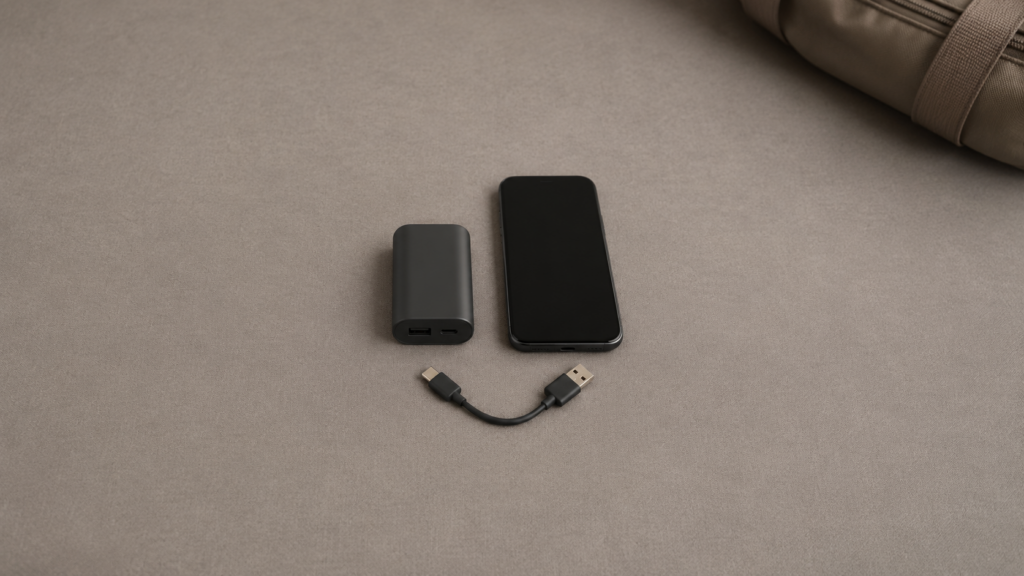
Buying framework
Start with the flight and the battery
Settle the carriage question while you still have a choice of models. A useful shortlist ties each candidate to a specific trip and a battery rating you can verify.
Start with the itinerary: Write down the route and the airline operating each flight, including the return. Those details tell you which authorities and airline policies to consult.
Identify what you’re carrying: A standalone lithium power bank supplies power to another device, so U.S. passenger rules treat it as a spare battery. Look under portable chargers or spare lithium batteries when reading the relevant travel rules.
Find evidence for the exact unit: Pull up the maker’s specification for the full model number and record its battery rating in watt-hours (Wh), a measure of stored energy. You’ll need a way to match that specification to the bank you receive.
Read the operating airline’s own policy: The airline’s portable-charger entry tells you what it allows on its aircraft. Read the current quantity, rating, storage and use terms before you narrow the field.
Give the bank a place in the cabin: Decide where the intact bank can travel, with protection that suits its design. A bank that meets the numerical limit still needs a cabin location that meets the applicable rules.
Who this is for
Buying around your carry-on plans
A straightforward nonstop can turn on one battery rating. A vague listing, a change of carrier or a bag you may have to hand over creates a different buying decision.
One bank and a confirmed operator: If you can identify the exact unit and the airline flying you, you can rule out models that exceed that airline’s rating limit before comparing charging features. Start with units whose full model numbers appear in the maker’s documentation.
A listing with several versions: A seller may put several capacities under a single listing and show a different model as you change options. Ask which exact unit ships with your selection and keep shopping if the seller cannot identify it.
An itinerary split across airlines: A connection or return on a different operating airline adds another set of conditions. Choose a unit and cabin arrangement that work across all segments so you can bring the same bank along throughout.
A roller bag you may have to hand over: If your main bag may go to the hold at boarding, choose a bank you can keep in an allowed cabin location independent of that bag. Work out where that will be before deciding how much space you have for the bank and its protection.
A phone you expect to charge in flight: Look up the airline’s onboard use rules if your plan depends on charging at your seat. A policy that limits use can change whether the bank is worth buying for the flight itself.
What to pay attention to
Battery specs and flight limits that matter
A manufacturer’s specification tells you what battery you are looking at. The authority and operating airline tell you how that rating, and the way you plan to carry the bank, affect your trip.
Exact battery identification and rating
Read the full model code and stored-energy rating together so the figure you compare belongs to the unit you can buy.
Operating airline and cabin arrangements
Compare the battery rating with the applicable rules, then see whether the airline’s quantity, placement and use conditions fit how you’ll travel.
Full model identifier: Match the entire model code, including any suffix, to the maker’s specification. Similar product names can lead to the page for a different battery.
Battery watt-hours: Wh measures stored battery energy, the figure used for the rating limit in this guide. A USB output rating in watts (W) describes power delivered at the port.
Documented battery voltage: If the maker documents the same model’s battery charge capacity in milliamp-hours (mAh) and its battery voltage, divide mAh by 1,000 and multiply by that voltage to get Wh. Use the battery’s voltage for the calculation.
U.S. provision and airline cap: The U.S. passenger provision generally caps lithium-ion batteries at 100 Wh and allows up to two individually protected larger spares per person in carry-on above 100 Wh through 160 Wh with operator approval. An airline can set a tighter power-bank limit.
Quantity and cabin position: The airline in the worked example limits each customer to one power bank and prohibits overhead-bin storage for it. It recommends a personal item under the seat in front.
Use and recharging at the seat: That same airline requires the bank to be visible while you use it and bars recharging the bank from in-seat power. Factor both conditions in if you expect to rely on the bank during the flight.
Avoid these traps
Buying mistakes that surface at boarding
The expensive mistake is discovering after purchase that the bank falls outside a condition you relied on. These are common ways a promising listing or packing plan can lead you there.
Sorting by the biggest wattage number: A fast-charging headline can put a model near the top of your search while leaving its stored energy buried in the specification. Open the battery details before keeping that model on your list.
Treating a stock photo as proof of the label: A listing image and a maker’s specification can help identify a model. Inspect the unit you receive while there’s still time to resolve a missing or unreadable rating or a unit that differs from the listing.
Buying in the hope of later approval: For a larger battery, first find out whether the operator’s current power-bank policy even offers an approval route. If the policy excludes that rating, waiting until boarding leaves you with a bank that falls outside the published limit.
Using the allowance for camera spares: A carrier may list removable batteries fitted to a camera separately from portable chargers, as the carrier in this guide does. Use the entry for the item you’re buying before counting what you can bring.
Assuming a cabin bag can go anywhere: A roller can stay in the cabin and still be headed for an overhead bin. If the carrier excludes that location for the bank, plan to keep the bank in a permitted spot even when the roller goes overhead.
Planning to refill the bank at the seat: A seat outlet may look like a backup when you expect to start the flight with a depleted bank. If your carrier bars that use of its outlets, decide whether you can charge the bank before boarding or still make use of it after landing.
Decision guidance
Which power bank makes the shortlist?
Consider a hypothetical nonstop from Los Angeles to Las Vegas operated by Southwest Airlines. The passenger has one USB-C phone, a compatible cable and room to carry one protected power bank in a personal item.
If the phone stays the same, compare the bank ratings: For two exact models, the maker lists maximum battery ratings of 37 Wh and 111 Wh. Both specifications list USB-C charging output, and the same phone supports charging over USB-C.
If a candidate is rated 111 Wh, set it aside for this flight: At 111 Wh, the larger bank falls within the numerical range of the U.S. operator-approval provision for larger spares. Southwest’s own power-bank policy, checked November 24, 2026, sets a 100 Wh cap, which excludes this model on the example trip.
If the actual 37 Wh unit matches, shortlist it: The 37 Wh model meets the rating condition for this flight. Before relying on it, confirm with the maker that the battery type meets the UN 38.3 transport testing requirements. Check that the unit you receive matches the documentation, is in suitable condition and can be protected and carried under the other applicable rules.
If your roller goes overhead, keep the bank with the personal item: On this flight, the bank must stay out of the overhead bin. The carrier recommends stowing it in the personal item under the seat in front, where it can be retrieved when needed.
If you’ll charge the phone at your seat, plan for visible use: Take the bank out of the personal item while it is powering the phone so it stays visible. If you need to replenish the bank, plan to do so before boarding or after landing.
Ownership & compatibility
Keeping the actual power bank ready to fly
The unit you receive is the one you’ll have to identify and protect on the trip. Keep its documents available and decide how you’ll handle it through boarding and during the flight.
Keep the documents that match your unit: Save the maker’s specification and the instructions supplied with the exact bank. If you buy a replacement with a different model number, use the replacement’s own documents for the next trip.
Check condition before packing: Inspect the unit and check its recall status before you pack it. Leave out a battery that is damaged, defective or recalled, as the carrier in the example directs.
Protect the intact bank and any exposed contacts: Follow the maker’s instructions for your unit and protect the bank from damage. The FAA lists a separate protective pouch as one way to keep exposed terminals from contacting metal.
Move the bank before handing over a bag: If your carry-on is gate- or planeside-checked on a U.S. flight, remove the bank before handing over the bag. Keep it with you in the cabin in a location the carrier allows.
Tell the crew if the battery changes condition: Alert the flight crew immediately if the bank or the device it’s powering overheats, swells, smokes or burns. The crew is trained to respond to lithium battery fires in the cabin.
FAQ
Carry-on power bank questions
The details that often need a second look are the label on the unit, the rules after a flight change and where the bank goes during boarding.
Does a power bank count as a spare if the battery is sealed inside it?
Can I calculate Wh from mAh and the voltage beside the USB port?
What if the model on the unit differs from the model I ordered?
Is a battery rated exactly 100 Wh over the example airline’s limit?
What if I’m rebooked and my flight number stays the same?
Can I bring two small banks if their combined rating is below the cap?
What if the airline takes my carry-on at the aircraft door?
Does a protective pouch let me put the bank in the overhead bin?
Can I leave my bank in my bag with a cable running to my phone?
Bottom line
Choose the bank you can carry on this itinerary
A portable charger earns a place on your shortlist when the rating belongs to the unit you’ll receive and its carriage conditions fit your flights. Any unresolved detail is a reason to hold off while you can still choose another model.
A rating you can trace: Buy from a listing that lets you match the offered unit to the maker’s battery specification, then verify the model when it arrives.
A match for the whole route: Keep the bank on your shortlist only if the applicable authority and every operating airline’s current power-bank conditions allow your plan.
A protected cabin spot: Commit to a unit you can protect and keep in an allowed cabin location, even when your main bag leaves your hands.
A realistic plan for charging: If your purchase depends on using the bank at your seat, let the airline’s use conditions determine whether it will serve that purpose.
A clear reason to stop: Rule out a bank that exceeds the operating carrier’s limit. When the rating or identity is uncertain, resolve it before buying.
Reading shortcuts
Find the battery rating, compare two banks for the same flight or check what happens at gate handover.
Before you buy
A quick pass through the details that can take a power bank off your shortlist.
- Exact unit: Match the full model code to the maker’s specification before relying on the battery number.
- Energy rating: Use the battery’s watt-hours when checking a limit written in Wh.
- Operating airline: Read the power-bank conditions for the airline flying each leg.
- Quantity: Count the individual banks you intend to bring.
- Cabin location: Pick a protected spot that works if the main carry-on goes to the hold.
- Seat use: Look up the carrier’s rules for using and recharging the bank before relying on it onboard.
Power bank terms
The terms you’ll see in battery specs and airline policies.
When to use a Top 10 list
Browse the accessory lists for portable chargers, then look up the watt-hours for each exact model.
- Starting from scratch: Scan a list when you want an overview of the kinds of portable chargers available.
- Still deciding what to carry: Use the entries to identify models you could keep in your intended cabin spot.
- Working with a fixed rating limit: Flag entries with a documented battery energy rating you can verify.
- Need a few leads: Keep models with enough identifying detail to find the maker’s specification later.
Use a comparison after you’ve checked each model’s watt-hours against the airlines’ limits for your flights.
When to use a comparison
Compare the charging interfaces and the space each protected bank would take up in your allowed cabin spot.
- Two documented candidates: Line up the exact model identifiers so each specification stays attached to the right unit.
- Similar-looking figures: Look for which numbers describe battery energy and which describe charging output.
- A fixed cabin spot: Review the space each bank and its protection would occupy in the location you can use.
- A known device: Look at the listed charging interface on each remaining bank alongside your device’s requirements.
If a shortlisted bank has no verifiable watt-hour rating, return to a category list to find a replacement.