
Travel Bags & Backpacks Buying Guide for Carry-On Travel
A travel backpack and detachable daypack can be easy to carry together through the airport and still be awkward to fit into a cabin allowance. Before buying the pair, decide how you’d present it at boarding. The answer tells you which measurements to check and whether each bag has an eligible place to go.
Buying framework
Choose how the bags will board
A detachable system gives you two ways to arrive at the gate with the same belongings. Think through the pieces you’ll actually present before deciding whether the attachment makes the pair worth buying.
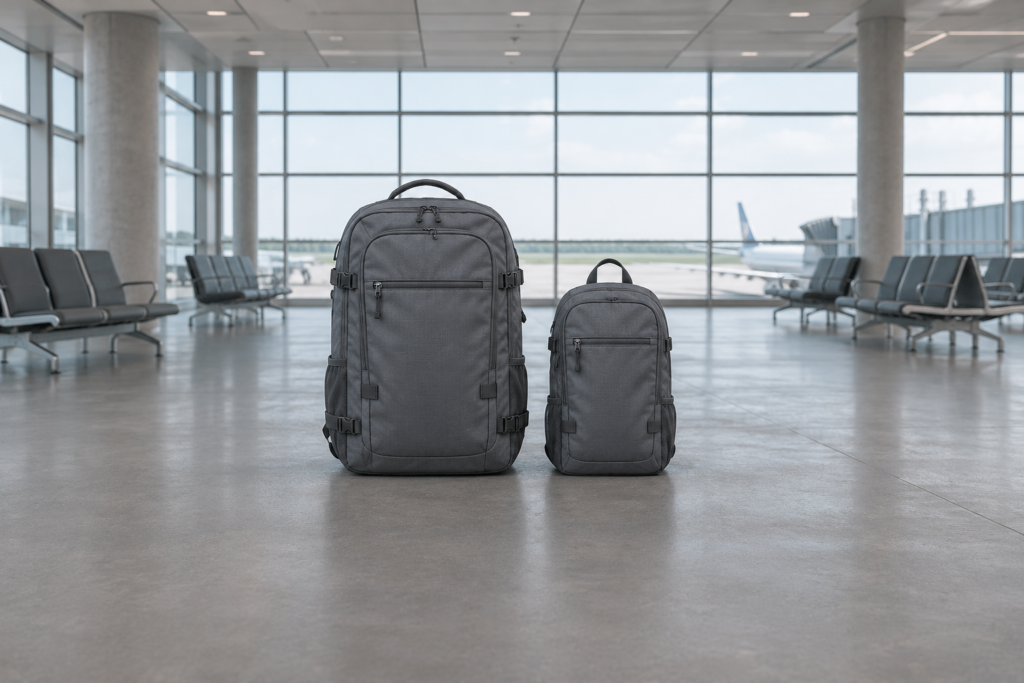
Identify both pieces: The pair here consists of a standalone 40 L travel backpack and its matching 15 L detachable daypack, sold separately. Treat each piece as a purchase decision if both need to earn their place in the cabin.
Picture the attached shape: With the daypack mounted, the two pieces make one physical assembly. A boarding plan that relies on that shape needs room for the daypack where it sits on the loaded main bag.
Give the detached bag a job: If the main pack is going overhead, the smaller bag needs its own eligible place under the seat. Decide what you actually want within reach there before settling on the accessory.
Check the allowance by category: Find out whether your fare gives you a place for each bag you intend to carry. A daypack that needs the same size allowance as the main bag can leave you with two pieces competing for one slot.
Set your purchase threshold: If both pieces must fly in the cabin, choose a setup you can verify with the load you’ll actually bring. If the main bag alone covers the trip, you can decide whether the optional daypack is worth adding later.
Who this is for
What you need the daypack to do
The attachment can help with the walk through the terminal, while a separately carried daypack can keep things within reach on board. Decide which job you need the smaller pack to do before you pay for it.
You want the bags together through the terminal: A mounted daypack can keep the two pieces together between the airport entrance and the gate. The attachment is still useful if you’ve planned to remove it before boarding.
You want your flight essentials under the seat: If you plan to reach for a book or headphones after takeoff, the daypack needs to hold those things in a shape that fits its personal-item role. A smaller companion bag may serve that job with fewer packing compromises.
You mainly need the overhead pack: Try the standalone main pack with your usual clothing load first. If it fills the available space on a limiting side, base your purchase on that bag’s measured shape before counting on a mounted accessory.
You can travel with one cabin bag: If the contents intended for the daypack can stay behind or fit inside the main pack, the accessory is optional for that trip. If you’d instead accept checking a piece, decide which bag you can manage without in the cabin.
You need both bags for the trip: Make the purchase depend on access to the exact pair for a realistic packing trial. If the seller can only show a different daypack version, its fit gives you less to go on.
What to pay attention to
Compare the pack dimensions with the fare limits
The maker’s figures describe the two components on their own. The airline’s limits apply to the outside of each piece as presented for boarding, so the useful comparison depends on whether the daypack is still mounted.
Maker-listed component figures
Use the dimensions from the matching versions as a first screen for each bag on its own.
Carrier allowances against packed shapes
Compare the fare’s two size categories with the pieces you would actually bring to boarding.
The exact pairing: The maker links the standard one-size 40 L main pack in its European catalog to the compatible one-size 15 L daypack from the same release. The daypack is sold separately.
The allowance for this example: For wholly domestic travel operated by Air Canada mainline on Economy Standard, the domestic tariff allows one standard carry-on and one personal item on tickets issued on or after January 3, 2025. The standard limit is 55 × 40 × 23 cm and the personal-item limit is 43 × 33 × 16 cm, both ordered longest to shortest.
The main pack on its own: The listed 55 × 35 × 23 cm fits within the standard limits on paper. That leaves 5 cm across the width, with height and depth already at their respective caps.
The daypack on its own: The listed 48 × 31 × 17 cm is 5 cm over the personal-item limit on the longest side and 1 cm over on the shortest. Its listed width fits, but each side needs to be within its own limit.
The size with both pieces attached: The maker’s pages give individual dimensions and leave the complete loaded size of the joined pair unspecified. A tape measurement of the whole assembly is the way to establish its actual shape.
The exterior the airline will see: Air Canada’s maxima include handles and wheels. For either arrangement, the measurement also needs to capture the bag’s packed bulges and any other protruding hardware, and the piece still needs to fit where it will be stowed.
Avoid these traps
Six assumptions that can spoil a two-bag plan
A detachable design makes it easy to imagine several ways to travel with the same bags. These shortcuts can lead you to buy a pair for an arrangement you can’t use.
Borrowing dimensions from another listing: The same daypack name can appear on regional listings with different measurements. Use the one tied to your exact main pack or the figures may describe a different pair.
Buying by litres: A capacity figure describes how much the bag is meant to hold. A narrow, tall daypack can still exceed the personal-item limit on its longest side despite its modest volume.
Adding the two sets of dimensions: The daypack’s mounted position determines which edges or bulges extend beyond the main pack. Adding catalog figures gives you an estimate that could send you toward or away from the wrong setup.
Treating the allowance as two overhead slots: The worked fare assigns a different size category to each piece. If both packs need the standard size limit, one still needs a different plan even when both are easy to carry separately.
Counting the attachment as airline approval: The maker confirms that the daypack mounts on the main pack. Ask the airline how it would count that exact boarding arrangement before you rely on it as one standard carry-on.
Using the carry-on label as a fit check: A manufacturer’s carry-on label can help you find candidates. Where the listed depth is already at the airline’s maximum, a packed layer pressing the front outward can be enough to change the result.
Decision guidance
The packing decision for one traveler
Imagine Maya traveling alone on a nonstop Toronto–Vancouver flight marketed by Air Canada and operated by Air Canada mainline. She’s considering the Economy Standard allowance above and the same pair of packs for both options.
Start with the same load: Maya puts clothes in the main backpack and a book, headphones and a light layer in the daypack. She keeps those contents in the same bags throughout and plans to bring those two bags only.
If Maya leaves the daypack attached: She would present the joined pair as a proposed single standard carry-on for overhead stowage. That plan remains open until she measures the complete loaded shape and confirms that Air Canada would treat the assembly as one item.
If Maya detaches the daypack: She would present two independent pieces, with the main pack overhead and the daypack under the seat. Each piece now needs to qualify for its assigned size category with the same contents it held when attached.
If Maya uses the listings to screen the separate plan: The daypack is the first obstacle because two of its listed sides exceed the smaller allowance. The main pack also has zero listed margin in height and depth, so she would measure both rather than assume the larger bag is settled.
If Maya needs both bags in the cabin: She can consider the separate plan if both loaded bags meet their individual limits and can be stowed as intended. The attached plan also needs a compliant packed size, a workable stowage position and the carrier’s confirmation of how it counts the assembly. Until she has a verified arrangement, she should pass on this pairing for an all-cabin trip.
Ownership & compatibility
Recreate the boarding setup at home
The useful measurement comes from packing the bags as you intend to travel with them. A repeatable trial lets you see which side changes when the load or presentation changes.
Match the labels to the listing: On each bag, check the version and size against the maker’s product page for the compatible pair. If you borrow a sample for the trial, confirm it matches the version you would buy.
Pack the intended contents: Put your usual travel clothes in the main bag and load the daypack for the flight. Close both as you would at the gate so that a folded layer or firm item shapes the bag as it normally would.
Set the straps for boarding: The maker describes a zip-away backpanel, harness and hipbelt on the main pack. If you intend to stow those parts, zip them away before measuring so the trial reflects that configuration.
Measure the outermost points: With the daypack mounted, measure to the outermost points of the joined assembly in all three directions. For the separate plan, take three outside measurements of each loaded bag, including its normal bulges, handles and hardware.
Keep the result with the packing plan: Record the load, whether the daypack was mounted, and how you set the harness alongside your measurements. Repeat the affected measurements if a new load changes the shape or you change how you’ll present the pair.
FAQ
Carry-on backpack and daypack questions
These answers cover the decisions that can still come up after you’ve chosen a boarding setup.
Can I buy the matching daypack later?
Can I detach the daypack just before boarding?
Which part of the daypack should I include when it’s attached?
Can I use the daypack as my standard carry-on instead?
Should I compare the figures in inches or centimetres?
Can I count on a lightly packed daypack to fit?
What should I do if one packed side is over the limit?
Where do I check the rule for Maya’s example?
What if a bag meets the limits but there’s no room?
Bottom line
Buy for the packing plan you can verify
The detachable design is useful when the bags can go where you need them on the flight. If both must stay with you, let the first unresolved fit question decide whether to keep shopping.
Start with the matching pair: Use the maker’s listing for each exact component, especially when the daypack is a separate purchase.
Set the boarding arrangement: Decide whether you’ll present the assembly or carry the packs individually, and give each proposed item a place to go.
Follow the tightest sides: In this pairing, start with the daypack’s listed overages for under-seat use and the main pack’s two sides at the standard limit.
Resolve the actual fit: Measure the exact packed forms you would take and, for the joined setup, verify how the carrier would count it.
Know what you’d do if a piece fails: If a different daypack or checking a bag would make the trip work, decide that before buying the pair. If you need both in the cabin, pass until you can verify a plan that keeps them there.
Reading Shortcuts
For Maya’s Air Canada flight, choose Packing Decision to see what changes when she detaches the daypack.
Decision Reminders
Plan what you’ll do if the matching daypack exceeds your fare’s under-seat allowance.
- Match the exact version: Use the product pages for the pieces you’ll buy together.
- Give the smaller bag a place: Budget for the under-seat size if the main pack takes the overhead allowance.
- Check what’s included: Verify whether the compatible daypack comes with the main pack or must be bought separately.
- Measure where the bags bulge: Include a loaded outer pocket or exposed handle if it sets the edge.
- Ask about the joined pair: Confirm how the operator counts the mounted pieces before relying on that boarding setup.
- Decide on a fallback: Know whether you’d swap the daypack or check a piece if your preferred setup fails.
Glossary Snippets
Terms for the two packs, their packed shapes and the cabin spaces they’re meant to use.
When to Use a Top 10 Review
Use a bag list to narrow the field by what you need in the overhead bin and under the seat.
- You’re exploring pack formats: Look for standalone backpacks and models that accept a detachable companion.
- You already have the smaller bag: Shortlist main packs that can serve as your overhead piece on their own.
- You want a companion from the same range: Look for candidates with a documented compatible daypack.
- You’re still deciding on cabin space: Use listed dimensions to flag candidates worth trying with your travel load.
Once you’ve shortlisted a few pairs, use a comparison to see which detachable daypacks meet your fare’s personal-item limits on their listed dimensions.
When to Use a Comparison
Compare shortlisted travel backpacks and their matching daypacks against the cabin roles you need them to fill.
- Your main packs have similar capacities: Look at which outside dimensions approach the standard carry-on limit first.
- Both candidates have daypacks: Compare the companion bags against the personal-item dimensions for your fare.
- The bundles are different: Check which companion is included and which one you’d need to order separately.
- You could use either pack on its own: See which standalone bag leaves more room on the sides that matter for your load.
Start with a Top 10 to find main packs with a documented detachable companion.