
Treadmills Buying Guide for Home Workouts
A home treadmill works best when it is easy to start and has a safe place to operate. Before choosing a screen or motor specification, confirm it can reach the room, use a suitable outlet, fit the required clearances and be kept away from children and pets.
Then match the belt and controls to the longest normal household workout. A folding deck may release floor space between sessions, but you still need the full operating area, manageable setup and a realistic maintenance plan.
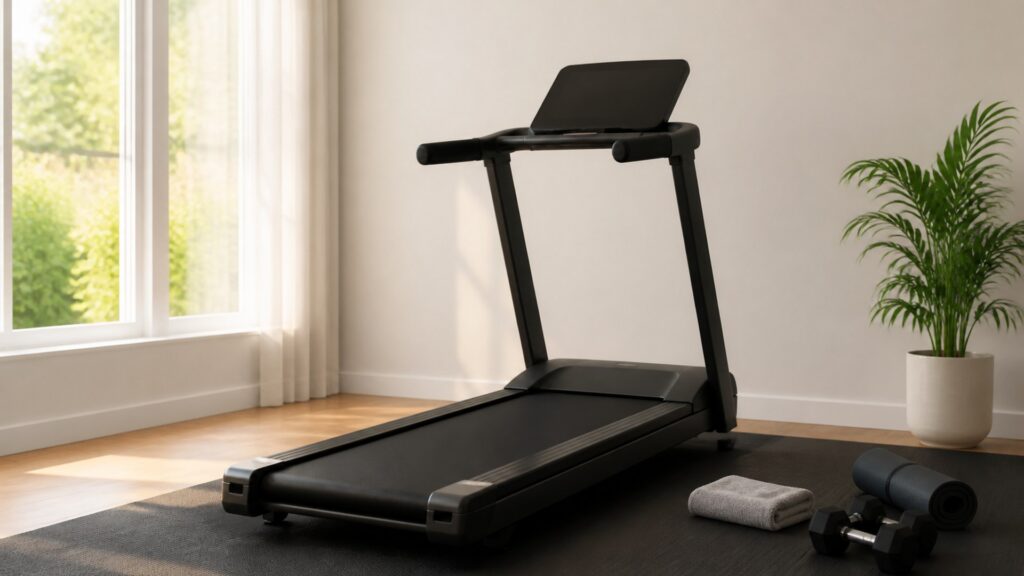
Buying framework
Plan the room before ordering
Mark the operating area: Tape out the treadmill and all manual-specified clearances. Include doors, drawers and walking routes. A corner that fits the frame can still be unsuitable for exercise.
Check headroom at incline: Use the model’s deck height and incline geometry with the tallest intended user. Allow for normal movement and overhead fixtures according to installation guidance.
Confirm power: Match the outlet, circuit and grounding requirements in the exact manual. Have a qualified electrician resolve uncertainty rather than assuming a power strip or extension cord is acceptable.
Trace delivery and removal: Check packaged and assembled dimensions against stairs, doors and turns. Get room placement, assembly and the procedure for a unit that will not fit in writing.
Who this is for
Match the machine to household use
One regular walker: Prioritize an easy start, readable feedback and a comfortable belt at walking pace. A compact model can work if its limits and controls match the entire session.
A household with runners: Trial the longest stride and fastest normal pace, then total expected weekly use. Check that intended duty and warranty match that pattern.
A multipurpose room: Try the full fold, latch, move and unfold sequence. If the user cannot manage it comfortably, a smaller permanent setup may be more useful than a heavy folding model.
Early or late workouts: Evaluate motor, belt, fan and footfall noise from the affected room. Consider household schedules and keep return protection for a home trial.
What to pay attention to
Check practical details beyond the screen
Access and controls: Compare step-up height, side rails, stop access and speed changes. A shared machine should have a predictable starting state after another user finishes.
Stored dimensions: Measure folded height, width and depth, plus space to lower the deck. Transport wheels help only if the route and moving procedure are suitable.
Operating environment: Check temperature, humidity and location restrictions. Do not assume a garage, covered patio or damp basement is allowed because there is space.
Session support: Check bottle placement, fan position and display readability while moving. A device mount must not obscure controls or leave a loose object near the belt.
Membership behavior: List the features lost after cancellation. Ask which manual controls remain available and whether a free account or internet connection is still needed.
Avoid these traps
Avoid home-installation surprises
Curbside delivery is not installation: Freight delivery may leave a heavy carton outside. Confirm unloading, stairs, assembly, packaging removal and damage reporting.
A mat is not soundproofing: An appropriate equipment mat protects flooring and may help some vibration, but footfalls can still travel through the building. Very soft support can affect stability.
Folding is not childproofing: A stored treadmill can still create access and pinch hazards. Plan a restricted exercise area and follow shutdown and key-storage instructions.
Keep rear clearance open: Furniture, baskets and accessories must stay outside the required space behind the belt, even in a small room.
Decision guidance
Check the treadmill after installation
Inspect before exercise: Confirm the ordered model, assembly, leveling, cord route and clearances. Resolve damage or missing parts before use.
Learn the controls: Review start, normal stop and the prescribed safety-key check. Attach the clip as instructed and use an easy initial pace.
Try each regular user: Within a comfortable range, check intended pace, incline, arm swing and console reach. Listen from an adjacent room to understand the household impact.
Practice shutdown: Stop the belt, follow power and key instructions, clean as directed and clear the area. Rehearse folding only after the machine is ready to move under its instructions.
Ownership & compatibility
Make upkeep and access control routine
Keep children and pets out: Restrict access during exercise and follow instructions for unplugging and key storage afterward. American Academy of Pediatrics guidance emphasizes securing home exercise areas and equipment.
Use the correct belt care: Keep the manual and maintenance record nearby. Lubrication depends on the belt/deck system; do not add a product intended for a different surface.
Allow service access: Leave the prescribed inspection and repair space. Record the serial number and warranty contact, and check labor, travel and parts terms.
Notice developing faults: Stop for slipping, unreliable controls, unusual heat, odor or instability. Use the service process rather than compensating with your stride.
FAQ
Home treadmill FAQ
Can I put a treadmill upstairs?
Can I keep it in a garage?
How much space should I leave behind it?
Will folding solve a small-room problem?
What should I budget beyond the treadmill?
Bottom line
Buy the setup you can use every week
Choose this treadmill when: It fits the room and delivery route, supports each user and can be started, stopped, cleaned and secured without a complicated routine.
Resolve these before paying: Uncertain power, inadequate clearance, inaccessible storage or no plan to restrict children and pets. A screen upgrade cannot compensate for poor installation.
Reading Shortcuts
Use the sections below to check fit, practical constraints and ownership before choosing.
Decision Reminders
Keep these checks in view when comparing finalists.
- Measure the delivery route and full operating area.
- Confirm electrical and environmental requirements.
- Try the complete folding routine.
- Keep the exercise area inaccessible to children and pets.
Glossary Snippets
Terms that help compare the actual machines.
When to Use a Top 10 Review
Use rankings to find candidates after defining your space, fit and session requirements.
- Look for: Exact-model dimensions, control details and ownership support.
- Then verify: The manufacturer’s manual and a suitable demonstration.
Evidence: American Academy of Pediatrics guidance addresses children and home exercise equipment. Horizon maintenance guidance explains surface-specific belt care. Installation requirements must come from the exact model manual. Sources reviewed September 24, 2026. No hands-on product test is claimed.
When to Use a Comparison
Use a direct comparison after two or three models meet the basic requirements.
- Fit check: Measure the delivery route and full operating area.
- Cost check: Include delivery, setup, wear parts, service and any subscription.
Keep the exact model and warranty terms alongside the quote so similar names do not hide different specifications.