
Vehicle Security Systems Buying Guide for Road Trip Technology Needs
Road travel changes both risk and response. The vehicle may hold visible luggage, spend nights beyond remote range, sit for days at an airport or trailhead, cross a cellular boundary, or pass through valet and repair custody. Home parking assumptions no longer describe the system's job.
Build a travel plan around each stop. Reduce visible opportunity, confirm local arming and sensor coverage, test remote and cellular notification from realistic buildings, verify GPS and roaming, measure long-park power, and carry a recovery packet outside the vehicle. Technology helps most when alerts lead to a calm, predefined police and insurance response.
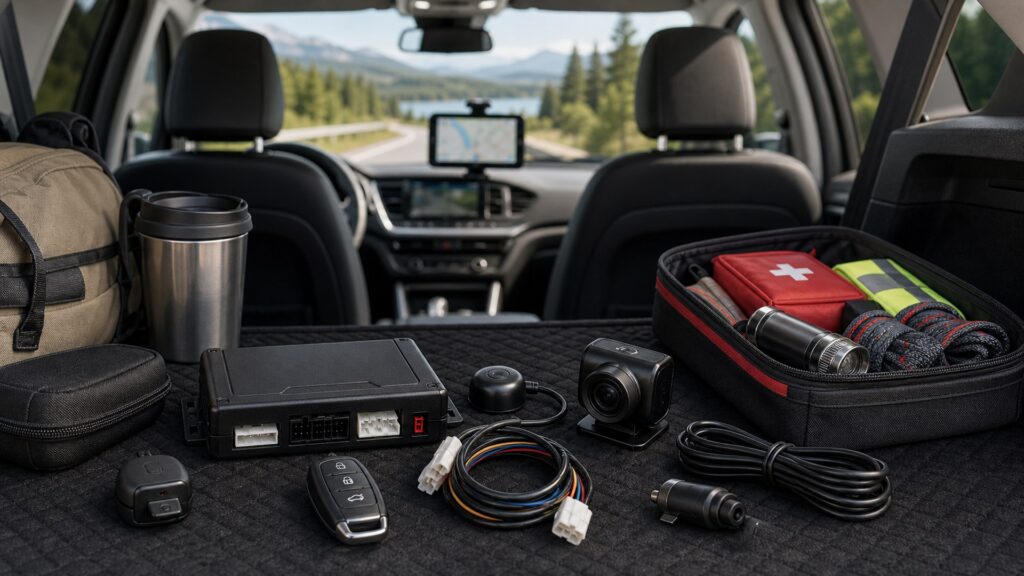
Buying framework
Map every stop, custody handoff, and response distance
Hotels, garages, trailheads, airports, street stops, valets, and service visits create different events and responders.
Classify each stop: Record duration, visibility, foot traffic, lighting, garage signal, luggage, wheel or tow exposure, key custody, and distance from the vehicle.
Assign local protection: Use locks, hidden cargo, factory immobilizer, perimeter, glass, impact or tilt sensing, siren, and visible deterrence according to the stop.
Assign remote communication: Choose two-way RF, cellular push or text, GPS, tow notice, geofence, and backup power with tested building and regional coverage.
Prepare the response packet: Carry VIN, plate, photos, insurer, police-report needs, tracking contact, account recovery, installer, valet override, and subscription details outside the car.
Who this is for
Match travel features to parking exposure
Short overnights, long unattended parking, border travel, and valuable cargo justify different communication and power layers.
Hotel and highway traveler: Fast arming confirmation, sensible entry and tilt coverage, two-way or cellular notice, and secure overnight removal of valuables address common stops.
Trailhead or remote-parking owner: Cellular maps, GPS view, backup power, parked draw, weather, response delay, and lack of nearby witnesses become central limitations.
Airport or cruise parker: Long sleep current, battery condition, subscription continuity, geofence or tow behavior, account access, and return-time disarm need advance testing.
Cross-border road tripper: Verify cellular roaming, GPS service, data law, app access, emergency numbers, and whether tracking information can be shared with local authorities.
What to pay attention to
Specifications that preserve security away from home
Travel value depends on range, roaming, account access, fallback, power endurance, notification clarity, and usable recovery data.
Travel Threats
Address luggage visibility, unfamiliar lots, wheels, towing, keys, valet custody, service stops, long parking, and whole-vehicle loss.
Remote Continuity
Verify RF range, cellular and roaming coverage, GPS, offline fallback, backup power, parked draw, account access, privacy, subscriptions, and recovery records.
Notification reach: Test two-way remotes through hotel walls and garages; cellular range is broader but depends on network coverage, roaming, phone permissions, account, and latency.
Location and movement logic: GPS, geofence, tilt, and tow alerts use different evidence; learn thresholds, update intervals, false movement conditions, and map availability.
Backup and parked power: Measure full vehicle sleep, cellular check-ins, tracker draw, backup-battery loads and runtime, low-voltage notice, and behavior after main-power loss.
Travel arming workflow: Confirm factory fob, alarm remote, app, passive arming, door-handle lock, trunk access, remote start, and valet or service sequences before departure.
Account resilience: Use strong authentication, recovery codes, alternate trusted contact, subscription status, current payment, remote-battery spares, and a plan for a lost phone.
Recovery information: Tracking history, current location, VIN, plate, description, time last seen, key status, police case number, and insurer contact should be quickly available.
Avoid these traps
Travel habits that weaken otherwise capable systems
Visible belongings, stale subscriptions, unknown valet states, and inaccessible credentials can defeat expensive hardware.
Leaving travel gear visible: No alarm removes the attraction of bags, electronics, documents, or keys; move items before arrival and avoid opening cargo in public.
Assuming cellular means universal coverage: Garages, remote regions, borders, roaming limits, outages, phone settings, or expired service can interrupt notice; test fallback.
Changing sensor sensitivity at every stop: Undocumented adjustments create nuisance alarms or gaps; keep a known travel profile and make deliberate recorded exceptions.
Chasing a stolen vehicle: Location information belongs with police and insurers; personal pursuit can be dangerous and may compromise evidence or recovery.
Decision guidance
Choose a platform by distance and parking duration
Buy the minimum system that maintains appropriate notice and evidence across the planned distance and duration.
For short visible stops: Prioritize reliable locks, hidden cargo, factory immobilizer, clear arming confirmation, perimeter coverage, and practical habits.
For nights beyond RF range: Add cellular notice and GPS only after testing hotel or garage coverage, account recovery, privacy, fees, and offline fallback.
For long unattended parking: Choose measured low sleep draw, backup power, low-voltage notice, geofence or tow logic, subscription continuity, and a trusted contact.
For border or remote travel: Use services with documented regional operation and a recovery plan aligned with local authorities; retain strong local alarm behavior when networks fail.
Ownership & compatibility
Carry access, tests, records, and power plans
A travel kit should survive lost phones, dead remote batteries, poor signal, long parking, and urgent police reporting.
Run a pre-trip drill: Trigger approved zones, verify siren and each notification path, test GPS and movement rules, enter and exit valet mode, and check authorized start.
Pack independent access: Carry spare remote power, account recovery, emergency override, installer contact, subscription proof, recovery packet, and secure key storage outside the vehicle.
Review after the trip: Remove temporary users and geofences, inspect sensors and power, reconcile alerts, update location records, restore the home profile, and document failures.
FAQ
Road-trip security questions before departure
Apply these answers to the itinerary, vehicle, installed platform, and current service region.
Will a two-way remote reach a hotel room?
Does cellular security work in parking garages?
Will my tracker roam across borders?
How do I protect luggage during stops?
Is a geofence useful while traveling?
Can the system drain the battery at an airport?
What should valet mode disable?
What information should be stored for theft reporting?
What should I do when tracking shows a location?
Bottom line
Prepare the response before the vehicle leaves home
A useful system is armed correctly, communicates as expected, preserves battery, and supports safe recovery action.
Plan each stop: Match duration, visibility, cargo, custody, tow risk, distance, signal, and local response to appropriate layers.
Prove remote continuity: Test RF, cellular, roaming, GPS, geofence, backup power, sleep current, accounts, subscriptions, and network-loss recovery.
Carry the response: Keep independent access, recovery data, police and insurer steps, safe tracking-sharing rules, and a post-trip reset checklist.
Reading Shortcuts
Move through the travel continuity across hotels, trailheads, garages, border regions, service stops, and changing cellular coverage decision in order.
Decision Reminders
Travel security succeeds when remote alerts have a prepared response.
- Classify each stop: Verify and record this requirement.
- Assign local protection: Verify and record this requirement.
- Assign remote communication: Verify and record this requirement.
- Run a pre-trip drill: Verify and record this requirement.
- Pack independent access: Verify and record this requirement.
- Review after the trip: Verify and record this requirement.
Glossary Snippets
Terms used in this security system plan.
When to Use a Top 10 Review
Use rankings only after the requirements are fixed.
- Plan each stop: Use this as a shortlist filter.
- Prove remote continuity: Use this as a shortlist filter.
- Carry the response: Use this as a shortlist filter.
- Exclude: Use this as a shortlist filter.
Already down to 2–3 options? A Comparison is usually the faster next step.
When to Use a Comparison
Compare finalists against the same parked arm, trigger, notification, disarm, authorized start, sleep, and service test.
- Classify each stop: Test this point on both finalists.
- Assign local protection: Test this point on both finalists.
- Assign remote communication: Test this point on both finalists.
- Prepare the response packet: Test this point on both finalists.
Still exploring? Start with a Top 10 to build a shortlist first.