
Vehicle Security Systems Buying Guide: How to Choose the Right One
Vehicle security is not one alarm box. Factory locks and immobilizers, visible deterrents, entry switches, impact or tilt sensing, a siren, owner notification, starting interruption, and recovery services address different stages of theft. Buying by siren loudness leaves those gaps unexplored.
Start with the exact vehicle and the loss you are trying to reduce: contents theft, wheel or catalytic-converter removal, unauthorized starting, key theft, towing, or recovery after disappearance. Add layers that complement the factory system, can be installed without impairing required equipment, and remain supportable through batteries, phones, subscriptions, and vehicle service.
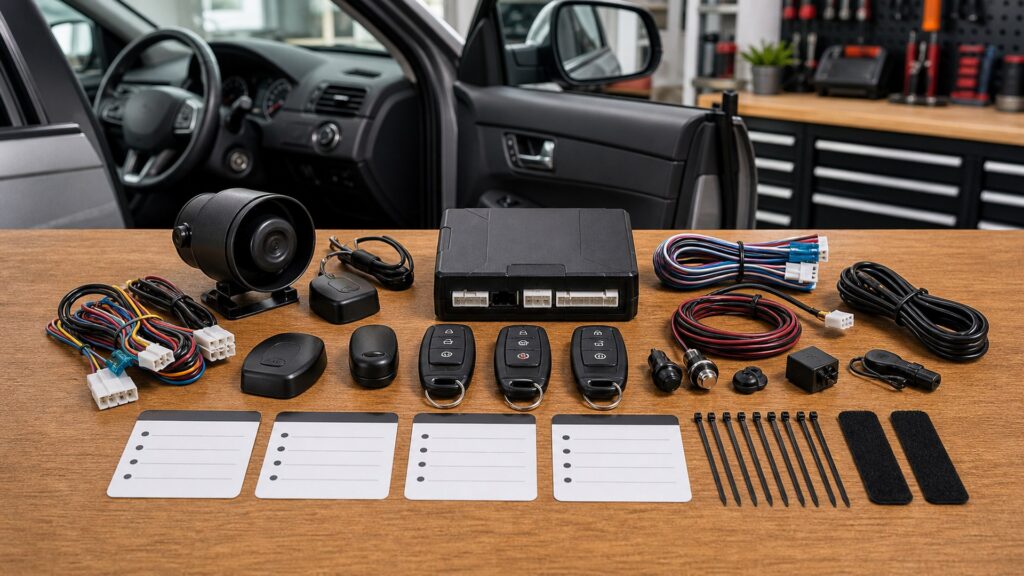
Buying framework
Map the threat sequence before choosing hardware
Identify existing protection and the entry, movement, starting, notification, or recovery gap the new system must address.
Inventory factory protection: Document locks, factory alarm triggers, passive immobilizer, keyless entry, connected services, wheel locks, and known software or hardware campaigns.
Describe likely loss events: Separate forced entry, glass breakage, impact, wheel lift, towing, key-enabled theft, relay attack concerns, and whole-vehicle disappearance.
Assign a response layer: Choose visible deterrence, monitored trigger, local siren, two-way notice, cellular message, safe immobilization, or recovery support for each event.
Plan human response: Define who receives alerts, when police and insurance are contacted, how tracking is shared, and how service or valet staff disarm the system.
Who this is for
Match security depth to the vehicle and parking pattern
Risk, parking visibility, factory equipment, response distance, and ownership horizon shape the appropriate system.
Factory-equipped low-risk owner: Improve habits and visible deterrence first; add targeted sensing or notification only where the factory system leaves a documented gap.
Street-parking driver: Entry, glass, tilt, local siren, and two-way or cellular notice can address attacks occurring beyond direct view.
High-theft-model owner: Confirm manufacturer campaigns and factory immobilizer status before adding professionally installed interruption, layered triggers, and recovery support.
Remote-parking or travel owner: Cellular notification, GPS recovery, backup power, account control, and a practiced stolen-vehicle response plan become more valuable than short remote range.
What to pay attention to
Specifications that determine useful protection layers
The important specifications describe coverage, behavior, installation, and service rather than the number of marketing features.
Protection Layers
Combine visible deterrence, entry detection, movement sensing, audible response, immobilization, owner notification, and recovery without overstating prevention.
Vehicle & Ownership Fit
Verify factory features, exact firmware, safe installation, battery load, remote range, cellular terms, privacy, service mode, and support.
Trigger coverage: Confirm doors, hood, trunk, hatch, ignition, and factory alarm status plus separate impact, tilt, glass, or proximity zones needed for the threat map.
Sensor adjustment: Sensitivity, dual-stage warnings, mounting surface, temperature behavior, and zone bypass should reduce nuisance alarms without leaving the intended event unmonitored.
Immobilization design: Any starter or propulsion interruption must suit the exact vehicle, preserve factory immobilizer logic, fail safely, and be installed by qualified personnel.
Notification path: Compare one-way remote, two-way confirmation, cellular push, text, call, alert history, range conditions, roaming, phone permissions, and subscription.
Recovery and privacy: GPS accuracy, update intervals, backup power, data retention, account security, authorized sharing, and police-report workflow define recovery value.
Installed lifecycle cost: Include vehicle interface modules, siren, sensors, remotes, antennas, labor, firmware, cellular service, replacement batteries, diagnostics, removal, and warranty.
Avoid these traps
Security purchases that create false confidence
Weak fit, poor adjustment, unavailable monitoring, and undocumented wiring can make an alarm noisy or unreliable.
Adding features before checking factory equipment: Duplicate triggers or incompatible immobilizer and remote-start logic can create no-start, keyless-entry, or false-alarm problems.
Treating alarms as guarantees: Security layers deter, detect, notify, immobilize, or aid recovery; none guarantees that theft, damage, or loss will not occur.
Using maximum sensor sensitivity: Over-sensitive impact or proximity settings create nuisance warnings and ignored alerts; tune against defined events in the actual parking environment.
Buying tracking without a response plan: Location data needs account access, power, coverage, a police report, insurance contact, and safe sharing; owners should not pursue a stolen vehicle.
Decision guidance
Choose the smallest system that closes real gaps
Add complexity only where the threat map and response plan justify it.
If factory immobilization is strong: Add only missing entry, tilt, glass, notification, or recovery layers while preserving OEM arming and key behavior.
If contents or wheel theft dominates: Prioritize perimeter, glass, shock or tilt sensing, a visible indicator, local warning, and timely owner notification.
If unauthorized starting is the gap: Use exact-vehicle professional integration with safe interruption and complete key, remote-start, emergency-override, and service testing.
If recovery is the priority: Choose cellular GPS with backup power, protected account access, current coverage, exportable vehicle details, and a police-centered response procedure.
Ownership & compatibility
Maintain credentials, batteries, sensors, and records
A system remains credible only when keys, accounts, backup power, sensors, software, and service procedures stay controlled.
Test the complete sequence: Monthly, verify arm, confirmation, each approved trigger, siren, notification, disarm, authorized start, override, backup power, and sleep behavior.
Control credentials and spares: Protect keys, remotes, app accounts, recovery codes, installer PINs, tracking access, and subscription ownership; remove former users promptly.
Keep an installation record: Store module locations, wiring diagram, firmware, sensor settings, fuse, serials, subscriptions, installer contact, service mode, override, and removal plan.
FAQ
Vehicle security questions before installation
Verify exact vehicle coverage and local legal or service requirements before applying these answers.
Does a car alarm prevent vehicle theft?
How does an aftermarket system work with the factory immobilizer?
Which alarm sensors are most useful?
Is a two-way remote better than a one-way remote?
Is GPS tracking the same as an alarm?
Will a security system drain the battery?
Can an alarm interfere with remote start?
What is valet or service mode?
Should I install vehicle security myself?
Bottom line
Build layers that still work after the sale
Effective ownership combines practical habits, compatible electronics, clear alerts, controlled immobilization, and a recovery plan.
Map existing layers: Verify factory locks, alarms, immobilizer, connected services, campaigns, keys, and normal arming behavior.
Close named gaps: Select only the triggers, sensors, warnings, interruption, notification, or recovery functions tied to realistic events.
Own the response: Maintain batteries, accounts, tests, records, service mode, subscriptions, police reporting, and safe recovery practices.
Reading Shortcuts
Move through the layered deterrence, detection, immobilization, notification, and recovery decision in order.
Decision Reminders
Security value comes from complementary layers, not one alarm claim.
- Inventory factory protection: Verify and record this requirement.
- Describe likely loss events: Verify and record this requirement.
- Assign a response layer: Verify and record this requirement.
- Test the complete sequence: Verify and record this requirement.
- Control credentials and spares: Verify and record this requirement.
- Keep an installation record: Verify and record this requirement.
Glossary Snippets
Terms used in this security system plan.
When to Use a Top 10 Review
Use rankings only after the requirements are fixed.
- Map existing layers: Use this as a shortlist filter.
- Close named gaps: Use this as a shortlist filter.
- Own the response: Use this as a shortlist filter.
- Exclude: Use this as a shortlist filter.
Already down to 2–3 options? A Comparison is usually the faster next step.
When to Use a Comparison
Compare finalists against the same arming, trigger, notification, disarm, start, sleep-current, and service-mode sequence.
- Inventory factory protection: Test this point on both finalists.
- Describe likely loss events: Test this point on both finalists.
- Assign a response layer: Test this point on both finalists.
- Plan human response: Test this point on both finalists.
Still exploring? Start with a Top 10 to build a shortlist first.