
Solid SPF Format
A sunscreen delivered in a waxy or balm-like stick rather than a liquid lotion.
- Role: Portable and low-mess
- Tradeoff: Harder to measure amount
- Use: Targeted coverage and reapplication
Sunscreen sticks are solid sunscreen formats that glide across skin instead of dispensing as a lotion or cream. They are convenient, tidy, and easy to carry, which makes them especially appealing for face touch-ups, kids' bags, travel, and outdoor reapplication.
Their strength is also their limitation. A stick can be excellent for targeted coverage, but it takes multiple passes and careful rubbing to deposit enough product evenly. For large areas, a lotion usually remains easier to measure and spread.
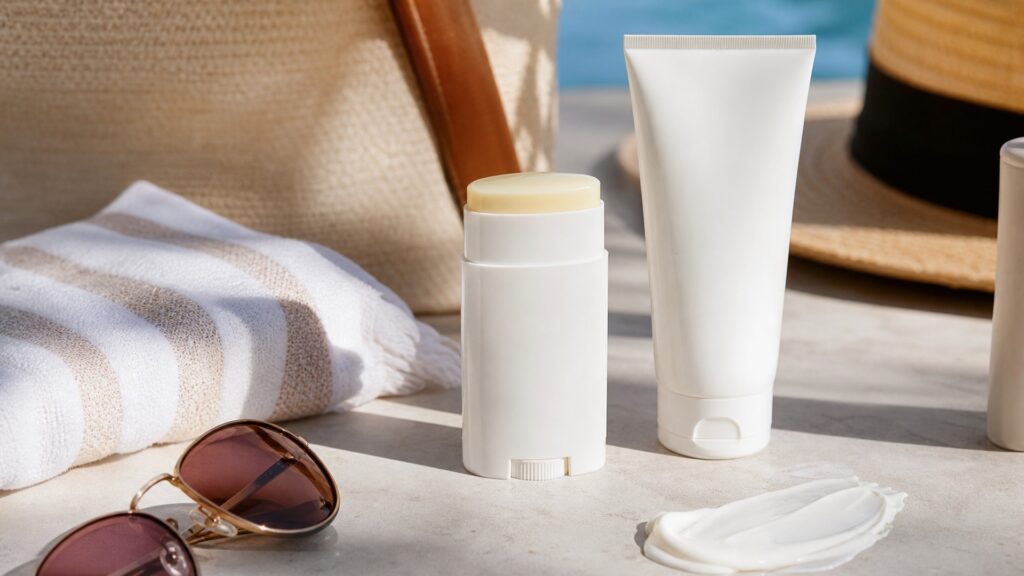
A practical comparison of solid sticks, lotions, coverage thickness, portability, and real-use limits.
Tip: Read the concept as part of a system, then connect it back to the use case.
These definitions connect the main idea to the variables, limits, and practical signals readers need to compare options.
A sunscreen delivered in a waxy or balm-like stick rather than a liquid lotion.
How much sunscreen the stick leaves on skin per pass.
Using sunscreen on specific zones rather than broad body areas.
The pulling sensation as the stick moves across skin.
A light blending step after swiping the stick.
The low-spill, compact advantage of stick packaging.
Tip: Keep the definitions connected; the strongest answer usually comes from the whole system, not one term.
A stick transfers sunscreen by contact. The product softens slightly against skin, leaves a layer, and then needs overlapping strokes to create a continuous film.
The format is convenient, but coverage depends on deliberate passes.
Sticks are compact and less messy than many lotions. That makes them useful when a person might otherwise skip reapplication entirely.
A stick's biggest advantage is making reapplication more likely.
Lotions are easier to measure and spread across arms, legs, shoulders, and back. Sticks can cover those areas, but doing so thoroughly takes more time and attention.
The stick format is targeted; lotion is usually more efficient for broad coverage.
A stick can feel different in cold, heat, sweat, or on textured skin. Too firm and it drags; too soft and it can smear heavily.
A stick should be judged in the conditions where it will be used.
Use lotion for the main layer when broad coverage matters, then use a stick for targeted top-ups or small exposed zones. That pairing uses each format's strength.
Sunscreen sticks are best when convenience improves maintenance without replacing careful application.
Sunscreen sticks solve portability and mess problems, but they can create coverage problems if used casually.
They make face, ear, hand, and travel reapplication easier.
They reduce spills and can be less disruptive during outdoor activities.
Lotions are easier to measure and spread over large areas.
Sticks can leave missed stripes if users rely on one or two quick swipes.
Common shortcuts and misunderstandings can make the topic seem simpler than it is.
A single swipe often deposits too little. Multiple overlapping passes and light blending are usually needed.
They can be useful for adults too, especially for travel, sports bags, and targeted reapplication.
They can cover skin, but lotions are usually more efficient and easier to apply generously over large areas.
Invisible finish does not prove even thickness. Coverage comes from amount and film continuity.
Tip: Treat strong claims as starting points for comparison, not final answers.
Concise answers to common questions readers may have after the main explanation.
It is a solid sunscreen format that applies by swiping the product directly onto skin.
They can be effective when enough product is applied evenly, but lotions are often easier for broad coverage.
They are useful for face touch-ups, ears, hands, travel, sports bags, and small exposed areas.
Light blending after overlapping passes helps even the film and reduce missed streaks.
Some people do, but texture and drag vary. Test how it layers and whether it disrupts makeup.
Sunscreen sticks are convenience tools that work best for targeted coverage and reapplication.
They should be applied with multiple passes and light blending, while lotions often remain the better first layer for large areas.
Use these Review Streets paths to connect the explainer to related categories, comparisons, and next decisions.
Explore Review Streets coverage in Skincare for related sunscreen context and product paths.
Explore Review Streets coverage in Sun Protection for related sunscreen context and product paths.
Explore Review Streets coverage in Sunscreen Sticks for related sunscreen context and product paths.
Choose a retailer
Prices checked regularly. We may earn a commission at no cost to you.