What is a Spin Bike?

A spin bike is a stationary indoor cycling bike designed to feel closer to road riding than casual upright exercise biking. It usually has a weighted flywheel, adjustable resistance, a narrow saddle, a forward-leaning riding position, and pedals meant for sustained cadence work. That combination makes it useful for interval sessions, endurance rides, and low-impact cardio in a small space.

This explainer walks through what a spin bike is, how its parts work together, and why the riding experience feels different from other exercise bikes. By the end, you will understand the role of the flywheel, resistance system, drivetrain, fit adjustments, and controls, along with the tradeoffs that make a spin bike right for some workouts and less ideal for others.

By: Review Streets Research Lab
Updated: May 31, 2026
Explainer · 8–12 min read
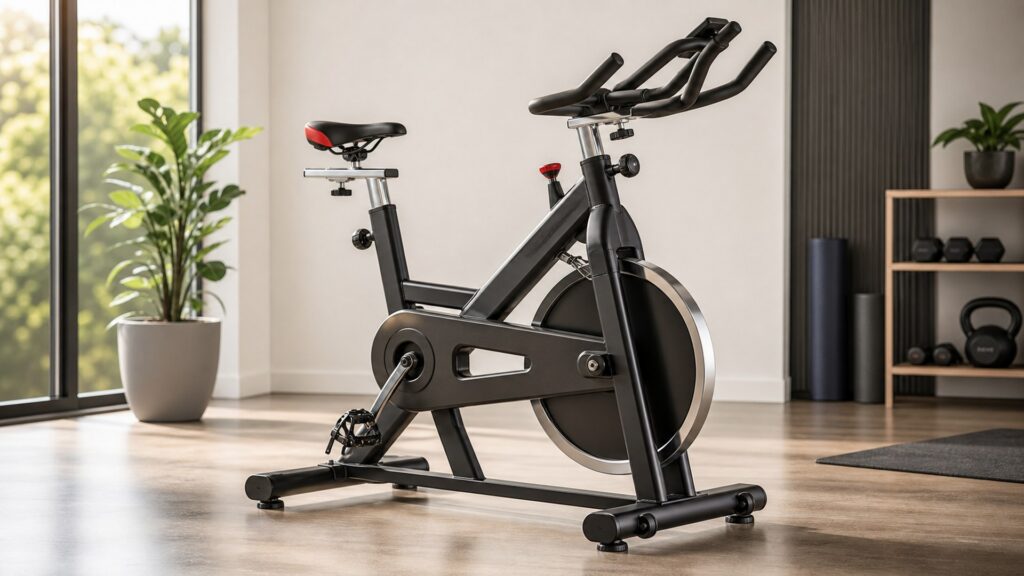
spin bike with flywheel, resistance knob, racing saddle, and multi-position handlebars in a bright home fitness room
What You’ll Learn

How a Spin Bike Creates an Indoor Cycling Ride

A practical explanation of the parts that make a spin bike feel direct, adjustable, and suited to cadence-based cardio workouts.

  • What separates a spin bike from a standard upright exercise bike
  • How the flywheel affects smoothness, momentum, and ride feel
  • Why resistance systems change workout intensity without changing location
  • How saddle, handlebar, and pedal adjustments shape comfort and control
  • Why cadence and resistance are the two main workout variables
  • Where spin bikes work well and where their limits show up
  • What to look for before deciding whether a spin bike fits your routine

Tip: Think of a spin bike as a simple indoor cycling platform: the bike stays fixed, while flywheel momentum and resistance create the riding challenge.

Definitions

Key Concepts That Define a Spin Bike

Spin bikes are easier to understand when each part is tied to its job: supporting posture, storing momentum, changing resistance, transferring pedal force, and tracking effort.

Spin Bike

A stationary indoor cycling bike built around a road-style riding position and adjustable resistance. It is designed for steady cadence, intervals, and class-style workouts.

  • Purpose: Indoor cycling cardio without moving across the floor
  • Feel: More forward and athletic than many upright bikes
  • Use case: Endurance rides, intervals, and low-impact conditioning

Flywheel

The weighted wheel connected to the pedals. It stores rotational momentum, helping the pedal stroke feel smoother and more continuous.

  • Role: Carries momentum between pedal strokes
  • Feel: Heavier or better-balanced systems can feel smoother
  • Limit: Flywheel weight alone does not define overall quality

Resistance System

The mechanism that makes pedaling easier or harder. Spin bikes commonly use friction pads or magnetic resistance to change intensity.

  • Friction: Uses contact pressure and may require pad care
  • Magnetic: Adjusts drag without touching the flywheel
  • Workout effect: Higher resistance raises muscular demand

Drive System

The belt or chain that connects the crank to the flywheel. It determines how pedal force reaches the wheel and how much noise or maintenance the bike may need.

  • Belt drive: Usually quieter and lower maintenance
  • Chain drive: Can feel direct but may need more upkeep
  • Stability: Tension and alignment affect smoothness

Riding Position

The relationship between saddle, handlebars, and pedals. Spin bikes usually support a forward lean that resembles road cycling more than relaxed seated biking.

  • Saddle height: Helps keep knee motion controlled
  • Reach: Handlebar distance affects back, shoulder, and wrist comfort
  • Adjustment: More fit range helps multiple riders share one bike

Cadence and Resistance

Cadence is how fast you pedal, while resistance is how hard each pedal stroke feels. Most spin workouts combine both variables to shape effort.

  • Cadence: Measured as revolutions per minute
  • Resistance: Adds load to the flywheel or drive path
  • Training: Intervals often alternate speed, load, and recovery

Tip: A spin bike is not just an exercise bike with a different name; its geometry, flywheel, and resistance controls are tuned for indoor cycling workouts.

Ride System

How a Spin Bike Turns Pedaling Into Indoor Cycling

A spin bike is mechanically simple: your legs turn the crank, the drive system moves the flywheel, and the resistance system changes how much force is required to keep it moving. The experience comes from how smoothly those parts interact.

  • The rider applies force through the pedals and crank arms
  • A belt or chain transfers that force to the flywheel
  • The flywheel stores momentum so pedaling does not feel choppy
  • Resistance increases the work needed to maintain cadence
  • Adjustable contact points help the rider hold a stable position

The result is a compact cardio machine that lets you vary effort through cadence, resistance, posture, and workout duration.

Flywheel Feel

Why Flywheel Momentum Makes the Ride Feel Smooth

The flywheel gives a spin bike its continuous feel. Instead of each pedal stroke starting from nothing, the wheel keeps moving between strokes, which helps the bike feel more rhythmic and controlled.

  • More stable flywheel motion can reduce dead spots in the pedal stroke
  • Balanced construction matters as much as the printed flywheel weight
  • Front and rear flywheel placement can change cleaning, sweat exposure, and feel
  • Emergency stop or brake controls matter because the flywheel carries momentum

A good spin bike feels smooth because the flywheel, drive system, and resistance path work together, not because one specification is large.

Drive Path

How Belts, Chains, Pedals, and Cranks Shape Control

The drive system connects the rider to the flywheel. Its job is to feel predictable under steady cadence, out-of-saddle efforts, and changes in resistance.

  • Belt drives are popular for home use because they tend to run quietly
  • Chain drives can feel familiar to outdoor cyclists but may need lubrication
  • Pedal type affects shoe compatibility and how secure the foot feels
  • Crank stiffness and frame stability matter during harder standing efforts

The drive path should disappear into the workout: smooth enough that you focus on effort rather than mechanical noise or hesitation.

Workout Load

How Resistance Changes Intensity Without Changing Speed

Resistance lets a spin bike simulate easier flats, heavier climbs, and short bursts of effort. Raising resistance increases the force needed at the pedals, even if cadence stays the same.

  • Low resistance supports warmups, recovery, and higher-cadence riding
  • Moderate resistance builds steady aerobic effort
  • Higher resistance shifts more work to the legs and can feel like climbing
  • Precise controls make intervals easier to repeat from session to session

Resistance is useful when it is predictable; small adjustments should change effort clearly without making the bike feel abrupt or uneven.

Fit and Control

Why Adjustment Range Decides Comfort and Confidence

A spin bike places the rider in a more active position than many upright exercise bikes. Seat height, fore-aft saddle position, handlebar reach, and pedal setup all affect whether that position feels efficient or uncomfortable.

  • The saddle should adjust high enough for a controlled knee bend
  • Fore-aft adjustment helps align the rider over the pedals
  • Handlebar height and reach affect wrist, shoulder, and back comfort
  • Leveling feet and a stable frame reduce rocking during stronger efforts

Fit is not a bonus detail; it determines whether the bike can support repeatable workouts instead of becoming a source of strain.

Quick Reality Check

Where Spin Bikes Shine and Where They Have Limits

A balanced look at what spin bikes do well, plus the situations where another exercise bike style may feel better.

What Spin Bikes Do Well

Spin bikes are strong for focused cardio because they combine a small footprint, quick intensity changes, and a riding position that supports cadence work. They suit intervals, endurance rides, and guided cycling classes.

They also keep the workout low impact compared with running, while still allowing high effort through resistance and cadence changes.

Where Spin Bikes Have Limits

The forward riding position is not ideal for every body or every goal. Riders who want back support, a wide comfort saddle, or a relaxed posture may prefer a recumbent or standard upright bike.

Spin bikes can also be louder or more maintenance-sensitive depending on the drive and resistance design, especially in shared living spaces.

Common Myths

Misconceptions About Spin Bikes

Spin bikes are often described in shorthand, but the real differences come from geometry, resistance, fit, and how the ride is used.

A spin bike is the same as any exercise bike

All spin bikes are exercise bikes, but not all exercise bikes are spin bikes. Spin bikes usually use a more athletic riding position, a flywheel-driven feel, and resistance controls meant for cadence-based cycling workouts.

A heavier flywheel always means a better bike

Flywheel weight can affect feel, but balance, resistance design, drive quality, frame stiffness, and pedal smoothness also matter. A well-designed lighter system can feel better than a heavy but uneven one.

Spin bikes are only for intense riders

Spin bikes can support hard intervals, but they also work for steady, moderate cardio. The key is using resistance and cadence at a level that matches your current fitness and comfort.

Magnetic resistance is always silent

Magnetic resistance avoids pad-on-wheel contact, but the bike can still create sound through the drivetrain, bearings, frame movement, pedals, and floor vibration. Quietness depends on the whole system.

Fit adjustments are only for taller or shorter riders

Fit adjustments matter for nearly everyone because they set knee angle, reach, wrist position, and hip comfort. A rider of average height can still feel cramped or stretched if the adjustment range is poor.

Tip: Judge a spin bike by ride feel, adjustment range, resistance control, and stability together instead of treating one specification as the whole story.

FAQ

Frequently Asked Questions About Spin Bikes

Short answers to common questions about what spin bikes are, how they work, and how they compare with other exercise bikes.

What is a spin bike?

A spin bike is a stationary indoor cycling bike designed for road-bike-style workouts. It uses a flywheel, adjustable resistance, and a forward riding position to support cadence-based cardio sessions.

How is a spin bike different from an upright exercise bike?

A spin bike usually has a narrower saddle, lower or farther-forward handlebars, a heavier cycling feel, and resistance controls suited to intervals. Upright bikes often place the rider in a more relaxed seated position.

What does the flywheel do on a spin bike?

The flywheel stores rotational momentum. That momentum helps the pedals keep moving smoothly between strokes and gives the ride a more continuous cycling feel.

Is magnetic resistance better than friction resistance?

Magnetic resistance is often quieter and lower maintenance because it does not press a pad directly against the flywheel. Friction resistance can still work well, but pads may wear and need adjustment over time.

Can beginners use a spin bike?

Yes. Beginners can use low resistance, shorter sessions, and a comfortable cadence. The important part is setting the bike correctly and increasing duration or intensity gradually.

Are spin bikes good for apartments?

They can be, especially belt-drive and magnetic-resistance models. Floor vibration, drivetrain noise, and bike stability still matter, so a mat and careful placement can help in shared buildings.

Do spin bikes need electricity?

Basic spin bikes may not need a power outlet if resistance is manual and the display is battery powered. Connected bikes with screens, subscriptions, or powered features usually require electricity.

What should I check before buying a spin bike?

Check adjustment range, frame stability, resistance type, drive type, pedal compatibility, maximum user fit, noise, display features, footprint, and whether the riding position feels comfortable for your goals.

Tip: If possible, compare spin bikes at your normal cadence and preferred riding position; comfort problems often appear before headline specs become useful.

Bottom Line

A spin bike is an indoor cycling bike built around flywheel momentum, adjustable resistance, and an active riding position. It is best understood as a compact cardio platform for cadence, intervals, and endurance work.

The best match depends on ride smoothness, fit range, resistance control, noise, and whether the forward cycling position supports the way you want to train.

Next Steps

Go Deeper or Compare Your Options

Use these Review Streets paths to move from understanding spin bikes to comparing exercise bike categories and related cardio equipment.

Spin Bikes

Explore the spin bike category if you want indoor cycling options built around flywheel feel, resistance control, and class-style cardio sessions.

Exercise Bikes

Compare spin bikes with other exercise bike styles, including upright and recumbent designs that use different postures and comfort priorities.

Cardio Equipment

Broaden the comparison to treadmills, ellipticals, rowing machines, and other home cardio equipment before choosing a training setup.

Quick Summary

Spin Bikes Explained

  • A spin bike is a stationary indoor cycling bike with adjustable resistance.
  • The flywheel stores momentum and helps the pedal stroke feel smoother.
  • Resistance controls intensity by making each pedal stroke easier or harder.
  • The riding position is usually more athletic than a standard upright bike.
  • Fit range, stability, drive type, and noise matter as much as headline specs.