What Makes Barcode Equipment Different from Office Printers

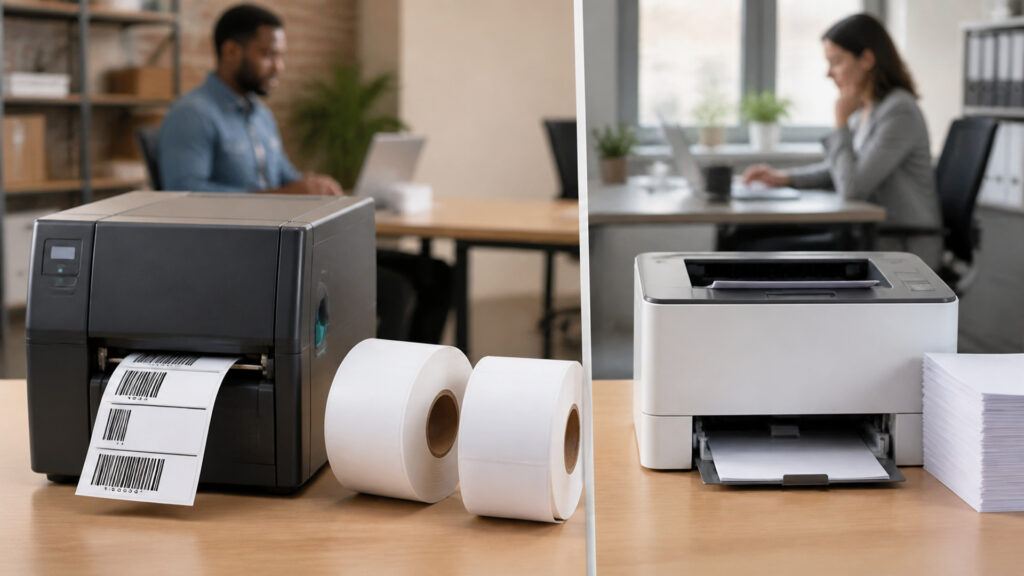
Barcode printers and office printers can both place a barcode image on media, but their production systems are built around different output units. Barcode equipment typically manages individual labels, tags, receipts, wristbands, serialized identifiers, roll stock, sensors, applicators, and rapid operational handoffs. Office printers primarily render page documents for human reading.

Those structural differences affect media handling, marking technology, device commands, calibration, durability, error recovery, and evidence of completion. An office printer may be adequate for occasional sheet labels. It does not automatically provide the continuous, precisely positioned, application-controlled production needed when every physical label must remain readable and tied to a unique business record.

By: Review Streets Research Lab
Updated: September 1, 2026
Explainer · 8-12 min read
Editorial business scene illustrating barcode equipment and office printers
What You'll Learn

Following Barcode Equipment and Office Printers From Barcode Label to Symbol Verification

Trace one barcode label through transfer ribbon, office page, and print driver, then test symbol verification against application handoff.

  • Comparing the Output Unit
  • Comparing Media Transport and Sensing
  • Comparing Marking Methods and Durability
  • Comparing Application Control
  • Comparing Completion and Quality Evidence
  • How office page changes the conclusion

Tip: Choose a real barcode label; record its source, state, responsible print systems specialist, exception route, and final evidence in the label production record.

Definitions

Terms That Keep Barcode Equipment and Office Printers Mechanisms Separate

These definitions prevent barcode printer, office printer, and gap sensor from becoming one vague idea.

Barcode printer

A purpose-built device that produces labels, tags, receipts, wristbands, or other machine-readable media under operational control.

  • Here, barcode printer optimizes compact repeatable outputs.
  • Its limit is that it requires matched media and calibration.
  • Verify printer command language before the print systems specialist relies on it in the label production record.

Office printer

A general-purpose laser or inkjet device that renders page documents from desktop or network applications.

  • Here, office printer optimizes human-readable pages.
  • Its limit is that it may print occasional barcodes without managing label workflows.
  • Verify office page before the print systems specialist relies on it in the label production record.

Direct thermal media

Heat-sensitive stock that darkens under a thermal printhead without a ribbon.

  • Here, direct thermal media supports simple label production.
  • Its limit is that it can fade with heat, light, chemicals, or time.
  • Verify toner engine before the print systems specialist relies on it in the label production record.

Thermal transfer

Printing that melts ribbon material onto compatible media.

  • Here, thermal transfer supports durable labels and varied substrates.
  • Its limit is that it requires matched ribbon, stock, heat, and speed.
  • Verify sheet tray before the print systems specialist relies on it in the label production record.

Gap sensor

A device sensor that detects gaps, marks, notches, or continuous media positions.

  • Here, gap sensor aligns individual labels.
  • Its limit is that it needs correct calibration.
  • Verify print driver before the print systems specialist relies on it in the label production record.

Symbol verification

Measurement of barcode quality characteristics under a defined method.

  • Here, symbol verification assesses production consistency.
  • Its limit is that it is more informative than visual inspection alone.
  • Verify symbol verification before the print systems specialist relies on it in the label production record.

Tip: Keep barcode printer distinct from office printer; they control different transitions and failure meanings.

Comparing

Comparing the Output Unit

Barcode printers handle individual labels, tags, receipts, or continuous stock; office printers organize toner or ink around cut sheets and page descriptions.

  • Name the print systems specialist responsible for barcode label
  • Retain the source establishing thermal printhead
  • Record direct thermal media as a separate state
  • Route uncertain transfer ribbon into an owned print defect
  • Validate printer command language against independent office page evidence
  • Preserve the label production record when toner engine is corrected

This mechanism closes only when printer command language, the originating fact, the print systems specialist's decision, and every material print defect agree in the label production record.

Comparing

Comparing Media Transport and Sensing

Roll holders, gap or mark sensors, peelers, cutters, rewinders, applicators, and calibration manage variable label geometry, while office devices use trays, duplex paths, and page finishing.

  • Name the print systems specialist responsible for thermal printhead
  • Retain the source establishing direct thermal media
  • Record transfer ribbon as a separate state
  • Route uncertain label gap sensor into an owned print defect
  • Validate office page against independent toner engine evidence
  • Preserve the label production record when sheet tray is corrected

This mechanism closes only when office page, the originating fact, the print systems specialist's decision, and every material print defect agree in the label production record.

Comparing

Comparing Marking Methods and Durability

Direct thermal and thermal transfer designs balance speed, ribbon, substrate, abrasion, chemicals, temperature, and lifespan differently from laser toner or inkjet page output.

  • Name the print systems specialist responsible for direct thermal media
  • Retain the source establishing transfer ribbon
  • Record label gap sensor as a separate state
  • Route uncertain printer command language into an owned print defect
  • Validate toner engine against independent sheet tray evidence
  • Preserve the label production record when print driver is corrected

This mechanism closes only when toner engine, the originating fact, the print systems specialist's decision, and every material print defect agree in the label production record.

Comparing

Comparing Application Control

Barcode systems often receive printer-language commands with exact coordinates, serialized fields, darkness, speed, copies, and sensor behavior; office printing commonly passes page documents through a driver.

  • Name the print systems specialist responsible for transfer ribbon
  • Retain the source establishing label gap sensor
  • Record printer command language as a separate state
  • Route uncertain office page into an owned print defect
  • Validate sheet tray against independent print driver evidence
  • Preserve the label production record when symbol verification is corrected

This mechanism closes only when sheet tray, the originating fact, the print systems specialist's decision, and every material print defect agree in the label production record.

Comparing

Comparing Completion and Quality Evidence

A successful office print job generally proves page rendering; operational labels may also require correct identifier assignment, stock, placement, scan testing, verification sampling, and downstream application recognition.

  • Name the print systems specialist responsible for label gap sensor
  • Retain the source establishing printer command language
  • Record office page as a separate state
  • Route uncertain toner engine into an owned print defect
  • Validate print driver against independent symbol verification evidence
  • Preserve the label production record when application handoff is corrected

This mechanism closes only when print driver, the originating fact, the print systems specialist's decision, and every material print defect agree in the label production record.

Quick Reality Check

What Barcode Equipment and Office Printers Evidence Can—and Cannot—Prove

The model can expose how transfer ribbon, label gap sensor, and printer command language connect. It cannot invent missing facts, make unsupported decisions, or turn symbol verification into universal proof.

Evidence That Makes transfer ribbon Defensible

A stable barcode label identifier preserves the initiating fact through correction and rework.

A reconciled label gap sensor label production record shows whether print driver reached its intended state.

Limits Beyond the office page Mechanism

Local rules, materials, environments, contracts, and professional judgment can change the appropriate toner engine treatment.

A successful symbol verification milestone cannot prove the source was complete, authorized, readable, or substantively correct.

Common Myths

Misconceptions About Barcode Equipment and Office Printers

These misconceptions confuse visible barcode label activity with the independent controls required at label gap sensor, toner engine, and symbol verification.

Does visible barcode label prove transfer ribbon is correct?

No. barcode label and transfer ribbon establish different facts in barcode equipment and office printers. The print systems specialist must connect them through the label production record, test office page, and route any print defect before relying on the result.

Can successful printer command language close the entire process?

No. printer command language proves one stage. The design must separately preserve toner engine, print driver, and the final application handoff evidence, including failures and authorized reversals. Check thermal printhead against direct thermal media.

Is sheet tray only a device setting?

No. sheet tray affects business interpretation, ownership, and the evidence surrounding symbol verification. Configuration can enforce rules, but the print systems specialist still owns exceptions and change control. Check direct thermal media against transfer ribbon.

Does symbol verification guarantee the outcome?

No. symbol verification is a milestone rather than proof that every input, decision, and handoff is complete. Reconcile it with the authoritative application handoff before closing the label production record.

Tip: Challenge a universal claim by locating its thermal printhead source, print defect route, and print driver completion evidence.

FAQ

Frequently Asked Questions About Barcode Equipment and Office Printers

These implementation questions assign authority for barcode label, separate states, route office page failures, and test the symbol verification handoff.

Which source should control barcode label?

Use the authoritative record that assigns or establishes barcode label. Record its identifier, version, owner, effective time, and correction route in the label production record. Check label gap sensor against printer command language.

Which states need independent timestamps?

Track direct thermal media, transfer ribbon, printer command language, and toner engine separately. A transfer ribbon transition needs its triggering event, acting identity, source reference, failure meaning, and authorized reversal rule.

How should a office page problem be handled?

Create an owned print defect with the affected identifier, current state, observed evidence, operational impact, permitted remedies, and closure test. Preserve the earlier event rather than overwriting it. Check office page against toner engine.

What must reconcile before symbol verification is accepted?

Compare the originating barcode label, intermediate label gap sensor, recorded sheet tray, acknowledgments, exceptions, and authoritative application handoff. Separate timing, duplication, mapping, version, and omission causes. Check toner engine against sheet tray.

When should the design be changed?

Redesign when barcode label lacks an owner, office page has no exception route, or application handoff requires recurring manual reconstruction. Check sheet tray against print driver. Assign symbol verification review to a named owner.

Bottom Line

Barcode equipment is designed around controlled labels and machine-readable operational outputs; office printers are designed around human-readable pages. Their media paths, sensors, command models, duty cycles, and quality tests reflect those different jobs.

Choose based on the production requirement, not on whether either device can print one sample code. Serialized labels, rolls, durable substrates, automated handling, exact positioning, and verification favor barcode equipment, while reports, packets, and occasional sheet labels favor office printing.

Next Steps

Continue Beyond Barcode Equipment and Office Printers

Use the adjacent explainer for the next printer command language boundary, or browse the direct category for systems sharing barcode label and application handoff.

Barcode Equipment

Browse the direct Barcode Equipment category for related systems involving barcode label, office page, and symbol verification.

Quick Summary

Barcode Equipment and Office Printers Explained

  • Barcode label establishes the starting fact.
  • Transfer ribbon has an independent completion test.
  • Office page changes the downstream decision.
  • Print driver needs retained authority and evidence.
  • Symbol verification must reconcile with application handoff.